Ukraine and Russian Imperial Messianism
This article was translated automatically and may contain differences from the original. For reference, read the original.
El Mostrador, February 26, 2022
The war in Ukraine is a tragedy from which Chile and Chileans cannot remain indifferent. Putin’s actions and those of his government violate all the principles upon which our society is built. Underestimating Putin’s actions is not only an error but, by omission, contributes to the validation of a way of acting in which neither law, human rights, nor diplomacy hold the slightest value.
Postponed for a few weeks (to avoid affecting the visibility of the Winter Olympic Games in China), the Russian bombing of Ukrainian cities, towns, and facilities continues unabated to -in principle- ‘protect’ the Russian-speaking population of the border region of Donbas from the ‘Nazi dictatorship of the Kiev government.’ It is worth noting that the population of that region has been subjected to violence from Moscow-backed separatists for eight years. The ‘protection’ of Russian cannons and missiles is now beginning to consolidate over the rest of Ukraine.
For all short- and long-term effects, this Russian invasion inaugurates a new and very dangerous period in the history of Europe and the world.
In the official version from Moscow, Donbas -like the rest of Ukraine- remains unacceptably divided between the ‘way of life’ of the West and the values of ‘Russian civilization’ represented in the language, race, and religion of Putin’s government.
In this week’s speech dedicated to recognizing the ‘independence’ of the aforementioned region, Putin took the opportunity to explain that concept, stating that ‘since time immemorial, the people who inhabited the southwest of what has historically been Russian territory (Ukraine, Moldova, and part of Romania) called themselves “Russians” and “Orthodox Christians,” meaning that all its inhabitants were never Romanians, Moldovans, or Ukrainians, but simply “ethnic Russians” or, at worst, “of Russian culture.”
Putin has also stated that ‘modern Ukraine was completely created by Russia or, more precisely, by communist Russia. This process began in 1917, right after the revolution, with Lenin and his advisors making grave decisions against Russia, separating and distancing what was historically Russian territory.’
The above amounts to asserting that, before the existence of the former USSR, during the period of the Russian Empire, Ukraine was nothing more than another Russian province, populated by ‘ethnic Russians,’ with entirely Russian language and religion. This, obviously, is not the case.
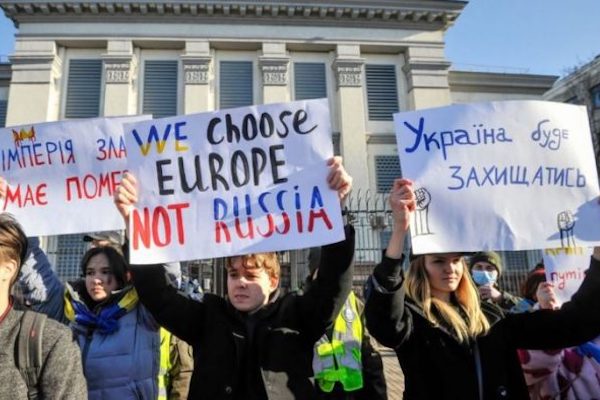
Among other differences, the Ukrainian language is much more than a possible ‘dialect’ of Russian, to the extent that it even uses its own version of the Cyrillic alphabet. Additionally, the Ukrainian population (especially in the center and west) originally practiced Orthodox Catholicism, the most persecuted religion during the Soviet era. These are some of the many fundamental differences between Russians and Ukrainians.
Ignoring all these facts, the crudely geopolitical objective of Putin and his oligarchy seems to be the reconstruction of the 1914 borders of the Russian Empire, an abstraction that, again in practice, ignores that such borders also included Finland, Estonia, Latvia, Lithuania, Belarus, and part of Poland (including Warsaw), that is, countries and nations previously conquered by the Tsarist armies. Whenever there are Russian-speaking minorities (and Orthodox churches) in these, the question arises whether these can be reasons to justify other military operations.
The truth is, however, that even before the end of the USSR (December 1991), all those countries had already begun to opt for the Western model instead of the ‘Russian model.’ Furthermore, in all of them, the historical fondness of the ‘Russian leadership’ for Italian suits, high-end German cars, large Spanish restaurants, the best French wine, and British manners is well known. Putin, along with his generals and oligarchs, has continued this tradition that, in public, they claim to despise. If the ‘Russian nomenklatura’ enjoys the advantages of the West, why should the rest be any different?
The urgency with which especially since 1993 (the attempted coup against Boris Yeltsin’s government) all the countries of the former Soviet orbit sought to approach NATO and the European Union is eloquent testimony that the inhabitants of that part of Europe have decided to reject the ‘Russian model’ for more than 30 years. For Ukrainians -just as in the 1990s for the Baltic, Bulgarian, Romanian, or Polish citizens- the comparison between a Lada and a Volkswagen does not merit comments. Nor has it for the thousands of Russians who, since the end of the USSR, have decided to leave ‘Mother Russia’ and emigrate to the West. The reality is that the lines to obtain visas are seen outside Western consulates in Moscow and St. Petersburg, not at Russian consulates in Paris, Los Angeles, Madrid, or Vienna.
It is this reality, in the form of an inferiority complex and frustration, that seems to weigh on Putin’s psyche, whose worldview insists on blaming ‘the Bolshevik leaders and the Communist Party of the Soviet Union’ for the ‘collapse of historical Russia known as the Soviet Union.’ The final insult to this psychopathic aspect of Putin’s personality (malignant narcissism) was delivered by Barack Obama when, in 2014, he referred to Russia as a ‘regional power.’
It is on this confused ‘imago’ that Putin’s ethnic-religious ultranationalism alternates between the Tsarist imperial argument and the Soviet imperial argument to ‘convert’ Ukraine -and undoubtedly other countries- into parts of what, using a term from Nazi geopolitics, supposedly constitutes the ‘living space’ of ‘Greater Russia.’
Under such an argument (typical of a genocidal dictatorship of the 20th century), the claim for ‘secure borders’ and ‘areas of influence’ that Putin demands is sheltered, all, of course, instrumental to cement his image as a statesman and conqueror akin to ‘Peter the Great.’ This is the image that Russians today seem to prefer, subjected to strict media control and disinformation campaigns. The cases of opposition leader Alexei Navalny (currently imprisoned under ignominious conditions) or former Ukrainian President Viktor Yushchenko (poisoned by Russian espionage in 2004 for suspected pro-European sentiments) exemplify what can happen to anyone who disagrees with Putin’s opinions.
If the wars in Chechnya (1994-2000) and the invasion of Crimea (2014) had raised the question of how far Putin is willing to go to restore Russia’s ‘imperial’ status, the invasion of Ukraine seems to have resolved all doubts.
Filled with paroxysms, distorted historical assertions, and false self-referential comments, all these actions are at odds not only with International Law and human rights but also with history and common sense. This does not prevent, from an essentially cynical point of view, the insistence on Russia’s ‘manifest destiny’ from being what largely justifies Putin’s continued hold on power and, by extension, the business of his oligarchy and the patrons of -using a distinctly Soviet expression- the ‘military-industrial complex.’
However, since the ‘recovery’ of the Russian borders of 1914-1917 should include not only Ukraine and Belarus but also Finland, the Baltic States, and parts of Poland and Romania (the latter now NATO members), the ‘manifest destiny’ of the strongman of the Kremlin appears more than complex. To resolve this ‘inconvenience,’ Putin resorts to victimization (an evident contradiction for an ‘imperial power’) explained under the pretext of ‘Russia as a besieged fortress’ by adversaries who want to strip it of its status as a great power.
Underestimating Putin’s actions is not only an error but, by omission, contributes to the validation of a way of acting in which neither law, human rights, nor diplomacy hold the slightest value.
Although it is evident that no NATO democracy has any interest in invading Russia (what would be the objective?), the noted victimization justifies the claim for ‘secure borders’ and ‘areas of influence’ in terms that both demands must not only be instrumental to Putin’s ego but also satisfy a national pride deeply affected by Russia’s evident decline (in the Winter Olympics, it cannot even compete with Norway, a NATO country of less than five million inhabitants).
Satisfying the demands of the Russian government would entail unacceptable structural changes in the international system, starting with recognizing the ‘Russian area of influence,’ creating a sort of new ‘iron curtain’ in Eastern Europe. At the same time, such recognition would ignore the right of millions of Ukrainians and other nationalities to be part of the European Union, instead making them part of Putin’s ‘new Russian empire.’ Putin’s political messianism does not allow for exceptions (nor ‘weaknesses’).
Nonetheless, within that same messianism lies the risk of ‘overreach’ that will ultimately end with Putin and his regime.
While the ‘alpha male of the Kremlin’ has challenged Europe, the United States, and its allies (i.e., Japan, Australia, and South Korea, all economies several times the size of the Russian economy) by asserting that the economic and political sanctions that will cost him the invasion of Ukraine will only make his country stronger, the reality is that this is -once again in practice- unlikely. This is not only because the sanctions will affect Russian trade, banking transactions, and transport but also because many of those included in various blacklists are close to him, known for maintaining valuable businesses and properties in London, Mallorca, New York, and other places far from ‘Mother Russia.’
Even neutral countries like Switzerland have become entangled in the web unleashed by Russia. This is because the Swiss federal government has announced that, while it will not create its own sanctions list, it will join those set by the European Union. Importantly, in addition to accounts in Zurich banks (and the Russian oligarchy’s habit of frequenting the super-exclusive stores of Bahnhofstrasse), 80% of Russian crude is traded on that city’s stock exchange. More than a detail.
It also remains to be seen the cost in casualties that the Ukrainian adventure will mean for Putin. In a country where the birth rate is very low, and today’s families tend to have only one child, it is a question how families of the fallen will react once the bodies of these begin to return to their cities and towns. For now, Western military cooperation has provided the Ukrainian army with sophisticated ‘defensive weapons’ that will likely cost the lives of hundreds of invaders. This is without considering the cost of an occupation in which, sooner or later, Russian soldiers will have to face a permanent ‘insurgency.’
The war in Ukraine is a tragedy from which Chile and Chileans cannot remain indifferent. Putin’s actions and those of his government violate all the principles upon which our society is built. Underestimating Putin’s actions is not only an error but, by omission, contributes to the validation of a way of acting in which neither law, human rights, nor diplomacy hold the slightest value.
Failing to condemn Russia and act accordingly is a mistake that could help set precedents for future unacceptable actions. This could be the case for Taiwan, should Beijing decide to use its armed forces to ‘protect’ Chinese victims of the ‘Nazi regime’ in Taipei, following the Russian example. It goes without saying that this would generate a conflict of proportions throughout the Pacific Basin, affecting not only our exports but the entire functioning of our economy.
Just as two decades ago our country firmly refused to participate in the invasions of Iraq and Afghanistan, Chile must today act according to its principles and reduce bilateral relations with Russia to a minimum. Failing to do so would be a violation of our most essential principles as a democratic society.
Chile must stand in solidarity with the Ukrainian families condemned to live a war they did not seek and did not want.
Jorge Guzmán
Associate Researcher, AthenaLab
Source: El Mostrador