Talking is not enough
This article was translated automatically and may contain differences from the original. For reference, read the original.
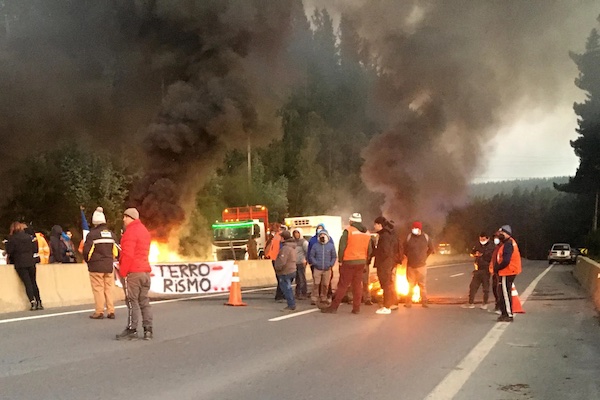
The situation in the south can no longer withstand further analysis. The intentions of the violent groups are clear, and the government must respond to them with more realism than idealism.
Security. That which we only remember when it is lacking, but which Chileans living in the Southern Macrozone have not forgotten for decades. This week, we witnessed the largest attack in 25 years. 23 trucks, 5 pieces of machinery, 4 vans, and 1 car were burned or shot at. 40 masked individuals in 7 epicenters, equivalent to an infantry platoon of the Army! The violence in the south is no longer merely a test that the government is failing.
But this was just the conclusion of a week that began with an arson attack on 4 houses, 4 vans, 1 car, and 1 warehouse in Quidico. It is urgent to restore the rule of law in the area. In addition to all the attacks, those living in that part of Chile must deal with the collection of ‘tolls’ to travel certain routes and the theft of timber production, among many other issues. The normal development of life is interrupted daily, and the community has had to organize itself to ensure security. This is something that the State is obligated to provide.
An important point to remember in this matter is the threat made by the Mapuche Resistance Lavkenche last December. ‘The weichan will not stop. Neither with Piñera nor with Boric.’ A warning that there was no reason to doubt, much less to think that a path of dialogue and peace would change the perspective of this and other groups that followed.
The government’s first measure regarding the situation of violence in the south was to end the State of Emergency and withdraw more than two thousand soldiers. Since the measure was lifted on March 26, there has been a 300% increase in land usurpations, a 106% increase in arson attacks, and a 650% increase in armed attacks, according to the report from the Multigremial of La Araucanía. It has been demonstrated that the message from the radical organizations was real and their willingness to engage in dialogue is hardly credible.
I am not saying that the solution is a permanent State of Emergency, much less the deployment of military forces in national territory to solve internal security problems that have a political nature. However, it is worth noting that this measure improved the security context for those living in the area, at least in the short term. What is important, however, is that it is accompanied by security strategies, clear policies, and real coordination among all actors. But before all this, humility and a genuine willingness to take decisive measures are required.
The not-so-new authorities arrived on March 11 with the idealism of dialogue and peace. But reality has been stronger. They have been prevented from arriving, have been attacked, and the attacks are increasing. In a month and a half, the violent groups in the southern macrozone have shown that their position is violence over dialogue, and the government must wake up and acknowledge this once and for all.
It seems that the only ones willing to use force are the radical groups, who do not have the legitimacy to do so. The monopoly on this belongs to the State, but it is unclear whether the Government wants to exercise it, at least in La Araucanía.
The situation in the south can no longer withstand further analysis. The intentions of the violent groups are clear, and the government must respond to them with more realism than idealism. Recognizing reality and understanding a problem is the foundation for solving it. We know that words matter, but they truly matter when accompanied by actions and real examples that address the needs of the population and impose the rule of law.
Pilar Lizana
Researcher, AthenaLab
Source: El Líbero


