Admiral Leadership: The Navy Put to the Test
This article was translated automatically and may contain differences from the original. For reference, read the original.
El Mostrador, May 26, 2022
The leadership of the Commander-in-Chief and Rear Admiral Parga is what today’s Chile needs—leadership dedicated to the country, the naval institution, and the sailors and marines that make up the Chilean Navy. They are shaped by the example of Prat and developed throughout their naval careers, and they are forms of leadership that could be emulated by those who guide the political destinies of the country, who sometimes prioritize their political agendas over what is best for Chile.
In recent days, the Navy has been making headlines, not only because May 21 is the date when Chile’s Naval Glories are celebrated, but also due to political situations that have tested two of its admirals.
The issue arose in part on Thursday, May 19, due to the President’s decision to replace Rear Admiral Parga (Commander-in-Chief of the Second Naval Zone) as Chief of Defense for the provinces of Arauco and Biobío, just 48 hours after appointing him, with Rear Admiral Zúñiga (Commander-in-Chief of the Submarine Force).
Initially, the reason for the change was unclear, but as hours passed, it became understood that it stemmed from a complaint by the family of Manuel Rebolledo against Admiral Parga for having stated, in July 2021, before the judicial ruling was issued, that he believed in the innocence of Corporal IM Medina, the driver of the vehicle that unfortunately struck Mr. Manuel Rebolledo. Corporal Medina was only convicted of negligent homicide, which implies the absence of intent, leading to the conclusion that Jorge Parga was not mistaken. For some in the Government, particularly the presidential delegate for the Biobío Region, what Rear Admiral Parga did is deemed incorrect and unbecoming of an authority, as it pertains to something pending a ruling, which is not illegal. He is also criticized for defending the marines being prosecuted for the Cañete incident in November 2021, where Yordan Llempi Machacan lost his life, an incident in which the IM patrol was attacked and had to respond.
Why is Rear Admiral Parga recognized for his leadership? He is recognized for his distinguished performance as a naval officer, but above all, for defending his people and standing up for the sailors and marines who have had to patrol and ensure the safety of residents in regions of Chile that have been under States of Constitutional Exception, and who, in fulfilling those exceptional duties, have had to use their service weapons when attacked or, in the case of Corporal Medina, drive a military vehicle in a Chile affected by social unrest.
What Rear Admiral Parga did is normal and expected of a naval officer, who will always be at the service of the personnel and troops under his command, but it is not very common in the civilian world and in current times. You do not know how reassuring it is for the troops to know that their leaders will support them if they face problems and have to use their weapons, especially when the rules of engagement (ROE) are impractical, particularly when they are attacked, and because, despite performing military functions, these cases are investigated by the Public Ministry and judged in civil courts rather than under the military justice system. Having the backing of their leaders, along with their love for the homeland, are the main reasons why, in today’s Chile, soldiers, sailors, marines, and aviators carry out the tasks required by a State of Emergency, which does not provide them with greater guarantees.
Jorge Parga complied with the presidential decision and returned to his duties as Commander-in-Chief of the Second Naval Zone. Quietly, with humility, without seeking the press and without wanting to assume the role of rockstar that some wish to assign him.
On the night of the following day, around 9:30 PM on May 20, the situation, already complicated due to Parga, became even more so when this media outlet published an article about a lunch offered by the Maritime League of Chile to the Chilean Navy, in honor of the Naval Glories, attended by its Commander-in-Chief and some members of the high naval command, in addition to members of the League and the maritime-port community. A lunch where the speech was unknown to the Commander-in-Chief, containing significant political content that left him in a complex position, compounded by the fact that he had the ceremony on May 21 the next day, with the attendance of all branches of government.
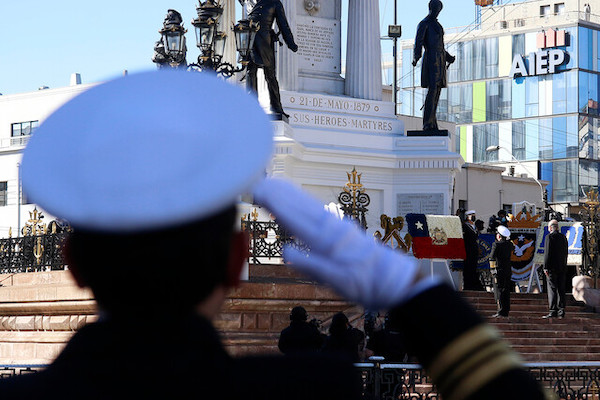
Here emerges the figure of the Commander-in-Chief, the only Commander-in-Chief, Admiral Juan Andrés De La Maza, who instead of adopting the comfortable position of silence and pretending that nothing has happened, clearly distances himself from the statements made by retired Admiral Miguel Ángel Vergara at the aforementioned lunch, reaffirming that the Navy works for all Chileans and that the thesis of an internal enemy is not shared. He does this by issuing an official statement and personally informing the President of the Republic and his Minister of Defense at the cocktail event following the midday ceremony in Plaza Sotomayor (see official statement from the Chilean Navy).
The easy route, which might have pleased many in the retired community, would have been for the Commander-in-Chief to remain silent or to confirm the diagnosis of what was said at the lunch, creating an even greater crisis than the one brewing at that time. Many do not forgive the President for the lack of security experienced in the country and, in particular, for changing Rear Admiral Parga, an officer who—as previously indicated—enjoys high prestige and is also a grandson, son, brother, nephew, and cousin of sailors.
Strategic leadership, which is inherent to the Navy’s Commander-in-Chief, often requires acting contrary to the voice of a polarized Chile and, in this particular case, to the opinions of several who were dissatisfied with the current Government and demand action from the defense institutions. Leadership in this case requires acting with a cool head and understanding what is best for Chile, the Chileans, and the Navy, while always keeping the purpose of the Navy in mind.
The leadership of the Commander-in-Chief and Rear Admiral Parga is what today’s Chile needs—leadership dedicated to the country, the naval institution, and the sailors and marines that make up the Chilean Navy. They are shaped by the example of Prat and developed throughout their naval careers, and they are forms of leadership that could be emulated by those who guide the political destinies of the country, who sometimes prioritize their political agendas over what is best for Chile. These are forms of leadership in which they do not seek to benefit from the fame that could come from being less humble and more bellicose, but rather aimed at what can make the difference between a Chile that can emerge from the unfortunate situation we are currently in and one that could end up sinking into the depths of underdevelopment.
Chile can be reassured; it has a Navy with admirals who will know how to fulfill their duty and lead the Navy correctly and appropriately, without deviating from its course and dedicated to its professional tasks, but who would be grateful if this and other governments discontinue the practice of using them to resolve political and internal security issues, as the cat is tired of being asked to pull the chestnuts out of the fire with its hands.
Richard Kouyoumdjian
Vice President AthenaLab
Source: El Mostrador


