South Korea Looks to the Indo-Pacific
This article was translated automatically and may contain differences from the original. For reference, read the original.
Diario Financiero, December 27, 2022
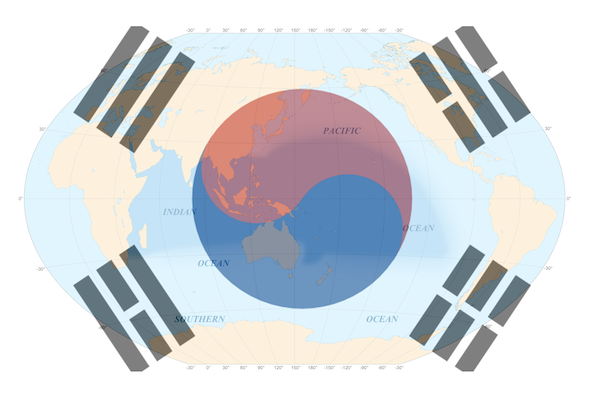
The exponential increase in missile tests by North Korea this year is certainly very concerning, but it is also a recurring issue. The true “Copernican turn” that has occurred in this area is represented by South Korea’s decision to adopt the “Indo-Pacific” as its strategic framework. Under the conservative President Yoon Suk-yeol, who took office last May, Seoul seems to have chosen to move beyond its traditional “strategic ambiguity,” where it attempted to maintain a delicate balance between the United States and China.
While the presence of U.S. troops is vital for South Korea’s security, a good political relationship with China—its main trading partner—is key to keeping the vassal Kim Jong-Un in check. Although local diplomats have clarified that the strategy is not directed against anyone in particular, its formulation was announced during President Joe Biden’s visit, a gesture that is more than symbolic. This is similar to the resumption of trilateral cooperation with Japan.
“The update of Seoul’s posture—similar to that adopted by Canada in November—speaks fundamentally to a more challenging geopolitics.”
What seems to have changed in the calculations of South Korean authorities is Beijing’s more assertive attitude in the South China Sea—where it has occupied islands and reefs disputed with its neighbors—and the fourth crisis in the Taiwan Strait. Should these conflicts erupt, commercial maritime and air routes could be severely compromised for an exporting power of industrial goods and an importing power of energy. Additionally, global disruptions in supply chains due to Covid-19 and the Russia-Ukraine war have added another layer of uncertainty.
In this sense, it is logical that in advancing the strategy, President Yoon stated that, first and foremost, peace and stability in the Indo-Pacific region are directly related to the survival and prosperity of his country.
Then, secondly, he explained that South Korea will make an effort to reinforce the “rules-based order” and rejected any “unilateral change of the status quo through force.”
Thirdly, Seoul has promised to promote an “open and fair” economic order in the Indo-Pacific region, whether to strengthen the resilience of supply chains or to ensure technological cooperation.
Although more details will be known when the document is released, it is clear that with its strategy, South Korea is declaring its interest in expanding its role in the fields of security and trade in the Indo-Pacific, which is very good news for like-minded countries, such as Chile, with which this year marks 60 years of bilateral relations.
The update of Seoul’s posture—similar to that adopted by Canada in November—speaks fundamentally to a more challenging geopolitics, where countries are obliged to design new paths and align resources to ensure their prosperity, which requires making decisions. Saying “Indo-Pacific” today is synonymous with adherence to international rules of behavior, economic openness, and, at best, a democratic life.
Juan Pablo Toro
Executive Director, AthenaLab
Source: Diario Financiero


