COLUMN | Chile halfway between the global supply and demand for coca
This article was translated automatically and may contain differences from the original. For reference, read the original.
El Líbero, March 24, 2023
Our ports, roads, and even international agreements are used by transnational drug trafficking groups.
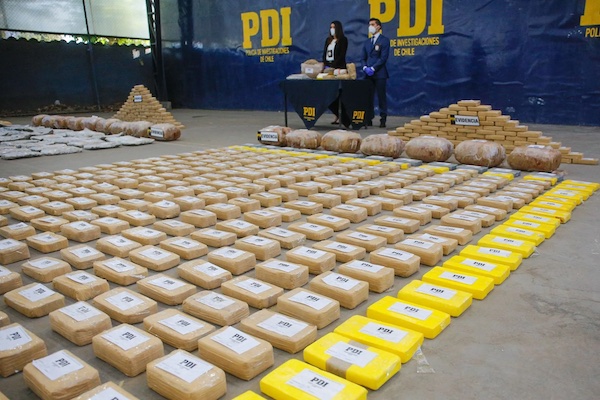
The demolition of the drug house in La Florida and the drug funeral in Valparaíso have led us to a local perspective on the phenomenon of drug trafficking in Chile. This perspective undoubtedly concerns Chileans the most, but from it, we cannot address the problem as a whole.
International cooperation, the magic words we cannot forget, as the demolition of houses and the protection of the population from a drug funeral will not have the desired effect if the entry of drugs from the north and their exit through important ports like San Antonio are not combated.
Chile’s position in the Pacific appears as a fundamental asset for our legal international trade, over 90% of which is conducted via maritime routes, but also for the illegal trade that uses our critical infrastructure for its operations.
The location in that calm sea that bathes us is the gateway to the world, one in which we are fully integrated, a fact we have deepened with more than 30 active trade agreements. However, to that exit door to the world, we must add an entry point: our northern border. A large thin glass partition that, along with weakened and difficult oversight, becomes the access point for drugs into Chile.
The more than 100 unauthorized crossings along our border with Peru and Bolivia are exploited by criminal groups to expand smuggling and trafficking. The arrival of new gangs in regions like Tarapacá, which have increased competition for distribution routes, drives up violence rates—according to the Ministry of the Interior, that region has the highest homicide rate in the country. Additionally, the drug groups operating in the area have benefited from the lawful transit of goods regulated by the Treaty of Peace and Friendship of 1904.
Our ports, roads, and even international agreements are used by transnational drug trafficking groups. Colombia, Peru, and Bolivia are the three coca producers in the world, and Central and Western Europe, along with North America, account for more than half of the demand for this drug. Halfway between supply and demand is Chile, distributing the product to Mexico, the United States, and Europe.
With such an important role in the global coca trade, it will be difficult for local actions to stop the entry of drugs. The business is too lucrative, and Chilean infrastructure presents a tremendous opportunity.
The challenge is to prevent drug traffickers from continuing to exploit our territory. The way forward is through measures aimed at a better territorial control derived from synergies generated by the complementary work of agencies such as the police and customs, while simultaneously developing a public security architecture that allows for the creation of policies applicable to local challenges that consider the international context of drug trafficking.
The desired end state is a context of peace for the development of Chileans and a secure environment for our infrastructure and international trade.
Pilar Lizana
Researcher, AthenaLab
Source: El Líbero