Why the insistence on UNASUR?
This article was translated automatically and may contain differences from the original. For reference, read the original.
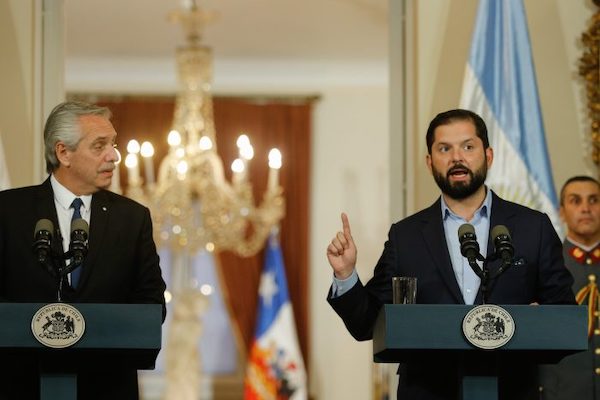
El Mostrador, April 9, 2023
What is Argentina’s interest in having Chile rejoin UNASUR? (…) Argentina is accustomed to winning by secret means, and we must not allow this, just as we must not permit the military instrument to be used regularly for purposes other than being prepared to protect our territory, defend our sovereignty, and safeguard national interests wherever they may be located.
In simple terms, geopolitics is a field of study dedicated to analyzing the effects of human geography and physical geography on politics and international relations. We could say that its center or focus is on political power in relation to geographic space. It is very likely that our experts in geopolitics are focused on analyzing the case of Ukraine versus Russia, because apparently, no one has paid attention to President Fernández of Argentina’s insistence that Chile rejoin UNASUR.
What is Argentina’s interest in having Chile rejoin UNASUR?
Relations with our neighbors have not been easy throughout history. They are not easy today either. We are by far the smallest country in area among the three with which we share borders. Our population only exceeds that of Bolivia.
Argentina, which insists on incorporating us into UNASUR, is four times larger than us in area and twice as populous; moreover, with a GDP of approximately $480 billion, it surpasses our $315 billion. Three simple variables—area, population, and gross domestic product—place us at a disadvantage in terms of capabilities compared to Argentina. How have we managed to maintain peace and stability in our neighborhood over time? By maintaining a balance of power with national power instruments that compensate for our asymmetries. We must never forget that the boundary treaty of 1881, by which we ceded Patagonia south of the Río Negro, was signed under Argentine political pressure, which threatened to open a third front while we were at war with our two northern neighbors. Several studies link, over time, the military capabilities of both countries with periods of crisis or greater conflict. Thus, the neglect of our defense capabilities in 1958 led us to the Snipe Islet crisis. President Frei Montalva was forced to urgently order the construction of two new frigates and two submarines from Great Britain due to Argentine diplomatic pressure and the events that resulted in the death of Lieutenant Merino of Carabineros at the hands of Argentine gendarmes. In January 1977, with a very favorable military potential for Argentina, our neighbor declared the British Crown’s arbitral award, which confirmed that Chile is the southernmost country in the world and that Argentina has no land possessions south of the main island of Tierra del Fuego, to be “irrevocably null.”
Due to the ongoing tensions with Bolivia, a neighbor that has elevated its aspiration for sovereign access to the Pacific Ocean through Chilean territory to constitutional status, and the Peruvian claim before the International Court of Justice to redraw the maritime boundary that both countries accepted and respected for over five decades, Presidents Eduardo Frei Ruiz-Tagle and Ricardo Lagos found it necessary to strengthen Chile’s national military power as support for its foreign policy and positioning in the international arena, after becoming the country with the largest number of free trade agreements in the world and generating Chilean national interests beyond our borders, especially in the Indo-Pacific and the Panama Canal, a route where we became the third largest user globally. Almost 25 years have passed since the beginning of that modernization process. Chile’s military instrument is a guarantee of peace in the region, respect for our sovereignty, independence, and self-determination, and an effective support for our foreign policy. The best proof of this is our capacity for deployment in peace operations under UN mandate and Chile’s participation in multinational exercises that test our training standards, logistics, sustainment, and operational reach.
UNASUR represents a utopian ideological vision that disregards the stubborn reality of international relations, whose political nature transforms them into power relations. International relations are a national power instrument for achieving and protecting national interests and objectives, wherever they may be. UNASUR does not align any Chilean national objectives or interests with those of the other member countries, and the ideologized vision that gives life to UNASUR does not account for the reality of the facts that shape the agenda with our neighbors. Despite the ruling of the International Court of Justice, Peru still does not adhere to the maritime boundaries established by UNCLOS and has yet to modify its territorial sea. Bolivia maintains its aspiration for sovereign access to the Pacific through Chilean territory at a constitutional level, and the most striking case is that of Argentina.
Before inviting us to join UNASUR, President Fernández inaugurated a military base in Tolhuín, Tierra del Fuego, and traveled to Antarctica, reinforcing his sovereignty claim, which overlaps with Chilean Antarctic territory over most of its extent. Argentina maintains in effect Decree 457/2021, which speaks of “joint control” of the Strait of Magellan and the Drake Passage (Hoces Sea according to Argentina), despite our Foreign Ministry’s note of protest. The decree restricting free navigation to and from the eastern mouth of the Strait of Magellan is also still in effect. Argentina’s claim for an extended continental shelf south of point F of the maritime boundary defined by the Treaty of Peace and Friendship of 1984, overlapping with Chile’s (non-extended) continental shelf, remains active. One after another, Argentina’s actions challenge Chile’s sovereignty and territorial integrity in the southern region.
Our Foreign Ministry has been lax in defending our national interests, as demonstrated by the leaked audio recordings from the ministry, where we even denied a British ship’s entry to appease the Argentine ambassador. We have no territory or population comparable. Our economy is hardworking, but the reality of wealth is incomparable to Argentina’s possibilities, and our Foreign Ministry has been conspicuously absent in defending national interests against Argentina’s advances in this 21st century. The only thing left for us is the military instrument to preserve national interests and peace through deterrence. That is the reason for President Fernández’s insistence that Chile join UNASUR, and that is why we must not join under any circumstances. Argentina is accustomed to winning by secret means, and we must not allow this, just as we must not permit the military instrument to be used regularly for purposes other than being prepared to protect our territory, defend our sovereignty, and safeguard national interests wherever they may be located.
Richard Kouyoumdjian
Vice President AthenaLab
Source: El Mostrador


