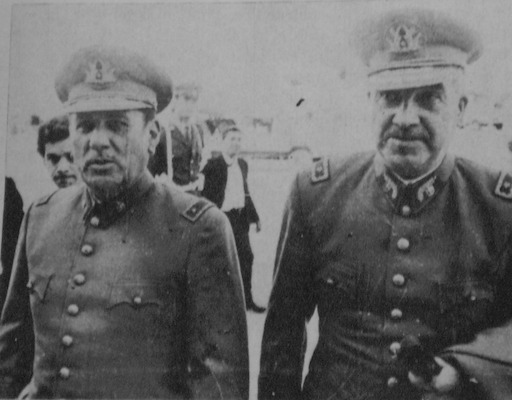
Generals Schneider and Prats
This article was translated automatically and may contain differences from the original. For reference, read the original.
El Mostrador, August 30, 2023
Undoubtedly, General Schneider’s statement was a response to the needs of the times, but today it could be interpreted as an act of open political deliberation. However, given the turmoil of the period and the military’s greater involvement in the daily affairs of the country, it was considered almost a necessity at that time. Moreover, it was celebrated and remembered to the extent that it is treated as doctrine.
Whether we like it or not, the Armed Forces have a political role, even if tacit, from the moment they exist. They are organized forces and, along with Carabineros and the PDI, hold the monopoly on the legitimate use of state power.
Political constitutions, whether those we have had in Chile or those of other countries, seek to balance or counteract the power generated by the monopoly on the use of force, focusing armed institutions exclusively on their proper function, the professionalization in the use of arms. Exceptionally, their use is contemplated in the Constitution during Constitutional States of Exception, situations that are very limited in scope, time, and geographic space, something that has not been much respected in recent years.
Constitutions, recognizing that the power of arms can have significant effects on the political life of a nation, limit and restrict the role that the Armed Forces and Law Enforcement can have in matters that are not their own. This is why they are explicit in stating that they are NOT deliberative, which renders any decision made under the pressure or threat of arms outside the law. This is something that the constitutions of 1833 and 1925 precisely repeated in their Articles 157 and 158, and 22 and 23, respectively.
The crisis experienced by our democratic institutions during the Popular Unity Government required a series of extraordinary efforts, in which our Armed Forces, and especially the Army, were not uninvolved. During those days, the actions of the Armed Forces in politics, especially the Army, were guided by Articles 22 and 23 of the 1925 Constitution. In this sense, what is known as the “Schneider doctrine” is not a doctrine per se, but simply a clarification of the constitutional role of the Army, which gains importance due to who says it and under the circumstances in which it is said.
What General Schneider—a cultured, intelligent, and upright general—said in the interview with El Mercurio of Santiago on May 8, 1970, was that “the Armed Forces will arrive at the election maintaining the traditional support for the decisions of the constitutional government of the Republic, which will guarantee the electoral process and ensure that whoever is elected assumes the Executive Power… that in the event of no absolute majority… the Full Congress is the owner and sovereign to elect… and it is our mission that this decision be respected.”
After the assassination of General Schneider and due to the doubts regarding the democratic credentials of a Marxist government that only received one-third of the vote, the Political Constitution of 1925 was amended by the constitutional reform that incorporated the constitutional guarantees negotiated by the DC with the UP, as a requirement and safeguard, before Salvador Allende was elected President of the Republic.
In this sense, Article 22 of the 1925 Constitution, in its modified version of January 1971, gains more substance and states that “the public force is constituted solely and exclusively by the Armed Forces and the Carabineros, institutions that are essentially professional, hierarchical, disciplined, obedient, and non-deliberative. Only by virtue of a law may the staffing of these institutions be established. The incorporation of these staff into the Armed Forces and Carabineros may only be done through their own specialized institutional schools, except for personnel who must perform exclusively civil functions.”
Undoubtedly, General Schneider’s statement was a response to the needs of the times, but today it could be interpreted as an act of open political deliberation. However, given the turmoil of the period and the military’s greater involvement in the daily affairs of the country, it was considered almost a necessity at that time. Moreover, it was celebrated and remembered to the extent that it is treated as doctrine.
With the unfortunate assassination of Schneider, General Prats assumed command of the Army, a general who had by far the highest seniority in his class, who, upon taking command, communicated his concept of command, which consisted of the following points:
- The function of the Army is exclusively professional.
- The professional sense of the Army is a guarantee of the validity of the popular mandate.
- National trust rests on this tradition.
- The unity between the people and their Army—allow me to emphasize that possessive adjective—is stronger than any action of contingent politics.
- The mission of the Army is to “guarantee national sovereignty against external and internal threats.”
- As an intrinsic part of the people of Chile, the Army cannot remain aloof from the legitimate ambition to achieve the highest degree of self-sufficient development for the sake of citizen well-being.
- As an armed force in a Rule of Law, the Army is prohibited from deliberating on national political alternatives.
- As a constitutive part of the “public force,” the Army will loyally and firmly ensure the stability of the institutional government.
- Its eventual participation in internal situations is expressly determined by the Supreme Government, to impose the rule of law when national security demands it.
- Discipline and institutional cohesion are the fundamental factors for the Army to fulfill the superior role that corresponds to it within Chilean society.
What we could call the Prats doctrine clearly goes beyond what the 1925 Constitution requires, and I have repeated it verbatim, as there are aspects that explain very well his subsequent actions as Commander in Chief and Minister in Allende’s Government. His understanding of the role of the Army of Chile is quite political in itself and very different from the current understanding. It speaks of guaranteeing sovereignty not only against external enemies but also internal ones, and indicates that its primary loyalty is to the Executive, to whom it owes its allegiance.
Clearly, upon assuming the position of Minister of the Interior and later as Minister of Defense, his concept of command loses strength, as he becomes a member of the cabinet of a government that represents the left of the political spectrum. He may have had very good and noble reasons, but clearly being part of a political cabinet, no less than as Minister of the Interior, is a clear demonstration of deliberation, even though President Allende referred to that cabinet as one of “national security.” Separating his role as a military officer and minister was not something easy to accomplish while he remained an active-duty general, and to a large extent, it opened the doors for deliberation to become part of the daily life of the institution he commanded, violating a fundamental principle of command, which is to lead by example.
Prats did not consider in his decalog what happens when the Executive deviates from the Constitution or does not respect it, leaving that responsibility in the hands of Congress. The argument was based on the premise that the Army’s loyalty was always to the Presidency of the Republic, regardless of its compliance with the Constitution, since if it did not comply, Congress would remove it and someone else would assume in its place.
The 1980 Constitution reflects what the military wanted to see in a Constitution, including much of what Prats established in his concept of command, eliminating what he considered a source of politicization (the approval of promotions to the ranks of colonel and navy captain by the Senate), but, like the previous constitutions of the Republic, it does not include a hermeneutic definition of what it means to deliberate, something that is fundamental, since, depending on the perspective granted by political positions, any word spoken today by a Commander in Chief can be interpreted as deliberation.
For this reason, I believe that in the atmosphere generated by the 50th anniversary of September 11, 1973, it is not surprising that the Commanders in Chief seek to maintain their professional role strictly and avoid being invited to events where they are required to make gestures or express opinions of a political nature.
The opinions of Generals Schneider and Prats, in current times, would clearly be interpreted as deliberative and political. For some, they may have been appropriate for the times they lived in, but all indications suggest that it would have been better if, rather than them speaking, the three branches of government, with their constitutional checks and balances, had carried out their role without involving the Armed Forces, or, at the very least, they could have limited themselves to stating that the Army of Chile would comply with what is indicated in Articles 22 and 23.
In conclusion, it does not help the current environment that former Commanders in Chief, regardless of being retired and having the freedom to do so, express opinions that may place the current active-duty commanders in a position where they need to issue clarifications. It is better for all of us to agree that all members of the Armed Forces will fulfill what they say in their oath to the flag, which certainly includes respecting the Constitution of the Republic. Personal interpretations of constitutional matters do not help at all and do not correspond, except to the institution that has the role of interpreting the Constitution.
Richard Kouyoumdjian
Vice President AthenaLab
Source: El Mostrador