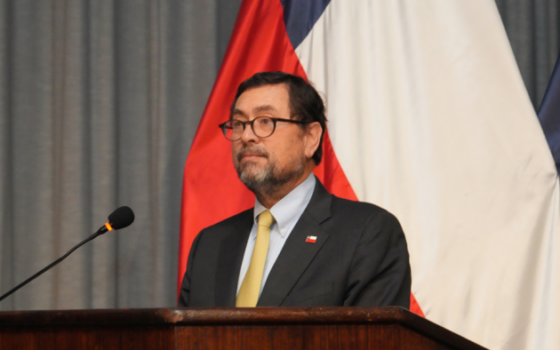
Pilar Lizana speaks with Emol about Chinese mafias in Chile
This article was translated automatically and may contain differences from the original. For reference, read the original.

The “discreet” and dangerous arrival of Chinese mafias: How they operate and why they choose Chile
The reserve is part of their operational framework, primarily focused on large indoor marijuana cultivation and human trafficking. Money laundering includes entertainment venues, such as karaoke bars and casinos.
On Wednesday, while President Gabriel Boric was in China, National Prosecutor Ángel Valencia appeared before the Senate Constitutional Commission to argue for the need to create a Supraterritorial Prosecutor’s Office specializing in organized crime and high-complexity offenses. On that occasion, the head of the Public Ministry reminded the members of the committee that this is a complex reality that Chile has been facing in recent years.
However, this phenomenon has evolved over time, not only due to organized crime itself but also because of new criminal markets “that appear to be dynamic and not anchored in a single territory,” making it necessary to advance investigative approaches that surpass the limited work in specific areas, “especially considering the significant evolution of criminal and transnational phenomena,” said Valencia.
Among the investigations the prosecutor’s office has conducted are the organization of the Tren de Aragua, Tren del Norte (Los Gallegos), Los Pulpos, Los Chotas, and Los Valencianos, port trafficking in San Antonio, and the criminal organization Bang de Fujian. The latter is a Chinese mafia that has so far been detected in the southern area of the Metropolitan Region.
On Thursday, Undersecretary of the Interior Manuel Monsalve also addressed the issue. “These are organizations that operate in various countries, including Chile. Some of the organizations you mention are from Latin America, while others are from different continents that, due to drug trafficking, arms trafficking, human trafficking, and even organizations engaged in cyberattacks, clearly have and develop crimes within national territory.”
Background on their expansion into the country
Indeed, the clues regarding the presence of Chinese mafias in the country are not as isolated as one might think. In September 2021, the Investigative Police (PDI) announced that it had dismantled a criminal gang dedicated to the cultivation and trafficking of a significant amount of drugs in our country, resulting in the arrest of 13 individuals, nine of whom were linked to the “Chinese mafia.”
The investigation established that these were Chinese citizens who arrived in our country, where they set up legitimate businesses and companies. Then, in a specific location, they proceeded to cultivate and harvest high-quality cannabis sativa, as they carried out an industrial harvesting process and even had people to guard the locations. Meanwhile, they typically launder money through entertainment venues, such as karaoke bars or casinos.
In fact, to better address the phenomenon, the PDI formed a team dedicated exclusively to the case, which led to greater findings. In September of that year, the civil police made a significant breakthrough, arresting nine individuals and confirming the existence of two additional warehouses in San Miguel and Macul in the Metropolitan Region.
At the end of August this year, a criminal complaint filed with the 7th Guarantee Court of Santiago for the crime of repeated illegal trafficking of migrants also sheds light on this trend of Chinese mafias settling in the country. The legal action was filed by the Chinese Culture and Commerce Association in Chile, which provides assistance in various matters to individuals of Chinese nationality.
“It is in this context that during this year our association received requests from a number of individuals who may have entered Chile irregularly, managing to determine the existence of various individuals dedicated to the illegal trafficking of Chinese citizens, taking advantage of their need to come to the country and their ignorance of the processes,” details the complaint.
How they operate and why they look to Chile
Chinese triads are criminal organizations originating from that Asian country, dedicated to marijuana cultivation, human trafficking, extortion, and other illicit activities, such as using entertainment venues as fronts for their illegal economies. Some of them include 14K, Shui Fong, and Sun Yee On.
On the other hand, the Bang de Fujian clan emerges as one of the most prominent organizations. Their commercial ties and geographical position have allowed Fujianese migrants to have a strong presence in Hong Kong, Southeast Asia, the United States, and Canada.
An investigation by the specialized portal Insight Crime states that the first significant operations of this group were carried out in Spain, and they later sought to replicate the model in Chile.
In conversation with Emol, security expert Pilar Lizana from AthenaLab comments that these Chinese organizations have a dense global network, and in the case of Chile, “we need to look at how they insert themselves for marijuana cultivation and the use of national ports to distribute drugs globally; that is an opportunity for them.” She also details that this drug cultivation does not occur in a closet inside an apartment, but rather involves large infrastructures used for these purposes.
Additionally, these groups also engage in activities associated with human trafficking. In fact, in the complaint filed by the Chinese Culture and Commerce Association, accounts from victim complainants are taken into consideration, pointing to various routes of entry into the country, such as through the city of Neuquén (Argentina) and Temuco. The mafias can charge between $2,500 and $8,000.
In early September, an investigation by this outlet into Chinese malls revealed the fear that owners of these large businesses feel about discussing insecurity or even providing their names when asked about the business’s development. One of the reasons they hinted at pointed to the triads.
“When one discusses these issues, those who do not belong to that world of mafias often provide codes without realizing it, which can be analyzed differently by criminal organizations, potentially harming their business. Unlike terrorist organized crime, which is very visible, for these groups, the best approach is to ideally not appear or be mentioned; the greater the secrecy, the better they can extend their business,” Lizama explains on this point.
In this sense, Chinese vendors may fear reprisals that, the expert clarifies, will not only be verbal threats but that “their lives may be at risk, depending on how that group interprets what they say.”
Investigations into trafficking
According to data from the Southern Metropolitan Prosecutor’s Office, since 2019, there have been at least three investigations into trafficking—primarily marijuana—opened regarding Bang de Fujian, all under the charge of prosecutor Yans Escobar. They indicated to this outlet that in an initial phase, five individuals—four Chinese and one Chilean—were charged with this offense.
The prosecutorial body also reports another investigation that included 14 defendants (one Chilean, one Venezuelan, one Peruvian, and 11 Chinese), all investigated for drug trafficking and one for arms. Of these, six have already been convicted, and eight are awaiting trial.
The third phase involves eight defendants (seven Chinese and one Chilean), of whom five are in preventive detention. There was also an investigation into drug trafficking, which resulted in seven defendants and one for ammunition; all are awaiting trial.
Despite these investigations being a reality, there is still little discussion about these Asian organizations. One reason, according to Lizama, is that in Chile, Latin American groups are more prominently discussed because they are better known and due to the “proximity” of their countries of origin.
“We are more accustomed to hearing about the Sinaloa Cartel, Jalisco, the Gulf Clan, Comando Vermelho, etc., because that is what occurs in our immediate environment, but we also need to be very concerned about Chinese mafias,” comments the expert.
For his part, Monsalve highlighted on Thursday the importance of strengthening the national policy against organized crime, which includes specific focuses that encompass a legislative agenda to empower the state to combat these organizations.
“One of them is the financial intelligence project currently under consideration; the intelligence law that is being processed; and laws that have been enacted, such as the law against drug trafficking in criminal organizations and the one that allows the use of special investigative techniques. This national policy agenda against organized crime and the legislative agenda responds to a diagnosis that there are international organizations that pose a threat to state security,” said the undersecretary.
Ultimately, it all comes down to opportunities: if there are weaknesses in various aspects of the country, such as institutions, investigations, or port oversight, these groups see more incentives to establish themselves and operate in these areas. And the Chinese mafias have already detected them.
October 22, 2023
Source: Emol