Is a State of Emergency Appropriate in the Metropolitan Region?
This article was translated automatically and may contain differences from the original. For reference, read the original.
Biobio, January 29, 2024
The request comes not only from the mayors but also from the residents of the municipalities most affected by organized crime and delinquency, as well as from the governor of the Metropolitan Region, who is always in tune with the issues that most concern the people of Santiago.
It is quite logical that in the face of escalating crime, people would call for the presence of National Defense institutions, as they enjoy a high public image, their leaders are among the most prestigious authorities, they are supporting the police at the borders with Bolivia and Peru, and, more importantly, their efforts have been a determining factor in making 2023 calmer and less violent than previous years in the Southern Macrozone.
The support of the Armed Forces in northern and northeastern Chile may make some common sense as they are guarding the border, a function included in the constitutional amendment regarding critical infrastructure, despite not being one, but which was accepted by Congress. They forgot to indicate that they would be performing police functions for immigration control, which is something for which they are not trained and do not have the human capabilities.
To provide logistical and technological support to the police at the borders, the decree 265 from the Piñera government suffices, which allowed the use of Armed Forces resources. The immigrants entering Chile are not enemy troops or opposing armies. They are mostly harmless individuals who do not pose a risk to national sovereignty, except for the occasional criminal who takes advantage of the circumstances to enter Chile.
The solution to the northern border does not lie in filling it with soldiers and sailors. It involves having good intelligence, monitoring systems, and clear instructions on what to do with immigrants still seeking to reach Chile. It also requires that the State as a whole be present, and not rely solely on military and police forces. It is of no use if other services only operate from 8 AM to 6 PM.
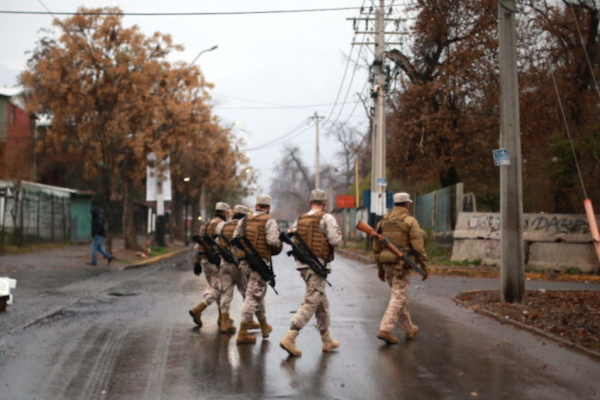
In the case of the Southern Macrozone, the army and navy have been deployed since the end of Sebastián Piñera’s government. Initially, the current government gave them a more limited role, only for the protection of main roads, before realizing that they needed to be given freedom of action to fulfill the ordered purposes, which has been reflected in reductions in rates of violent incidents.
The best use of the Armed Forces has been accompanied by more effective and coordinated efforts from the Public Ministry, courts, state agencies, and the state apparatus as a whole, but it has its limitations, as the problem is diagnosed as one of crime and more recently, as terrorism, but the truth is that we are talking about insurgency, as the Mapuche groups operating in the area seek territorial control and to replace the State of Chile.
If this is the case, understanding that we are facing insurgent movements that sometimes appear as criminals or terrorists, the military has an important role, but it will be ineffective unless ordered to eliminate or neutralize those groups seeking to be sovereign and autonomous. And, again, if there is no effort from the entire State, it is likely that military action will not achieve lasting results.
The use of the Armed Forces in internal security tasks must be exceptional. This is established by the constitution. One thing is to use them to eliminate or neutralize those who wish to threaten the sovereignty and territory of Chile, as is the case with the insurgents operating in the Southern Macrozone, and another is for them to perform immigration control functions at the borders, which is purely a police matter.
This is why the constitution limits the options of the President of the Republic in this matter. It seeks to prevent misuse and assumes that other institutions, such as the police, the public ministry, and courts, will do their job properly, with the support of the Armed Forces for maintaining public order being exceptional.
The Armed Forces are designed for other purposes
Their organization, equipment, doctrine, and human capital adhere to the logic of war between states and, eventually, addressing insurgency problems. Their prolonged use in the Southern Macrozone and now at the borders with Peru and Bolivia is illogical, despite having the approvals of Congress. It is thought that due to their versatile capabilities, they serve all purposes, but this is incorrect. They are not designed to be police, firefighters, and health workers.
They are not designed to be police forces in the Metropolitan Region. They do not have the necessary human and technological resources to fulfill the task. They are not trained nor do they have the doctrines required. They also lack the legal safeguards that the use of force requires, which makes both police and military forces reluctant to solutions of the type of states of emergency, and which was key in the case of Ecuador, one of the conditions that the armed institutions of that country set for going out into the streets.
Chile is not Ecuador, but it could become one. The solution is not to deploy the armed forces onto the streets now; it is to ensure that the government, police, prosecutors, and judges do their jobs effectively. If they do not, there will be no choice but to use the armed institutions, but the use of organizations trained for war in roles different from their primary function implies that one must assume the costs that this entails, not very different from putting an elephant in a china shop.
I hope I have made it clear that the solution for the Metropolitan Region is not military force, but it could eventually be if those who should be doing the work do not do it effectively and efficiently. However, once they are deployed, it is difficult to remove them. Just look at the examples from the north and south where people have become accustomed to being provided security despite not being employed correctly and to their full potential.
Let us not complain if Chile militarizes, and let it be clear that it is not at the initiative of the Armed Forces. It is because Chileans are asking for it, and their political authorities are ordering them to go out into the streets with the approval of Congress.
Richard Kouyoumdjian
Vice President of AthenaLab
Source: Biobio


