Why do politicians want to militarize public security?
This article was translated automatically and may contain differences from the original. For reference, read the original.
El Mostrador, February 2, 2024
I put myself in the President’s shoes and understand that all the buses are useful to him, but he forgets that an effective national intelligence system is even more important. Otherwise, he will not know who the enemy is, when there are imminent dangers, and which targets need protection.
The President of the Republic announced yesterday that he had summoned the National Security Council (Cosena), an entity that, since the constitutional amendments of Ricardo Lagos, is merely consultative and has no decision-making power, serving for all intents and purposes as a simple communication action aimed at conveying that public security is a matter of great importance for the Government.
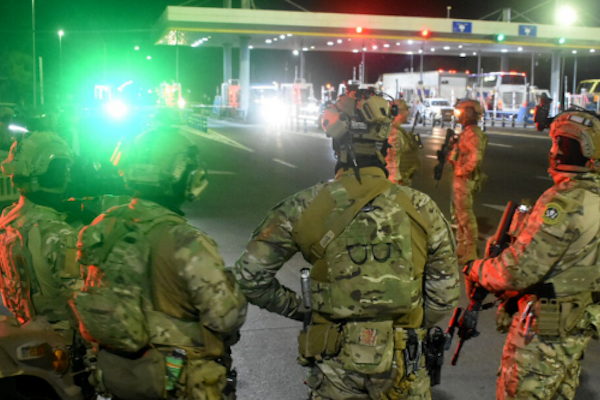
The presidential communication indicates that, in addition to establishing a special security cabinet, “I have decided to convene the National Security Council, Cosena, for next Monday morning, to receive contributions and comments on the best way to implement the critical infrastructure project currently under consideration in the National Congress, which will allow us to have military personnel in critical locations where police action needs to be reinforced.”
The above assumes that the Government has a strategy to address the issue, understands what it means to militarize public security, and that the Armed Forces not only agree to be used for purposes other than their primary missions but also possess the capabilities, budget, training, doctrine, and legal protection to avoid ending up in court at the first shot that needs to be fired, something that also concerns the police, as they do not feel supported by the Government, the Public Ministry, and the courts in this matter.
It is striking that 50 years later, not only is the memory of what happened in Chile in 1973 being recalled, but we are also militarizing Chile in ways similar to those Salvador Allende had to resort to in order to maintain power, who had it easier, as at that time the Armed Forces had accepted that internal security was a matter they could not escape, since the 1925 Constitution included them in what was called “the public force.”
I put myself in the President’s shoes and understand that all the buses are useful to him, but he forgets that an effective national intelligence system is even more important. Otherwise, he will not know who the enemy is, when there are imminent dangers, and which targets need protection.
While I disagree with the use of the Armed Forces for public security purposes—and that, if necessary, it should only be occasional and exceptional—their use for infrastructure protection is neither efficient nor effective. If he wants to declare war on organized crime and criminals, he will have to do it the Ecuadorian way. That is, he must go out and seek them and put them in jail. Waiting for them to come and attack is not advisable. It is as inefficient as dedicating them solely to protecting roads in the southern macrozone.
Although it is true that placing military personnel on the streets may impress public opinion, it does not impress those who wish to disrupt public order and potentially affect critical infrastructure. Knowing where military forces are located, operating merely as security guards without special powers, is something criminals will take advantage of. They will clearly not attack where there are military personnel, and moreover, they may not even be interested in affecting critical infrastructure. If I were one of them, I would stay far away from where the Armed Forces are stationed, as it does not contribute to their criminal objectives.
I have always been critical of the critical infrastructure project. It is something that was poorly conceived and is poorly framed, to the point that I prefer a strong State of Exception that allows for a more effective use of armed institutions: if we are going to involve them, let’s do it properly. If not, it is merely exhausting their personnel, misusing their capabilities, and conducting ineffective actions that do not go beyond being a marketing and publicity effort by the Government, which will surely attribute the lack of effectiveness to the Armed Forces if things continue as they are or worsen. To use the Armed Forces, one must understand their purpose, what they are trained for, their capabilities, how they operate, how they plan their operations, their doctrine, and rules of engagement. In this sense, using them as security guards undermines their deterrent capacity, as their location, mission, and operational rules become known. The military is trained to seek out their enemies, neutralize or destroy them, or defend military objectives from attacks by enemy forces. They are not designed to defend critical infrastructure from attacks by Chileans, much less from organized crime.
Any employment of military forces in matters other than the protection of Chilean territories, maritime and air spaces, or national interests, wherever they may be located, is neither efficient nor effective, and their use in police duties will necessarily degrade their capabilities in the areas to which they should be dedicated. They can be used to neutralize or destroy insurgent forces seeking to replace the State of Chile, and they can provide logistical and technological support to the police, but nothing more than that, and if used for internal order and security purposes, it should only be in an exceptional and not permanent manner.
We must not confuse the fact that they are organized, disciplined, hierarchical, obedient, and non-deliberative Armed Forces with being public servants for all uses, including being police officers, firefighters, and health workers. If we do so, we will be mortgaging the future and possibly opening ourselves to the problems we have already experienced in the past when Chile militarizes.
Resorting to the Armed Forces to fix public security indicates that things are wrong and perhaps out of control. I see no other reason for the Government to want to militarize the streets and hand over control, just as Sebastián Piñera did in October 2019. I hope they do not consider bringing the commanders in chief into the cabinet and asking General Iturriaga to be the Minister of the Interior and Public Security. Empowering the police and applying a firm hand is much more effective.
Richard Kouyoumdjian
Vice President of AthenaLab
Source: