Chile at The Hague over the Palestine-Israel Conflict: Loose Ends
This article was translated automatically and may contain differences from the original. For reference, read the original.
Ex-Ante, February 21, 2024
It is unlikely that what Chile states in its writings or arguments will contribute to the Court’s deliberations. However, for Chile, the form and substance of this action are relevant. A personalist, opaque, and pretentious foreign policy serves little to the national interest, which is always our primary consideration. The same applies to the parties in the conflict and the international community.
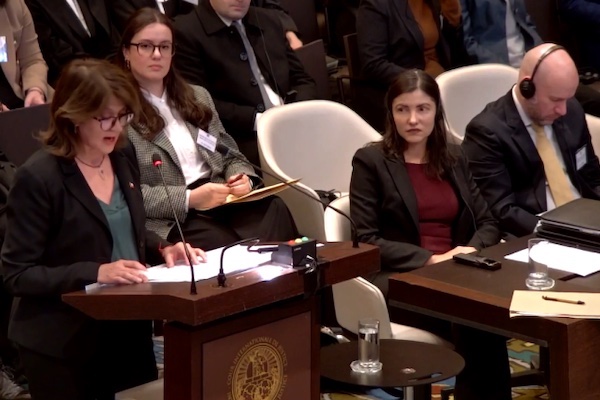
On Tuesday, February 20, Chile intervened orally before the International Court of Justice in the proceedings regarding the legal consequences arising from Israel’s occupation of Palestinian territory (Advisory Opinion). The Court published the writings previously submitted by Chile in this procedure, along with a transcript of the Chilean argument made by former Undersecretary Ximena Fuentes, now an external advisor, in her capacity as “special representative of the Republic.”
The Chilean Foreign Ministry also issued a statement yesterday—its first regarding this management—which essentially states that Chile’s arguments “reaffirm the historical position of our country regarding the conflict between Israel and Palestine,” without explaining the reason for Chile’s intervention. This is an important omission, as this advisory procedure is not the first concerning the Palestinian-Israeli conflict.
There was one in 2004, where the Court analyzed another aspect of the dispute (the legal consequences of the wall built by Israel in occupied Palestinian territory). In that instance, Chile abstained from participating through arguments or writings, in line with its traditional policy on the matter: not to import the conflict to our country. In that previous case, it should be noted, the Court’s advisory opinion had zero effect in pushing for a resolution to the conflict.
Chile’s active participation in the current proceedings before the ICJ, therefore, implies a shift in our foreign policy. In fact, it represents a greater commitment: Chile is part of a small group of interveners (14 in total) that submitted writings in the two rounds held for this purpose (July and October 2023). In this group of double submissions, Chile is, in fact, the only OECD country present outside the United States.
This high-interest group mainly includes actors with obvious geopolitical interests (Palestine, the U.S., Egypt, Jordan, Algeria, Qatar, Pakistan, the Organization of Islamic Cooperation, and the League of Arab States), or with significant Muslim populations (Pakistan, Indonesia, Bangladesh) or previous histories linked to colonialism or occupation (Namibia). What explains Chile’s presence? The Foreign Ministry does not communicate this to the public (it is attempting to do so now, albeit belatedly); nor to the Foreign Relations Committees of Congress, nor to the Foreign Policy Council (an entity that by law must ensure the unity of our foreign policy). Before yesterday’s argument, the public was only aware of Chile’s intervention through press reports, which surprised parliamentarians and members of the aforementioned Council.
The very late information from the Foreign Ministry regarding Chile’s role in this case contrasts with the fact that the Chilean intervention corresponds to a decision made early on. The writings from our country indicate extensive preparation, as they are among the longest (in the first round of writings, submitted in July but which interested countries could begin preparing in February, Chile submitted 41 pages: for comparison, Italy submitted 4, Canada 6, the Netherlands 15, Brazil 16).
Now, the Chilean argument on Tuesday mentioned as reasons for participating in this instance the duty to contribute to the strengthening of international law, in light of UN membership; a historical support for Palestinian self-determination and the two-state solution; and the conviction that advisory procedures assist in the process. This justification underscores the impression that the management is directed at a national audience. However, by not receiving appropriate and timely information, that same national audience could question the secrecy of this action and the prioritization of the Boric administration.
Substantively, the argument referred to milestones in Chile’s historical position regarding the conflict and aligned with what countries with greater geopolitical interest in the conflict state regarding the questions posed to the Court for it to provide its opinion, namely:
- What are the legal consequences arising from Israel’s ongoing violation of the Palestinian people’s right to self-determination, stemming from its prolonged occupation, settlement, and annexation of occupied Palestinian territory since 1967, including measures aimed at altering the demographic composition, character, and status of Jerusalem, and the adoption of discriminatory measures?
- How do Israel’s policies and practices influence the legal status of the occupation, and what are the legal consequences of this situation for all States and the United Nations?
A close reading reveals that the formulation of these questions is problematic. While theoretically aimed at clarifying general legal consequences, “for all States and the United Nations,” they actually seek to indirectly ventilate, through advisory means, a conflict between two countries (Israel and Palestine), when the conditions for this to occur directly (a contentious case) are not met, thus forcing the ICJ to also rule on key elements of the conflict without the necessary consent of one of the parties (Israel).
Therefore, the contentious case South Africa vs. Israel, although framed within the allegation of Genocide, may be a more appropriate forum to address the conflict, at least from the perspective of Israel’s consent to litigate and the interest of third States in participating.
The advisory route is not the most suitable procedural framework for meeting the evidentiary threshold required by the gravity of the charges: this does occur in the contentious case South Africa vs. Israel. Here, on the other hand, if the Court decides to issue an opinion (it may decline to do so), the conclusions reached in the absence of evidence could ultimately complicate the resolution of the conflict even further.
The Israel-Palestine conflict, the most complex of the modern era, requires a negotiated solution that responsible political leadership on both sides can implement. Finding such leadership has proven impossible: those who have attempted to do so have paid with their own lives. The legal route will not lead to that long-desired political solution: the evidence does not support that illusion.
It is unlikely that what Chile states in its writings or arguments will contribute to the Court’s deliberations. However, for Chile, the form and substance of this action are relevant. A personalist, opaque, and pretentious foreign policy serves little to the national interest, which is always our primary consideration. The same applies to the parties in the conflict and the international community.
Paz Zárate
Senior Researcher, AthenaLab
Source: Ex-Ante