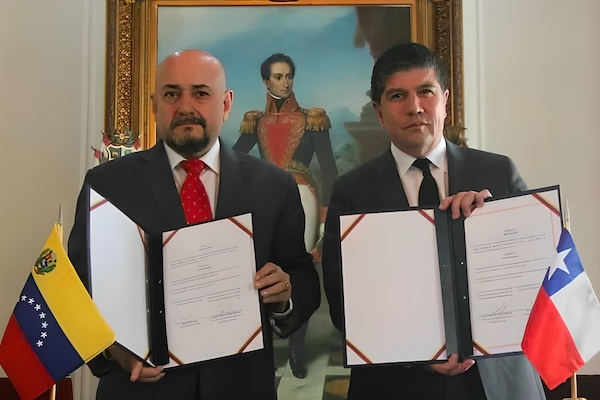
The police agreement with Venezuela
This article was translated automatically and may contain differences from the original. For reference, read the original.
El Líbero, March 1, 2024
Selecting partners is key, not only the partner itself but also their international relations.
Among all the comments about what might have happened in the case of the kidnapping of the former Venezuelan military officer, from a media outlet in Caracas speculation arose regarding the role of the police agreement signed between Chile and Venezuela. The second democracy in Latin America was signing an agreement with the second dictatorship (after Cuba) in the region. At the very least, this is concerning.
Caracas not only has a dictatorial government but also maintains relations with nations such as Russia and Iran; there has been discussion about Hezbollah’s actions in that country and the role organized crime plays in Maduro’s government. These are issues that should have been on the table when deciding to sign an agreement with Venezuela.
If at the time the bidding for passports to a Chinese company raised questions about the continuation of the visa waiver with the United States, what will our strategic partner say about this agreement? Especially in light of the possibility that Donald Trump may return to the White House.
In terms of illegal income the lack of information shared by Caracas and its limited willingness to cooperate appear as problems in addressing a migratory wave that brings with it those seeking opportunities and the organized crime that moves along the same routes.
So how is it possible to sign an information exchange agreement with a country that does not share information? Why decide to partner with a state where arms trafficking, illegal mining, oil trafficking, drug trafficking, etc., control the territory?
Chile is a country that honors its word and fulfills its commitments. However, a dictatorial government supported by internationally questioned states has few incentives to keep its word.
After reading the document, there are more questions than answers. The very breadth of it is a risk. If there is an exchange of information, how reliable will the data provided by Venezuela be, and how will that country use the information provided by Chile? And beyond that, why would a country controlled by organized crime want to share data that would be used to pursue it, or… perhaps what it seeks is intelligence that contributes to its security.
Whatever the reason, Chile does not benefit much. The Undersecretary of the Interior has justified himself by stating that the agreement is not active and that what was published by the Venezuelan media is false. However, the fact that it is not in effect does not make it any less risky nor does it diminish the impact that signing a document like this with a country like Venezuela can have on Chile’s image.
The fight against organized crime has a significant international aspect. Cooperation is essential to pursue it, and state instruments must contribute to that. Selecting partners is key, not only the partner itself but also their international relations. Focusing on the tree and not the forest could end up placing us in the midst of the ‘axis of evil,’ as they would say in the United States. The urgency to resolve a specific issue related to expulsions could end up being riskier if the relevant analysis is not conducted.
Pilar Lizana
Senior Researcher, AthenaLab
Source: El Lïbero


