Critique of the Government's Public Security Strategy
This article was translated automatically and may contain differences from the original. For reference, read the original.
El Mostrador, March 26, 2024
The Government bases its rationale on the European example of using Armed Forces for these purposes, but overlooks that those efforts face clearly defined threats: Islamic terrorists, whose groups and organizations are under constant surveillance by efficient intelligence systems.
I would consider it a success if any authority from the Central Government, Public Ministry, courts, or Congress reads this column and finds the points made here meaningful. This is a critique of the current Government strategy regarding public security, but it is presented with arguments aimed at achieving, at the end of the day, a better Chile, where all its inhabitants, particularly the most vulnerable, can feel safe.
Chile faces several distinct and differentiated problems regarding security, which become more complicated when cases arise, such as that of the former director general of the PDI or murders like that of former lieutenant Ojeda. The security issues I refer to are:
1) Professionalized and violent organized crime operating in the main cities of the country.
2) Mapuche insurgency in the southern macrozone, which sometimes manifests as delinquency, rural violence, or terrorism.
3) Illegal immigration through our borders with Peru and Bolivia, resulting in undocumented immigrants about whom we know nothing, several of whom may be criminals or agents of foreign states.
4) We are located in a bad neighborhood. Peru, Bolivia, and Argentina are weak states that can be exploited for criminal purposes or by third parties, such as Iran, Cuba, or Venezuela.
5) Our cybersecurity is weak and not up to modern standards. It is enough to recall events such as the cyberattacks on the Joint Chiefs of Staff or on state services like the Civil Registry, or those that have affected banks and critical infrastructure.
6) Forest fires, both due to high summer temperatures and poor urban planning decisions, which are exploited by arsonists and terrorists.
The Government’s security strategy is based on five pillars, namely:
- Critical Infrastructure Law, which seeks to operationalize the respective constitutional amendment.
- Rules of Use of Force (RUF) Law, which elevates to legal status the rules that Armed Forces and police must employ when using force.
- Intelligence Law, which aims to correct deficiencies and modernize the 2004 version.
- Ministry of Public Security, which creates a ministry focused on public security issues.
- Tohá-Coloma security agenda, which contains 31 projects, of which 19 had been approved by the end of 2023.
The question one must ask is whether the Government’s strategy addresses security problems, particularly those related to organized crime, insurgency, and illegal immigration.
Critical infrastructure is not under threat from any of the five problems described, except for the insurgent violence in the southern macrozone, which could target infrastructure as an act of terrorism. The idea of protecting critical infrastructure arose during the “social outbreak,” a period during which metro stations and supermarkets were affected, but it is not something currently at risk, so the urgency to assign this protection to the Armed Forces or to demand that Congress prioritize it is not understood, as it does not resolve organized crime issues, no matter how much it is said to free police for other functions.
Those police officers are protecting people, not facilities. In the specific case of the southern macrozone, successive States of Constitutional Exception have become the norm, assigning the Armed Forces an indirect role in safeguarding the region’s infrastructure.
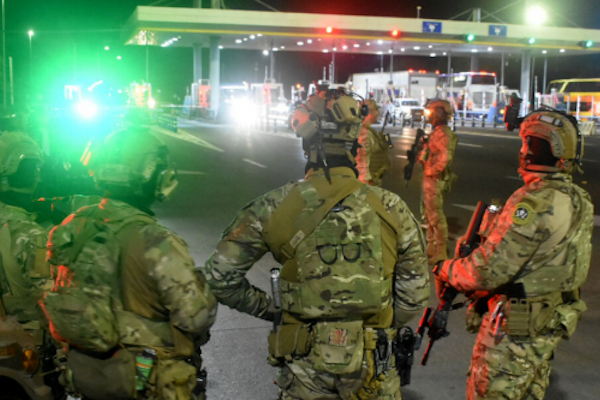
The Government included border protection in the definition of critical infrastructure, and interestingly, Congress accepted it. The military forces supporting the police at the borders with Peru and Bolivia are operating under a Supreme Decree that established how this would be done while the respective law was being drafted. The unfortunate reality is that all the effort made in the north is quite futile, at a tremendous cost, regarding immigration from Bolivia, as the redirection of anyone other than Bolivians is not accepted.
The Government bases its rationale on the European example of using Armed Forces for these purposes, but forgets that those efforts face clearly defined threats: Islamic terrorists, whose groups and organizations are under constant surveillance by efficient intelligence systems that merge information and alerts among several countries. None of this occurs in these territories, where organized crime shows no evidence of wanting to affect infrastructure, as they and their business also need everything to function well. Organized crime has economic objectives, and it is in pursuit of these that it employs its violence and force.
One could argue that the critical infrastructure initiative serves to address the problems in the southern macrozone, but once again, they are mistaken. The insurgency does not want to destroy infrastructure; rather, it seeks to take control of the territory and displace the State of Chile. Terrorist actions aim to instill fear in the population or disrupt productive activities that do not pay them royalties. royalties.
The insurgency is neutralized or eliminated by addressing the security threat, capturing insurgents, and incarcerating them. The issue is not resolved by protecting bus terminals, power plants, or supermarkets, or by doing what is currently being done, placing controls on roads, which certainly help but do not resolve the problem, as the military can only detain in flagrant cases, but to go further, they need the cooperation of the police, which operate under the instructions of the Public Ministry.
The RUF are only necessary if we are indeed going to employ the Armed Forces in public security tasks similar to those that occurred during the State of Emergency established during the “social outbreak” or mistakenly in the protection of people rather than infrastructure. The current rules only have the status of a Supreme Decree. Elevating them to the status of law is useful, but it is meaningless if they are poorly designed, with too many rules and not recognizing the reality faced when applying force.
The RUF act on the conduct of the soldier, but do not constitute rules of engagement for the units that may eventually have to deploy the Armed Forces. In the case of the Armed Forces, what matters is the command and adherence to it. That is what should be observed, and that is what military units are accustomed to.
Military forces, when deployed in the field performing public security activities, must do so under what is established by the Constitution and under the jurisdiction of military justice, not civil courts that act in conjunction with the Public Ministry. This would make their use much more effective, as today it is the main impediment, causing them to operate with the unease that at the first use of force, their members will be brought to trial, where they have not fared well so far.
In the current context, the RUF assist those deployed in the southern macrozone or at the borders, but by themselves, they will not reduce the actions of insurgents, the entry of illegal immigrants, or the actions of organized crime. As they were sent to Congress, they are ineffective and headed directly for failure.
In the case of the Intelligence Law, it is beyond discussion that what exists must be modernized and that the imperfections stemming from the 2004 version must be eliminated, where something was designed to be ineffective and innocuous. Some did not want a KGB, and others did not want a DINA. We left the ANI without operational capabilities and with little or no ability to lead the national intelligence system.
No matter how much we fix everything wrong with the current law, we will achieve nothing if resources, staffing, and, above all, strategic clarity regarding the objectives expected from the intelligence system and the use of information by the Government are not assigned. The greatest disasters in terms of intelligence have occurred when the respective authorities have not used the information and taken action based on it.
The creation of a Ministry of Public Security may be reasonable, but it should not be overly celebrated. We already have a minister and two undersecretaries quite dedicated to the issue, so there should not be significant gains in productivity and effectiveness. It sounds better than it is, and I would not expend much effort on this initiative, which surely brings more expenses, conflicts of competencies and responsibilities, and not the corresponding benefits in reducing organized crime, insurgency, and illegal immigration.
In contrast, the Tohá-Coloma security agenda has proven to be the most effective so far. With two-thirds of the projects already approved, it has managed, through minor actions, to improve multiple aspects of public security, so seeking to complete the remaining third sounds reasonable from the perspective of combating crime and organized crime.
Unfortunately, and except for the initiatives of the security agenda and those related to intelligence, the rest does not significantly impact resolving the problems we face. This occurs because an adequate diagnosis has not been made, nor does the Government have a clear understanding of what it wants to achieve. The remedies for eliminating organized crime and capturing criminals are very different from entering into a kind of coexistence with them. The same applies to the insurgency in the southern macrozone or, in the case of illegal immigration, stopping it or redirecting it.
It is obvious that all this would be easier to implement if we had a national security strategy, with its respective organization and system, that allows us to anticipate or better react to unforeseen events, as well as an Executive that is not afraid to make difficult decisions – such as incarcerating all organized crime – which, if not taken promptly, will only make our public security problems more complex in the future. How different our country would be if a good part of our Government, Congress, judges, and court ministers had completed their military service and understood a bit more about what it implies and means to assign public security tasks to the Armed Forces with the RUF currently under discussion.
Richard Kouyoumdjian
Vice President AthenaLab
Source: El Mostrador