The case of soldier Robledo: An example of Chile's payment
This article was translated automatically and may contain differences from the original. For reference, read the original.
El Líbero, March 27, 2024
Those who wear military uniforms have sworn to give their lives for Chile, but they did not swear to sacrifice themselves in internal security tasks where, if they are not extremely careful, they end up behind bars instead of the criminals.
On Saturday, March 23, 2024 María Carolina Olguín, mother of Carlos Robledo, published a letter in El Mercurio of Santiago that left many stunned, and perhaps was much more effective than many of those who write about the use of the Armed Forces for maintaining public order and the risks it entails for the military when they carry out those functions.
Mrs. Olguín’s letter seeks to draw attention to the case of her son Carlos, who is imprisoned with a 10-year sentence, as he is accused of having fired a shot that unfortunately killed a 26-year-old man participating in a violent looting of the Mall de la Serena during the so-called “social outbreak.” Alongside him, the captain in charge of the unit, a corporal, and another conscripted soldier were also convicted.
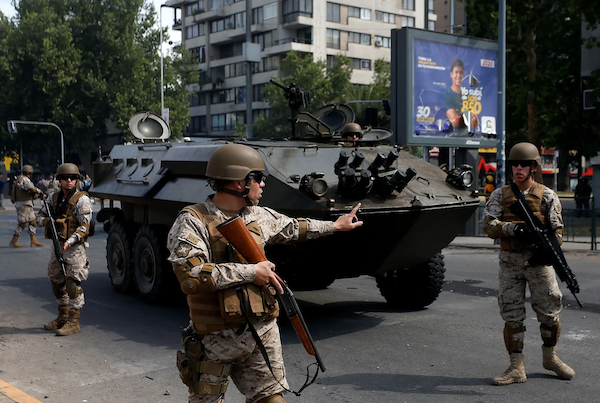
Carlos Robledo was 18 years old at the time and was voluntarily serving his military duty in the La Serena regiment. He, like others, and as a good disciplined, obedient, and respectful soldier of military hierarchy, was following the orders of the President of the Republic that day, who had declared a state of emergency across the national territory due to the violent disturbances and destruction occurring at that time, which were particularly intense and violent in La Serena. Those who were looting in the streets were not innocent bystanders and were perhaps much more than simply disenchanted individuals with Chile in 2019.
Carlos Robledo, like many other members of the Armed Forces, is imprisoned for similar realities that occurred during some of the frequent states of emergency that have taken place since October 2019. They are a vivid example of the risks that military personnel assume when asked to take charge of public order, something for which they are not trained, and should only be very exceptional, and which they must carry out in environments where there may be dead or injured from the moment the State decides to use military force to impose order, security for the population, and peace and tranquility for the inhabitants of Chile.
Carlos Robledo is imprisoned. He is receiving Chile’s payment. His family seeks justice, but they also bravely ask us to do something for him and for the other military personnel who share the same fate. In none of the known cases of this type have the judicial processes been fair. They may appear to be so, but that is far from reality. If they are lucky, they are defended by lawyers from foundations like the one called “Nos Importan” led by Alejandra Cruzat, as otherwise they are assigned inexperienced lawyers from the Public Defender’s Office because they lack the resources to hire experienced criminal defense attorneys. Why is this important? It is because they face in these trials the full weight of the Public Prosecutor’s Office, complainants such as the INDH and other organizations that are openly leftist and hostile to the Armed Forces, and also, why not say it, judges who do not have sympathy for Chile’s armed institutions.
The Armed Forces and Carabineros are quite limited in what they can do to defend their personnel in such cases. In a not very intelligent or clearly well-intentioned modification of military justice from several years ago, when a civilian is involved, military justice does not apply and the case falls into the hands of the Public Prosecutor’s Office and civil courts, which means that those addressing the issue are not specialists in military matters and in situations where armed institutions must use force.
Among the challenges faced by soldiers like Carlos Robledo are all kinds of actions from complainants or the judicial system that seek to prevent those with sentences of less than 5 years from serving their sentences in freedom. The latest is that they apply the gun control law so that their sentences are served in prison. Can you imagine how far those who propose and accept such arguments have gone? We are talking about young military personnel and police officers who, by definition, carry weapons in their professional duties as they represent the force that the State applies when it is necessary to ensure public order with those means.
Everything I indicate in this column is true and obviously impacts those who wear a uniform. Of course, they do not want, just like in Argentina, to be assigned to public security tasks since the risk of ending up in prison themselves and not the ones causing disturbances, criminals, or delinquents, is high, very high, and that is why they ask for simple and clear rules of engagement, in case they have to be judged, to be under military justice, and above all, that the government that gives the order for the use of military forces in public security tasks be held politically and judicially accountable, as it is they and not the military who decide the use of the Armed Forces in states of exception or potentially in the protection of critical infrastructure.
The Armed Forces are trained for war, to neutralize or eliminate enemies. They are not trained to perform public security tasks, which should only be exceptional, and if that were to change, meaning the exceptional becomes habitual, the legal and judicial conditions under which they operate must also change.
Many civilians find it difficult to understand the reluctance of the Armed Forces to get involved in security issues, to the point that some believe it is an unpatriotic attitude. In that sense, they could not be more mistaken. Those who wear military uniforms have sworn to give their lives for Chile, but they did not swear to sacrifice themselves in internal security tasks where, if they are not extremely careful, they end up behind bars instead of the criminals.
The examples of soldier Robledo, the captain in charge of that unit, and the other two imprisoned members are very present among those currently in uniform, just as is the case of those who spend their old age in the Punta Peuco and Colina prisons for having performed public security duties during the military government.
If we want the military on the streets, it is not free, and we must ensure the conditions for them to help resolve the problems that affect us, but first we must support foundations like “Nos Importan” that are on the ground defending the Carlos Robledos of this world, or the marines who faced Mapuche insurgents in a confrontation for which they are blamed for a regrettable death, when the evidence indicates otherwise.
Welcome to Chile where the good are bad, and where military personnel are imprisoned, not the delinquents, violent individuals, and criminals.
Richard Kouyoumdjian
Vice President AthenaLab
Source: El Líbero