Military justice for military personnel and police
This article was translated automatically and may contain differences from the original. For reference, read the original.
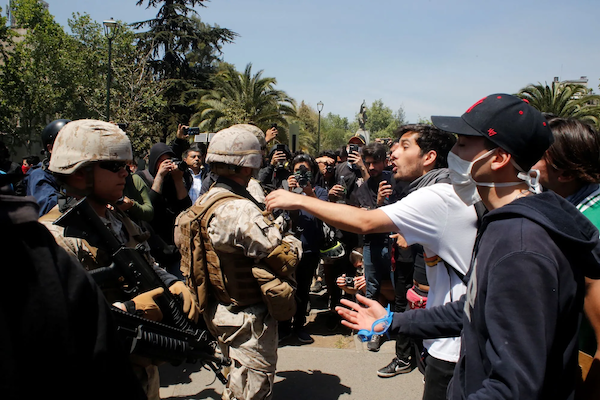
In times when the possibility of returning to the streets is being discussed, the Armed Forces and police take note of how Chile compensates those who have had to follow orders or simply bear the burden of having been military personnel or police officers at the wrong time.
It has become clear to many that, without changes in the internal security situation, the likelihood that the Armed Forces will have to take a more active role is increasingly real, which is why we must consider what needs to be addressed if their use becomes necessary.
The misguided strategy of the government in security matters places emphasis on axes that do not necessarily have an impact or do not apply to the local reality, such as the case of critical infrastructure without any terrorist threats putting it at risk, or on rules of engagement —which seek to prevent its use by state agents—ignores resolving what is the main problem in order to effectively use the force of arms that is in the hands of military personnel and police.
The problem I refer to is the justice received by military personnel and police when acting as state agents in internal security tasks, such as those generated in states of constitutional exception, which could arise under the concept of critical infrastructure or whenever they must act against organized crime, insurgents, terrorists, violent actors, and revolutionaries, such as those who acted in October 2019.
Understanding that no one is above the law and that the law must be just, it is accepted that it may be blind, but under no circumstances should it lose its essence of being just and giving each person what they deserve, including, of course, military personnel and police who act on behalf of and under the orders of the State of Chile, its President, or those who legally belong to the chain of command.
Unfortunately, military justice did not perform well during the military government, which is the main reason why its scope of action has been significantly limited in more recent times. This reduction excludes cases involving civilians, whether current, such as the cases of Robledo, Crespo or the marines who had to act in Cañete in 2021, or old cases from 1973 where judges have been appointed to investigate and issue sentences under the old criminal procedural system. Authorities at the time may have seen the above as necessary, but the truth is that the current system fails, as do the cases nearly 50 years old.
I believe that no one doubts the injustices suffered by Robledo or Crespo, or those that may affect
General Yáñez , or the police officer accused in thePío Nono bridge case . All are examples of military and police actions where the State of Chile ordered them to intervene to restore the rule of law, only to be accused of doing so with excessive force or to the detriment of the human rights of the perpetrators, forgetting that they were being attacked, or that they had to deploy the forces responsible for addressing the problem, as was the case with the main commanders of Carabineros in 2019, whom political authorities left in complete abandonment, and with whom some from the far left wish to take advantage.Evidently, the aforementioned cases, as well as those I will indicate below from earlier times, would have been better addressed by military justice, which specializes in cases involving military personnel and police, and which, like any other court in Chile, is supervised by higher instances, as on one side is the Military Court (composed of a majority of appellate court judges), and above it, the Supreme Court, which removes the arguments of lack of independence and of being 100% militarized that some attribute to it in order to discredit it and prevent it from being used in cases involving civilians.
In previous columns, you can find more details about the cases of conscript soldier Robledo and Lieutenant Colonel Crespo. These are current cases being handled between the Public Ministry and civil courts, unlike a case from October 1973 that occurred in Angol, where unfortunately two young people died and which involves thirteen military personnel from that time, two of whom were conscript soldiers serving their military duty.
This was a case already judged, in which the second commander of the Húsares regiment, who gave the order to kill them and was confessing, was convicted. Subsequently, in 2005, the Supreme Court granted amnesty to the convicted individual due to the statute of limitations on his crime.
For some reason
under the first government of Piñera, many cases of this type were reopened , and perhaps that could have been logical in other cases, but not in this one, where there was already a clear responsible party who had been judged and convicted.The reopenings were not conducted under military justice. They were done by assigning cases to visiting judges who operated under the old justice system in which the magistrate investigates, processes, and issues sentences, in clear absence of due process. Of the 13 who were convicted in October 2023, only two had direct involvement, as they were the ones who fired, but having said that, they were a corporal and a conscript soldier following orders, so they should be exempt from the case.
The other 11 bear no culpability in the deaths of the young people; condemning them at their age, more than 50 years later, for something they are not guilty of and where the command assumed responsibility does not sound very just, not just at all. It is to send them to die in prison.
The Armed Forces and police of present-day Chile observe these cases and the more recent ones that have occurred when they have had to restore order to disturbances, riots, and revolutions, or fulfill superior orders.
In times when the possibility of returning to the streets is being discussed, they take note of how Chile compensates those who have had to follow orders or simply bear the burden of having been military personnel or police officers at the wrong time. It is to be hoped that at some point common sense will return and that in all cases where military personnel and police act as agents of the State of Chile, and where it is determined that justice must act, military justice will be the one to act, as the one currently being used seems not to be providing guarantees of justice, turning the good into the bad, condemning people like
General Cheyre for being in the wrong place at the wrong time, or for being unable to show compassion and clemency towards individuals entering their fourth age, imprisoned or soon to be, for cases in which they are not responsible or are merely guilty of following superior orders. In conclusion, I hope this column provides hope to those affected by injustice and suffering the consequences in Chile. They are not alone, and many of us want them to receive justice and dignified treatment.
Richard Kouyoumdjian
Vice President of AthenaLab
Source:


