INTERVIEW | John Griffiths: "We Are Not Creating the Right Laws Against Terrorism"
This article was translated automatically and may contain differences from the original. For reference, read the original.
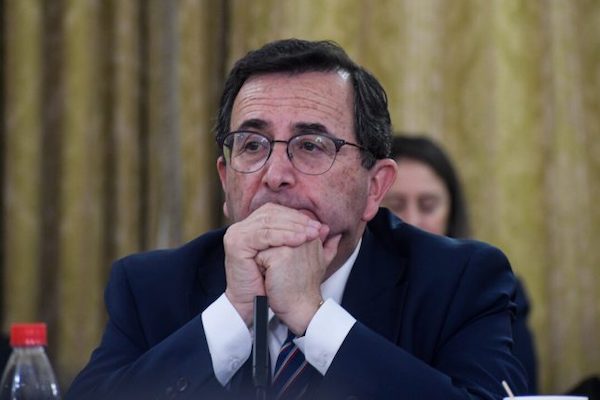
Doctor in American Studies, Head of Security and Defense Studies at Athenalab, and former Chief of Staff of the Chilean Army, John Griffiths discusses the legislative debate that arose after the murder of three police officers in Cañete, the role that should be assigned to the Armed Forces in this scenario, and the extreme violence threatening the country. “If the rule of law is not enforced, we will not solve the problem even with NASA engineers,” he says.
-In El Mercurio, a group of high-ranking retired generals and admirals stated that what is being discussed regarding security is useless because, fundamentally, there are no judicial guarantees for uniformed personnel.
-The first thing to clarify is the nature of the phenomenon you are going to face. To confront terrorism, the rules of the use of force (RUF) are of little utility.
-Why?
-Because the RUF are designed to address normalcy. The origin of these rules lies in the agreements of 1979 and 1990, under the auspices of the United Nations. What happens now is that we are facing a situation of exceptionality. And that means a different legal and force threshold.
-What kind of guarantees should a law of this type have?
-You do not need a law. You need the political will to deploy the Armed Forces to do what they need to do. However, this must be under a different legal threshold, because it is not acceptable for them to end up prosecuted by peacetime and normality courts.
We have managed to reduce the possibilities of legitimate defense! Let’s not deceive ourselves. What must exist here is the rule of law and the necessary powers for the force to do what it must do.
-Are some powers in the law but not used?
-You can operate with what is provided. What I cannot do is lower the threshold of legitimate defense. If you are in a procedure and strange forces start shooting at you, you will understand that at that moment, the legitimate right of defense of the police or military forces must prevail.
-Has the threshold of legitimate defense been lowered?
-Logically. We have uniformed personnel who are being prosecuted or imprisoned. Note that international provisions, even when the Armed Forces are on Peacekeeping Operations, authorize the use of lethal weapons in the face of any aggression that poses a serious injury or endangers their physical integrity. Period.
In contrast, we have made a series of provisions that ultimately do not work. When facing criminal or terrorist organizations, should we negotiate with the terrorists attacking us? Are you going to fire blank shots first?
It is ridiculous. Let’s not over-theorize the use of force, because the reality is completely different: when you are on the ground and facing such an attack, what must prevail there is legitimate defense, and the force must be backed by political power. And if any excess occurs, that is what military justice is for.
-Would a state of emergency also not make much sense?
-If you want to establish a state of emergency without granting powers to the police or military force, we will have more of the same.
-Another point that has been discussed is that the Armed Forces were not trained to face the civilian population. Is that true?
-They are not equipped for that. When you have a constitutional state of exception, it is because the President of the Republic, with the agreement of Congress, determines that there is a threat to the rule of law. In other words, you have an exceptional situation. Every democracy understands that when the Armed Forces are deployed on the streets, they come with all their deterrent power.
-With the capacity to kill?
-But it is not about going out on the streets without respecting the norms of law. The Armed Forces need legitimacy for the use of force, with lethal weapons, and not to be subjected to peacetime courts afterward. Or are we going to pretend that all soldiers go out with smoke bombs? Or with tear gas and police equipment? No. Because if that were the solution, then let’s have more police and save ourselves the trouble.
-What do you think of the anti-terrorism law being discussed in Congress?
-We are not creating the right laws to be useful against terrorism. The United Nations establishes three things to define it: it is evidently a violent act, carried out by organizations that are evidently non-state, with the aim of harming innocent civilians and causing terror for political purposes. The problem is that we are filled with euphemisms, like rural violence, what is that? We have become accustomed to changing the names of things.
-In their letter, the retired uniformed personnel criticize the statements of President Boric’s government. Do you think there is a lot of talk and little action?
-Beautiful words, prose, and poetry have little place here. What is needed is action. The best levels of security are achieved when force is used legitimately, efficiently, but with political will.
-There are still not many data, but what impression does the murder of the three police officers in Cañete leave you?
-There are many hypotheses on the table. I do not want to speculate, but three police officers were executed. They were shot in the face and chest. Then they were burned. And their bodies were transported to a place where they were left with the truck completely burned. If that is not terrorism, I do not know what is. Is it violence? Yes. Is it carried out for political purposes? Yes. Is it intended to instill terror? Yes. If that is not terrorism, I do not know how to classify it. Institutions should not only be given responsibility; they must also be given powers. Without powers, you cannot have responsibility.
-Could all these powers that the Armed Forces could have solve the conflict in La Araucanía?
-Let’s see, this is a political problem that must be addressed with all the instruments of power. The political government is the first. Second, you have police elements. Third, you have military elements. The important thing is to combine all the instruments you have at your disposal in an effective strategy. The military is not a magic bullet that will solve the problem.
If you are going to use the military, you must use them surgically for specific objectives that the strategy must determine. Those magic solutions, those who assure that in a week we will have this issue resolved, are not effective because force must be used in a legal context.
It is not about barging in like an elephant in a china shop. It is about using force in the context of a strategy and with all instruments of power. One of the most important instruments of power is justice. If there is no firm and decisive effort from the justice system to pursue these criminals, we will not be able to do anything either.
-It is said that the commanders themselves told the President that a state of emergency was not appropriate. On the other hand, it is also criticized that Boric has not had the leadership to convince about a line.
-It is not about leadership. Do we want to capture the leaders of these criminal and violent organizations? Well, we must start by identifying them. Then capture them and bring them to trial.
I do not know of a force more powerful, even more than police or military force, than the force of the rule of law. If the force of the rule of law does not exist, we will not solve the problem even with NASA engineers.
SOURCE: Ex-Ante