Mandatory Military Service
This article was translated automatically and may contain differences from the original. For reference, read the original.
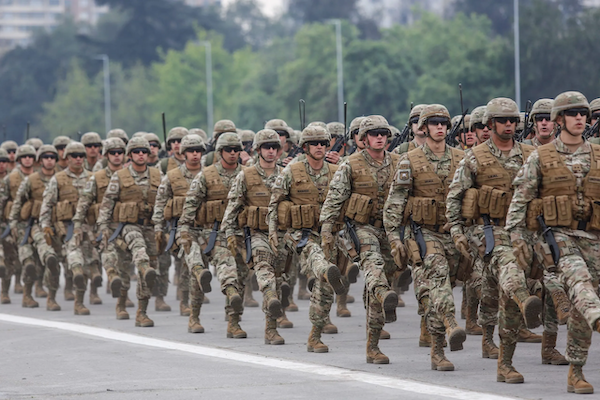
EL Líbero, May 8, 2024
The Army needs soldiers, despite being a more technological force today and less reliant on manpower than in the past. It still requires soldiers, among other reasons, because the current situation in Chile has them permanently deployed at the borders with Peru and Bolivia, and in the Southern Macrozone.
On Saturday, April 27, 2024, conscript soldier Franco Vargas passed away. My sincerest condolences to his mother Romy, family, and friends.
On the same day that Carabineros non-commissioned officers Cisterna, Arévalo, and Vidal were murdered, conscript soldier Franco Vargas also died. The causes and circumstances of his death are still under investigation, as are the events that occurred during the march that 245 conscripts were conducting in the highlands as part of their initial training in the Chilean Army.
For now, we know that 114 requested to be discharged from military service, that the Army’s commander in chief relieved two of the responsible officers from their commands, that there are inquiries and judicial investigations, and that as this column is being written, two conscript soldiers remain hospitalized.
Putre is not Antuco and I am sure that lessons will be learned from what happened. Justice will be served, an investigation will take place, and at the end of the day, we will have a better Chilean Army, the same one that Chileans want to see on the streets addressing public security issues. We cannot bring soldier Vargas back to life, but the least we can do for him, his mother, family, and friends is to ensure that his death is not in vain. Young people aged 19 are not in surplus in Chile.
Cases like this bring the issue of mandatory military service back to the forefront and raise the question of its necessity. What is the purpose of Mandatory Military Service? That is the question to answer, and if we manage to answer it correctly, we will understand whether it is something that should be maintained, changed, or modified.
The Chilean Army, and to a much lesser extent the Navy and Air Force, receive new generations of conscripts every year, who generally come to perform mandatory military service for a maximum of 24 months. Since the pandemic, it has become common to have two contingents serving simultaneously, which was not normal a few years ago.
This service is mainly performed by young people from low-income families, with shorter summer versions available for those who, prioritizing their university studies, also want to serve as soldiers of Chile and join the reserve with training.
Currently, an average of 5,000 conscripts enter each year, figures that are far from the numbers known in previous years when not only those who volunteered were called to service, but rather the number that the Chilean Army needed to maintain its readiness and capabilities, as well as the reserve that might be required in case of war.
In 2024, just over 6,000 conscripts entered, which, combined with those remaining from the previous contingent, brings the number of conscript soldiers to nearly 10,000. Each year, more women are entering, making this no longer an exclusively male activity.
This government and previous ones have preferred that mainly volunteers enter, despite knowing that this is not what the Army needs. The civilian world views military service as a training option for young people who have no other opportunities in life. Their period of military service includes courses and training in non-military subjects that have SENCE certification, which later serve for civilian life.
It is not that military service does not benefit the Army. It does, as long as they enter in the necessary quantities and for time periods that allow for the training programs that enable its various units to maintain and develop their combat capabilities, which are becoming increasingly complex due to the technologies involved.
Evidently, the Army would prefer to have a 100% professional force, but that comes with another cost, which is something that needs to be analyzed. Today, there is a professional cadre of officers and non-commissioned officers, complemented by professional soldiers and conscripts.
Professional soldiers are those who can serve in that capacity for up to 5 years, during which they can apply to non-commissioned officer or officer schools if they wish to continue a military career. Many in this group were once conscript soldiers. It started with considerable interest but has lost momentum due to low economic incentives, and because the private sector values them highly, a situation that the current security concerns have made even more pronounced than in the past. If we want professional soldiers, we will have to dig into our pockets and pay what they actually cost. With fewer than 2,000 currently, we are low in this category, which is perhaps the most effective.
The Army needs soldiers, despite being a more technological force today and less reliant on manpower than in the past. It still requires soldiers, among other reasons, because the current situation in Chile has them permanently deployed at the borders with Peru and Bolivia, and in the Southern Macrozone. It also needs them for the ongoing disaster situations that affect us, the forest brigades formed in the summers, and as it seems, for public security tasks, counterinsurgency, and border protection under the figure of military border police.
The question raised by the previous paragraph, which we must be able to answer, is how many soldiers we need and what characteristics they should have. Whether this can be achieved with conscript soldiers is something I have doubts about. Perhaps for forest brigades, but assigning tasks of public security, border protection in the high-altitude areas, or counterinsurgency to 18 or 19-year-olds who have just graduated from high school seems incorrect both for them and for the effectiveness of the work they would have to perform.
If the purpose of military service is to provide tools, discipline, and skills for life to young people from more disadvantaged families, it is not clear to me that the Chilean Army should be in charge of that function. If the goal is for the youth of Chile to love their homeland and their Army, then it should be for everyone and not just a few, it should encompass all social classes, as it is in Israel, and it should be mandatory as it is supposed to be legally, and if so, it should take on characteristics that make it compatible with technical and professional studies, something that young people aged 18 or older pursue at that stage of their lives.
In memory of conscript soldier Franco Vargas (RIP)
Richard Kouyoumdjian
Vice President AthenaLab
Source: El Líbero


