Military Courts: An Unresolved Trauma
This article was translated automatically and may contain differences from the original. For reference, read the original.
El Líbero, May 10, 2024
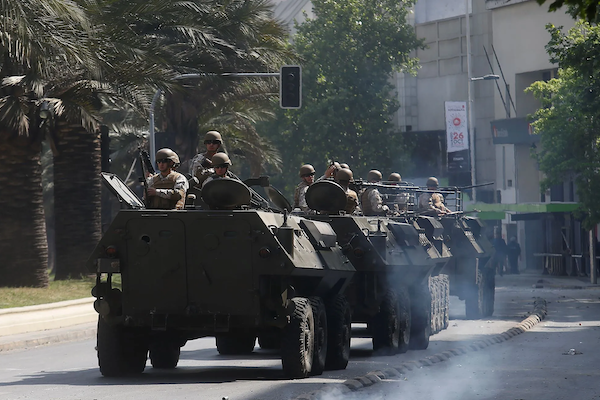
Against all odds, those who in 2019 called for the military to return to their barracks are now extending states of emergency and requesting the deployment of the Armed Forces to combat organized crime.
“In our government, there will be no military courts again,”said the President this week in light of the debate on the rules of the use of force. But why should we discuss this? Because against all odds, those who in 2019 called for the military to return to their barracks are now extending constitutional states of emergency that seem to have become normal and requesting the deployment of the Armed Forces to combat organized crime.
We are no longer debating whether it is right or wrong to deploy the military on national territory; now, the core of the problem relates to functions that go beyond defense.
There is no doubt, as expressed in the Constitution, that the Armed Forces can be deployed on national territory to fulfill functions different from their original ones. That is why states of emergency exist, but for them to be implemented, there must be guarantees and clear rules governing the actions of that exceptionalism.
We are not the only ones seeking to resort to the Armed Forces to address issues of security. Italy and Brazil have done so, and the type of justice does not seem to be a matter for debate.
In the European country, the military carry out protection and surveillance missions at certain points defined as critical, freeing up human resources from police agencies. In Brazil, we all witnessed the intervention in the State of Rio de Janeiro. And, in both Italy and the South American giant, military justice was responsible for what occurred during the operations. In the former, the military are subject to both civil and military justice depending on the norm violated; and in the latter, crimes committed by military personnel against civilians and vice versa, while the operation lasted, were judged by military justice.
Without trauma and with clarity, operations were regulated. With a clear final objective, the mentioned countries have sought to respond to the threat of organized crime. However, in Chile, when it is believed that the goal is clear, everything becomes blurred as the debate is colored by an ideological perspective, and while this prolongs discussions, the State loses valuable time.
No one says that discussions on this matter should be taken lightly; what is requested is that they be approached with a state vision, learning from the lessons that other countries have drawn. By knowing cases that have faced similar challenges and adapting the most promising actions for Chile.
It seems that the government is clear that the threat is organized crime. It has repeated this countless times; however, when it comes to debating which tool to use and how to use it, that same clarity does not exist. The pressure from one official sector becomes insurmountable when the other sector yields to it. And thus, what other countries do without trauma and with clarity, in Chile is approached with trauma and difficulty.
Pilar Lizana
Senior Researcher, AthenaLab
Source: El Líbero


