Perceptions on Foreign Policy and National Security
This article was translated automatically and may contain differences from the original. For reference, read the original.
El Mostrador, May 16, 2024
Employing the Armed Forces in ways that Chileans desire necessitates addressing the issue of Rules of Engagement and justice for military and police personnel.
The popular saying “data kills narrative,” particularly in the public discourse, does not apply to the annual survey conducted by AthenaLab, with the support of Ipsos. In the fifth iteration of this survey—which measures perceptions from both the general public and experts in Foreign Relations, National Security, Defense, and the Armed Forces, and includes a special section dedicated to Argentina in light of the 40th anniversary of the Treaty of Peace and Friendship with that country—it indicates that the primary objectives of foreign policy should be combating drug trafficking, protecting borders, and regulating immigration.
Far behind are integration with Latin America, promoting democracy, and human rights in other countries, issues that are priorities for our Foreign Ministry and the government of President Boric. However, and perhaps due to circumstances and current events, these are not the main concerns of Chileans and those engaged in international relations (for more details, I recommend viewing the 2024 survey, at this link).
This survey, with its five years of existence, has the advantage of documenting how Chilean concerns have not significantly changed in these areas. What worried Chileans at the beginning of 2020 are essentially the same priorities in 2024, except for combating climate change, an important issue that has lost prominence in the Chilean mindset over the years, which should be a concern for authorities, especially the current ones.
In 2020, the world of experts was misaligned with the general public. Priorities were focused on projecting towards the Asia-Pacific, defending maritime interests, and promoting free trade with other countries (to see what we thought five years ago, it is recommended to read the 2020 survey).
Another noteworthy aspect, among many that are novel, is the issue of model countries for Chileans, who rank the United States first, followed by Canada, with a tie for third place between China, Australia, and Germany. In contrast, experts rank New Zealand first, followed by Australia and Canada. China’s position in third place will leave experts pondering for a while and is likely a surprise for its own embassy, as it is also highlighted when Chileans view it as a partner country, where China ranks second after the United States, again showing differences with the specialized world, which places China in sixth place.
It is also worth noting that Chileans view Peru and Bolivia as competitors and are neutral towards Argentina, a sentiment that experts also agree with. This is a matter for the Foreign Ministry and its focus on Latin America, which does not preclude the need to be good neighbors, but clearly the common sense of the public and those engaged in international issues suggests otherwise.
When we turn to the National Security section, we see that the previous themes are repeated, except that for the general public, pandemics occupy the third place, while for experts, it is cyberattacks. The porosity of borders has grown the most since 2020 in both segments, yet it is an area where actions have only recently been taken more forcefully.
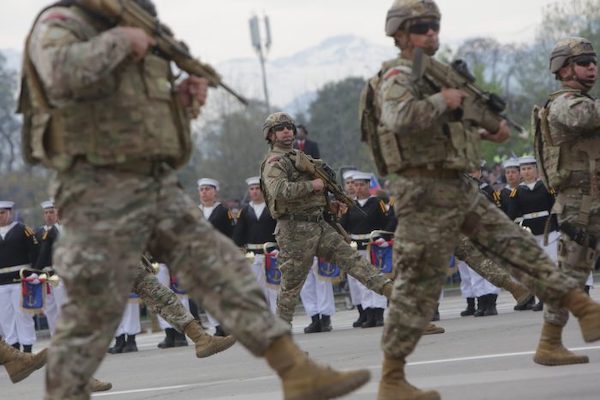
In the section on the Armed Forces, the public wants to see them engaged in border surveillance and protection, combating drug trafficking, and defending sovereignty. Support for the police ranks sixth, and protection of critical infrastructure is in ninth place. Experts, on the other hand, have a more traditional view, as the defense of sovereignty ranks first.
Border protection coincides in second place with the general public, but combating drug trafficking is the lowest priority, which is striking and should raise many questions. Experts also do not assign a very high priority to the issue of protecting critical infrastructure.
It appears that the government’s security agenda aligns with what non-experts want, but is very misaligned with the expert perspective. In any case, this survey should be essential reading for the Ministries of the Interior and Public Security, as well as for the Ministry of National Defense—which is currently reviewing the Defense Policy—and the Defense Committees of the Chamber of Deputies and the Senate.
The Armed Forces we have are more aligned with the priorities established by experts. Adjusting to what the public desires is significant, especially for an Army that still has a high dependence on conscript soldiers, given that the type of services required by the average Chilean is not something that a conscript with only a few months of training can adequately address. Employing the Armed Forces in ways that Chileans want necessitates addressing the issue of Rules of Engagement and justice for military and police personnel.
In conclusion, the section on Argentina, conducted with the same methodology as the Chilean part, conveys a similar message regarding concerns from both the general public and Argentine specialists. Drug trafficking and borders are their major issues, confirming that what we are experiencing is more of a regional phenomenon than something local and specific to each country.
Richard Kouyoumdjian
Vice President, AthenaLab
Source: El Mostrador