Requirements for the Use of Force: Military Prisoners and Justice for Military Personnel - The Case of Chile
This article was translated automatically and may contain differences from the original. For reference, read the original.
Pucará Defensa, July 29, 2024
While this column is framed within the current situation in Chile, it also applies to what is happening today in Argentina, where the use of the Armed Forces for internal security is being considered, while a significant number of military personnel have been in preventive detention for years, without conviction, in clear violation of due process and the National Constitution.

Who will sacrifice themselves for Chile if the State of Chile does not provide them with guarantees of due process, legally protects them when ordering them to act, and assumes responsibility for the orders given?
Perhaps the political world does not grasp the importance of the issue concerning military personnel and police officers imprisoned for human rights violations during the military government, nor the cases affecting those who have been brought to trial, and in some cases already convicted for events that occurred during what is known as the “social outbreak” or as a result of the deployments of the Armed Forces under the states of exception declared since the last quarter of 2019.
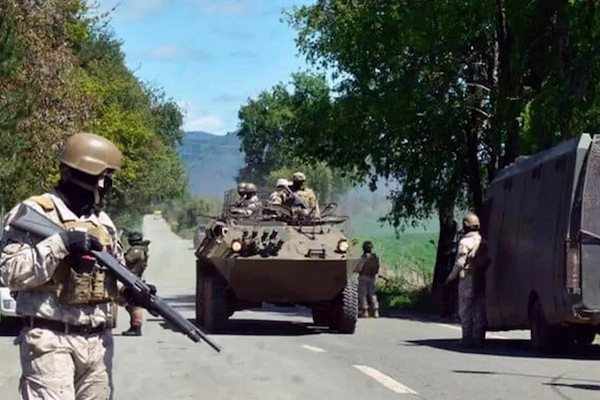
The issue is significant not only due to the serious injustices and human rights violations committed against elderly former military personnel and the lack of due process, but also because it conditions the future actions of the Armed Forces in case they are required to support the police in combating organized crime, which could eventually occur under constitutional states of emergency or siege, or under a revised critical infrastructure initiative (not the current one) more focused on supporting the Armed Forces to assist the police rather than protecting something that is not at risk.
The current Armed Forces observe what happens to their predecessors, whether due to actions taken during the military government or more recently when they have had to intervene in public order, border security, or due to the insurgency present in several provinces of the Biobío region or La Araucanía.
The treatment of past military personnel in the Punta Peuco and particularly in Colina 1 prisons is not appropriate for the age of those imprisoned or the health conditions they are in. I do not know if this is the responsibility of the Minister of Justice and Human Rights, or a failure attributable to Gendarmería. They are clearly individuals who, in the eyes of the government and the courts, do not have human rights, which becomes even more incomprehensible for them, their families, friends, and comrades considering that they were often convicted through judicial processes rife with a lack of due process, simply for having been military personnel and for following orders.
We are talking about individuals in their third or fourth age, who at that time were mostly junior officers, non-commissioned officers, classes, and conscripted soldiers. They are mostly military personnel, with a few sailors and police officers accompanying them. They were not the decision-makers, and in many cases, they are spending their last years in prison simply for having been part of the Armed Forces during the 1973 period. For them, the left applies the principle of no forgiveness and no forgetting; they have no human rights, and they are treated worse than the most despicable individuals on earth.
There are still open cases, which were reopened during Piñera’s first term, involving at least 67 individuals convicted in the first instance by the visiting minister Álvaro Mesa. They add to those already imprisoned for similar cases, but perhaps if logic prevails and the green shoots that are beginning to appear in the courts continue, they will not end up in prison and may share the fate of General Cheyre, another extremely unjust case, especially given his position as the commander-in-chief of the “never again,” in a case that no one understands and that makes no sense to anyone.
I do not know if the left, Congress, and politicians in general are aware of the effect they have on the current Armed Forces regarding the “payment of Chile,” and how this can affect the expectations placed on them should their use become necessary in complex environments. It is clear that in the world of retirees and the military family, this situation does not go unnoticed, generating frustration, anger, and perhaps even hatred. It is never good to overstrain things; the risks of doing so are very high, and when this happens in Chile, things do not end well.
Clearly, the situation of the Punta Peuco, Colina 1, and other prisons where military personnel from the past are held is a political issue. Leaving it solely in the hands of the courts or the judicial system is not a good idea, nor is failing to resolve the problem. Its non-resolution or the failure to apply minimum standards of humanity and human rights for these prisoners amounts to an act of vengeance, an eye for an eye, something that lacks basic decency and justice.

Members of the Armed Forces and Carabineros also observe the actions of the judicial system and the Public Ministry in cases arising from the times they have had to act under states of exception or to restore public order. It is applauded that justice was served in the case of Corporal Zamora, there is hope for what may happen with the pending trial for Commander Crespo and Corporal IM Seguel, and there is concern for cases like that of Soldier Robledo and the other members of the patrol that had to act in La Serena on October 19, 2019.
For many, the use of the Armed Forces in support of the police to combat organized crime is something that is already assumed as necessary and accepted by public opinion. For that use to be effective and not a waste of time, two basic conditions must be met: 1) Cross-party political support, which must be recorded as an agreement in which all political parties participate, as well as the various branches of government and autonomous entities such as the INDH and the Public Ministry, and 2) The rules for the use of force (RUF) must be easy and quick to implement, without the need, as General Bassaletti said in El Mercurio on Sunday, to request permission before acting.
It is clear that no one is above the law, but that said, the left must overcome its complex regarding the use of state force and having intelligence services with operational capabilities. The current reality does not allow for more, but it does require that addressing the reality of military prisoners from the past be a enabling condition for the use of the Armed Forces, that the current open trials follow the path of the case of Corporal Zamora, that the errors made with the soldiers in La Serena be corrected, and that someone oversee what Judge Álvaro Mesa Latorre is doing in Temuco, since if he sends the 67 he has convicted to prison, it becomes difficult for the current Armed Forces, regardless of whether there are perfectly desired RUF and cross-party support for their use, to be an effective resource in combating organized crime.
Who will sacrifice themselves for Chile if the State of Chile does not provide them with guarantees of due process, legally protects them when ordering them to act, and assumes responsibility for the orders given? Is President Boric ready to assume responsibility for the orders he will give to the Armed Forces?
In memory of the military personnel of the past, the present, and the future.
Richard Kouyoumdjian
Vice President AthenaLab
Source: Pucará Defensa


