COLUMN | Elections 2025/2026: South America Towards a New Normal
This article was translated automatically and may contain differences from the original. For reference, read the original.
- por Juan Pablo Toro
- Columnas
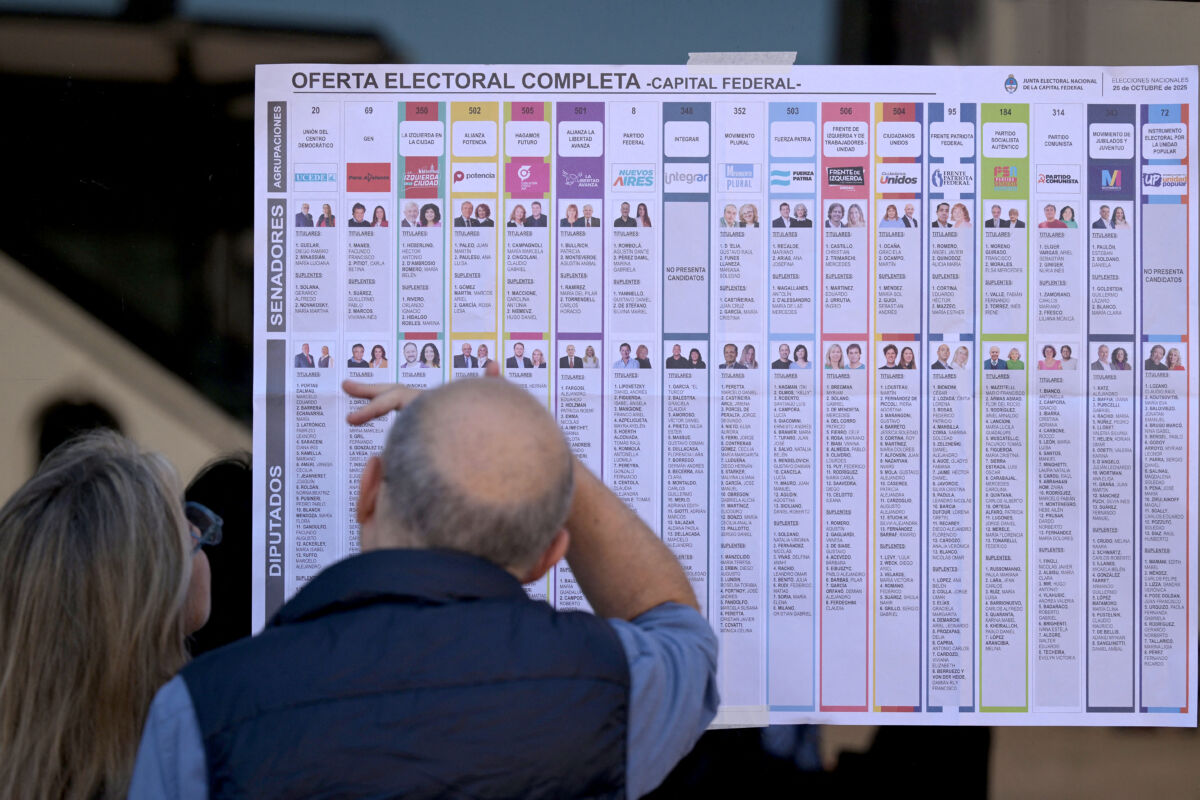
Elecciones legislativas en Argentina (France Presse)
In the region, there is a demand for peaceful streets, an economy that generates jobs, and a functional state; not an omnipresent one. There is something exceedingly dull about all this, or normal, if you will, which is not entirely bad. But it is not easy either.
Every so often, a series of elections in South America coincide, which, depending on their outcomes, lead to assertions that the region has shifted to the right or the left. The different causes that bring forces to power and their unique characteristics do not matter. It will always be easier and more appealing to paint the map red or blue.
The recent results in Bolivia and Argentina are already being interpreted within a broader framework, and likely, those from Chile (November and December) and the presidential elections in Peru (April and June), Colombia (May and June), and Brazil (October) next year will be as well.
However, a more careful examination should not focus so much on the direction of the winds, but rather on their origin, to explain the political change that is already beginning to manifest and, according to polls, will continue in societies that share acute polarization, fragmented party systems, stagnant economies, and public security crises.
It seems that after transformational attempts, exhaustion of statist models, and the election of outsiders, South America is finally betting on regaining a certain “normality,” that is, on a politics that focuses on solving practical aspects of people’s lives and is not an identity quagmire.
What the “centrist” Rodrigo Paz offered in Bolivia was unity, a return to growth, a functional democracy, and liberation from ideological ties that bound the country to Venezuela and Russia. Nothing could be further from the plurinationality of Evo Morales, nothing could be more necessary.
Last Sunday, Argentines validated in the legislative elections the classic neoliberal adjustment policies promoted by the libertarian Javier Milei, despite the fact that for them these have an experimental character, given how impermeable the country has been to such recipes since the “Corralito” of 2001. But shouldn’t it be “normal” for inflation not to be in triple digits and for foreign investors to be attracted by Argentina’s vast resources? At least, for a well-managed economy, it should be.
There also seems to be a demand for a more subdued politics, contrary to the flourishes advocated by the “redeemers” —as historian Enrique Krauze termed them— whether they were a young deputy with foundational ambitions, a rural teacher imbued with archaeological communism, or a former guerrilla who has done more damage to the image of the state from the presidency than while wielding arms.
With all the differences that exist between Chile, Colombia, and Peru —which has had eight presidents in the last 10 years— polls indicate that voters demand that the government at least return to providing security, one of its minimal tasks. Nothing could be more “normal” than going out and returning home without having to adopt all kinds of preventive measures.
Brazil is a separate case, as Lula da Silva has stated that at 80 years old, he is seeking a fourth term, thus perpetuating the idea that he represents the institutional normality that the country requires, something that even Jair Bolsonaro’s supporters validated by attempting to seize state powers. Better someone known than someone unknown, seems to be the motto.
More than the ideological expansion of one sector over another, there is today a profound demand in the region for such mundane issues as peaceful streets, an economy that generates jobs, and a functional state; not an omnipresent one. There is something exceedingly dull about all this, or normal, if you will, which is not entirely bad. But it is not easy either.
Juan Pablo Toro, Executive Director of AthenaLab
El Mercurio, November 1, 2025