JAMES R. CLAPPER, former Director of U.S. Intelligence: "Today we are safer than before 9/11, but not necessarily secure."
This article was translated automatically and may contain differences from the original. For reference, read the original.
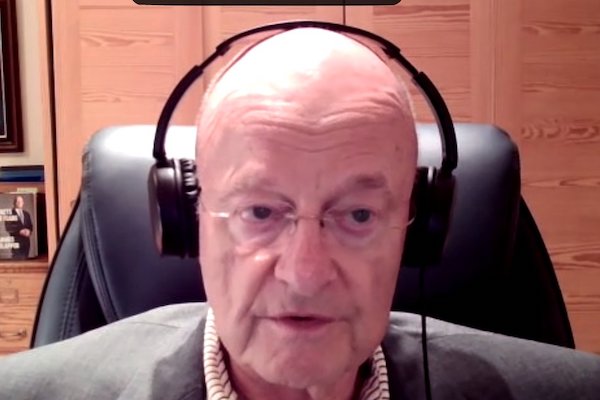
“The goal of intelligence is to reduce uncertainty for decision-makers, whether they are in the White House or in a trench.” This is how retired General James R. Clapper, former Director of National Intelligence (DNI) of the United States, began the conversation he held on Thursday with AthenaLab and the Global Center at Columbia University, regarding the twentieth anniversary of the terrorist attacks on September 11, 2001.
Whoever was in charge of Intelligence during President Barack Obama’s administration from 2010 to 2017 shared his experience over decades dedicated to that discipline. For example, he recalled that one of the main challenges for those working in the field is to always distinguish what they know from what they think or believe.
In this regard, he warned that it is very important to understand that there are secrets, which are pieces of information that can be known, and mysteries, which cannot be known. He also emphasized the difference between the capabilities and intentions of adversaries.
Clapper then proceeded to enumerate a series of state, transnational, and domestic challenges facing his country that will impact the coming years:
AFGHANISTAN
“I believe President Joe Biden made the right decision regarding Afghanistan, but it was poorly executed. There was no elegant way to do it, but there were ways to withdraw with more grace or efficiency.”
“A constant failure we have had is our inability to determine the will to fight in our allies. In Afghanistan, we overestimated the willingness of Afghan military forces to fight, in which we invested a fortune.”
“In contrast, the Taliban has an ideology—like their main motivation—that one may detest, but they have it.”
Clapper believes that Afghanistan will again become a sanctuary for terrorist groups like Al Qaeda, which may reemerge. Furthermore, he estimated that the presence of the Taliban and ISIS-K will create very interesting dynamics.
PAKISTAN
“The wild cards now are the neighboring countries, like Pakistan. Will Pakistan share intelligence with us? I don’t know.” He highlights its strategic ambiguity.
9/11 ATTACKS
“As a result of September 11, 2001, the issue of terrorism generated greater exchange with foreign partners, which continues to this day. The result is that we are safer, but not necessarily secure.”
“September 11 was another intelligence failure, and what came out of it was the Intelligence Reform and Terrorism Prevention Act of 2004, which reorganized the intelligence community, creating the position of Director of National Intelligence,” as the main coordinator of all U.S. intelligence agencies.
According to Clapper, the fact that an attack of the magnitude of 9/11 has not been repeated is not due to luck, but to the constant work of intelligence. He also recalled when he was in the Situation Room at the moment U.S. Navy SEALs executed Al Qaeda leader Osama bin Laden in May 2011, after a decade of pursuit. He described that moment as a success.
RUSSIA
“President Vladimir Putin is a throwback to the Tsarist era, more than to the Soviet era. He has a vision of the Russian Empire. But Russia is in decline (demographically, for example), which is not the case with China. China is on the rise.”
CHINA
“Dealing with China is even more complex; it won’t be long before it surpasses the United States in economic size, and its military buildup is frightening.”
NORTH KOREA
“The North Koreans are not going to denuclearize. I see no circumstances under which that will happen. The paranoia is palpable.”
CYBERSECURITY
“Cyberspace is not a threat; it is the behavior of the actors within it, whether they are nation-states or individuals. We need enforceable international norms. Until then, it will be like the ‘Wild West.'”
CLIMATE CHANGE AND PANDEMICS
Clapper described climate change as a “challenge for humanity” and asserted that the coronavirus (COVID-19) will not be the last pandemic. He also linked both phenomena, as climate can change the environment and, therefore, the behavior of agents that spread infectious diseases.
DOMESTIC EXTREMISM
“Violent domestic extremism is a serious problem. We saw an example of this on January 6, during the attack on the U.S. Capitol.” Clapper recommended providing more resources and increasing the staffing of the Federal Bureau of Investigation (FBI), as well as reforming laws that penalize extremism.
DECAY OF TRUTH
Clapper warned about the “decay of truth,” citing a report from the RAND Corporation About Truth Decay | RAND, which analyzed how the growing disagreement over facts and the predominance of opinions erode political dialogue, generate paralysis, and increase uncertainty in American society.


