INTERVIEW | From Copper Theft to Ransomware: Chile's Criminal Challenges Are Increasing
This article was translated automatically and may contain differences from the original. For reference, read the original.
From Copper Theft to Ransomware – Chile’s Criminal Challenges Begin to Mount
InSight Crime, June 1, 2022
A new report by Chilean think tank AthenaLab has revealed Chile’s expanding range of criminal threats, from copper theft and illegal fishing to cybercrime and weapons trafficking.
Chile’s reputation as Latin America’s “golden child” remains intact. In comparison to its neighbors, the country’s homicide rate remains low. It consistently outperforms European countries in international corruption rankings. And its gross domestic product (GDP) per capita is among the highest in the region.
Yet concerns about criminality are growing. Homicides saw a troubling increase in 2020, while gang violence and drug trafficking are on the rise. Chile’s natural wealth, from copper to fisheries, is being exploited. In its new report, “Illegal Economies – Factors Facilitating Organized Crime in Chile,” AthenaLab reviews this series of threats facing the country and examines potential solutions.
InSight Crime spoke with lead researcher Pilar Lizana to discuss its findings.
InSight Crime (IC): Copper theft appears to be an overlooked criminal economy in Chile. Has it been a priority for the government?
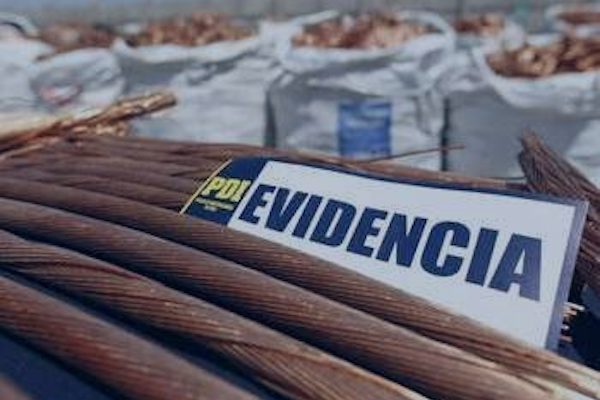
Pilar Lizana (PL): We are currently studying this specific issue. During our research, we have observed organized criminal groups operating in the illegal copper economy, stealing everything from cables and minor components to concentrates and copper cathodes. This copper theft has an international dimension: large seizures at national ports indicate that the stolen goods are exported to Asia, primarily to China.
There is less media coverage of copper theft compared to other criminal activities in Chile. However, specialized journals do report on it. An additional factor affecting coverage of copper theft is the presence of other criminal economies in the country, which exhibit higher levels of violence, such as timber theft or micro-trafficking.
In terms of government priorities, it is important to note that we have legislation that criminalizes the theft and receipt of stolen copper cables. The country’s investigative police have specialized teams dedicated to investigating this crime, and the affected companies collaborate with government agencies to assist in prosecuting criminals. Both private and public companies are victims of this criminal economy. Mining, electrical, and telecommunications companies suffer from theft or from cables being cut. The state mining company, Codelco, has experienced significant quantities of copper concentrate being stolen.
The illegal copper economy presents a major challenge for the State, and agency coordination is essential. However, we have already seen results from the coordination of the Attorney General’s Office, Customs, Internal Revenue Service, and police, starting in 2007, and with the Scrap Plan in 2011.
Copper theft is certainly less visible than other criminal economies in Chile, but it has a million-dollar impact on the national economy and on the country’s development. It directly affects mining companies and has consequences for communities, which are left without power when cables are cut or stolen.
SEE ALSO: Chile’s Microtrafficking Zero Program: Success or Failure?
IC: The report suggests that Chile’s institutions are not prepared to combat organized crime.Did the country’s reputation as a regional safe haven slow its response to crime? What steps does AthenaLab recommend to improve this?
PL: The surprise is not that organized crime has arrived in Chile. Sooner or later, this was going to happen, especially with Chile opening up and the undeniable effects of globalization. The challenge is preparing the country to confront this threat. The state either operates as a facilitator of crime or it does not.
The conditions in the country allow for crime. The strengths and weaknesses of institutions, social conflict following the 2019 protests, issues with violence in Macrozona Sur, the financial system, and the infrastructure that connects Chile all have an impact.
The government has promoted certain bills that would enhance its ability to combat organized crime, such as the Intelligence Law and the packages against organized crime that have been debated in Congress. However, there is still progress to be made regarding comprehensive strategies that address the phenomenon as a whole and that allow for the development of specific planning for each illegal activity.
Organized crime is relatively new for Chile. While drug trafficking has had an impact since the last century, the emergence of new crimes such as targeted killings and territorial control are phenomena that have taken the population by surprise and heightened the perception of insecurity. Despite having one of the lowest homicide rates in the region and being far from the complex realities in countries like Mexico, Colombia, or Jamaica, the perception of security has declined.
This situation compels our leaders to design strategies to confront this new reality. Because it was predictable that organized crime would arrive, the State’s response was delayed.
I believe that a national system against organized crime is necessary, built on a comprehensive vision and coordinated work involving various State sectors. Police officers are essential for combating this criminal phenomenon, but they are not the only ones.
The response to organized crime requires cooperation from different actors within security and health, and includes financial, educational, and judicial aspects. Therefore, an exercise in effective sovereignty across the country, educational campaigns for crime prevention and for the rehabilitation and reintegration of criminals, as well as fair punishments, would help us address this problem comprehensively, improving security, development, and the well-being of the population.
IC: There has been a recent influx of arms trafficking into Chile from Argentina. Where are these weapons crossing into Chile? Are gangs increasingly better armed, and what consequences have we seen from such arsenals?
PL: We are aware of arms shipments from Argentina, but there are also others that have entered from the north. The most observed trend is in blank-firing guns being modified for lethal ammunition. There are also modifications for semi-automatic weapons to be converted into automatic weapons. In that sense, the use of modified and unmodified weapons in street riots, as seen recently in the Meiggs neighborhood of Santiago, is of great concern. In Meiggs, a micro-trafficking street vendor allied with organized gangs and has begun to take territorial control of the area.
Criminal gangs are not afraid to use their firepower on public streets, and even to push back against the State, as evidenced during recent social unrest when police stations and police checkpoints were attacked.
However, the main consequences of trafficked weapons are felt by those already living in areas with higher rates of violence, where drug trafficking and organized crime have taken root. In the case of Macrozona Sur, firearms are also used by radicalized organizations.
SEE ALSO: Chile Increasingly Worried About Weapons Trafficking from Argentina
IC: AthenaLab has noted a steady decline in corruption in Chile, but the magnitude of cross-border criminal economies indicates that there is some degree of official involvement. What evidence exists of customs officials, police, and the government supporting or turning a blind eye to organized crime?
PL: The Corruption Perception Index places Chile in a privileged position compared to other countries. However, the Index shows that perceptions slightly declined between 2005 and 2020, opening the door for organized crime to exist. This has mainly been observed at the local government level, such as in the municipality of San Ramon.
This setback provided an opportunity for criminal groups to corrupt state agents and expand their operations. The theft of copper and its export to Asian markets would suggest some level of corruption, but I do not believe we can say that government officials are ‘helping’ organized crime, as is the case in other regions. There may be isolated instances, but it is not at the level of widespread corruption seen in other Latin American countries.
IC: Ransomware attacks are increasing across the region. How has Chile responded and how has it prepared to combat such attacks?
PL: We have experienced two significant cyberattacks in Chile; one on Banco de Chile and the other on Banco Estado. The cost was substantial for Banco de Chile, leading to strengthened cybersecurity measures.
There are now several regulations against cybercrime. Progress has been made in developing policies in this area. There is a National Cybersecurity Policy and a Cyberdefense Policy, which aim to promote inter-agency dialogue and coordination to counter cybercrime. Further progress is still needed.
IC: The consequences for Chile’s marine life from illegal fishing, including Chinese fleets and algae theft, have been significant. What actions are being taken?
PL: It is important to consider that both fish theft and unreported and unregulated fishing have a negative impact on Chile and result in millions of dollars in losses for the industry.
Both activities significantly affect an important production sector. Organized criminal organizations are involved, and their activities jeopardize the health of those who consume the poor-quality products, as well as the environment, due to indiscriminate exploitation. Illegal fishing also violates national sovereignty.
The Navy, through its maritime police, plays a crucial role in monitoring and protecting the ocean and its environment to combat illegal fishing. In cases of fish theft, the police, through their various units, investigate and prosecute criminals. The justice system is responsible for imposing sanctions.
As with copper, a specific investigation into fish theft is anticipated, which will provide more information.
Source: InsightCrime


