MEDIA | Head of Studies discusses military deployment at the northern border with various media outlets
This article was translated automatically and may contain differences from the original. For reference, read the original.
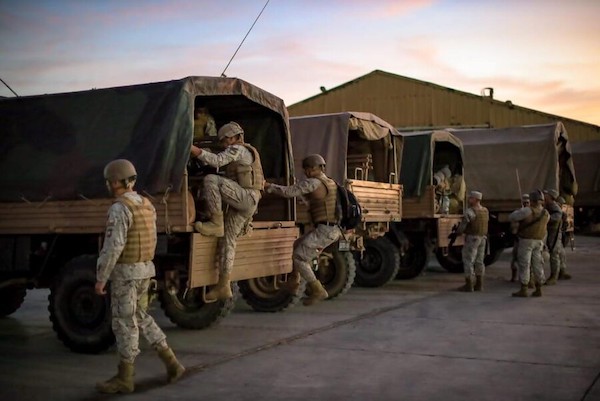
RADIO DUNA | John Griffiths on military deployment at the northern border: “It seems we are heading in the right direction, but we are far from having an effective strategy”
February 28, 2023. In Hablemos en Off, John Griffiths, Head of the Security and Defense Studies Area at AthenaLab, discusses the deployment of military personnel in the Northern Macrozone.
Listen to the full podcast below:
Source: Radio Duna
RADIO BIO BIO | John Griffiths on military deployment in the north: “There are armed individuals at the border, and that is the problem”

One year has passed since the Russian invasion of Ukraine, and the situation has progressively changed, but the question of how this conflict will end remains. What is evident is the strengthening of NATO and the gradual wear of the Russian army.
In a new edition of the Interview with Tomás Mosciatti, we spoke with retired General and former Chief of the Army General Staff, John Griffiths, who also provides a comprehensive analysis of the situation at the borders of the Northern Macrozone due to the migration crisis and the arrival of organized crime.
Role of the army in the North
“The concept that is essential for the use of military force is that we must always analyze the nature of the problem. If it is not a public order issue and is of a higher level due to the actions of organized crime and drug trafficking, then I must recognize that my problem is no longer one of public order,” he stated.
He added: “The Armed Forces are equipped, trained, and have the doctrine to use their weapons. Changing their constitutional mission in normal circumstances to public order and security functions is extremely complex if the corresponding powers are not granted.”
“The reality at the border is different; it is not just a migration issue but a much more complex security one. If migrants were the problem, a good law and effective border control, as done by countries in Europe, would suffice. The 189 kilometers with Peru are somewhat more controlled, while the 850 kilometers with Bolivia are not. They have tremendous permeability, and that is why criminal organizations are operating there,” he concluded.
Problems at the borders
“I have the document with the 7 steps, and I have read it; this is suitable for controlling a public order problem at Plaza Baquedano, not for a border where the possibility of using force against criminal organizations is high,” he expressed.
He insisted: “At the border with Bolivia, we have drug trafficking, criminal organizations, smuggling; there are armed individuals at the border, and that is the underlying problem. Military personnel will end up legally affected due to a misuse of force.
“The army can indeed assist in a military deployment at the borders, but the primary function must undoubtedly be executed by the forces we have, Carabineros and the investigative police,” he emphasized.
Check HERE for the full interview with Tomás Mosciatti on Bio Bio TV
February 24, 2023
LA SEGUNDA | Armed Forces in control of the border: Costs of an “invention” that will last
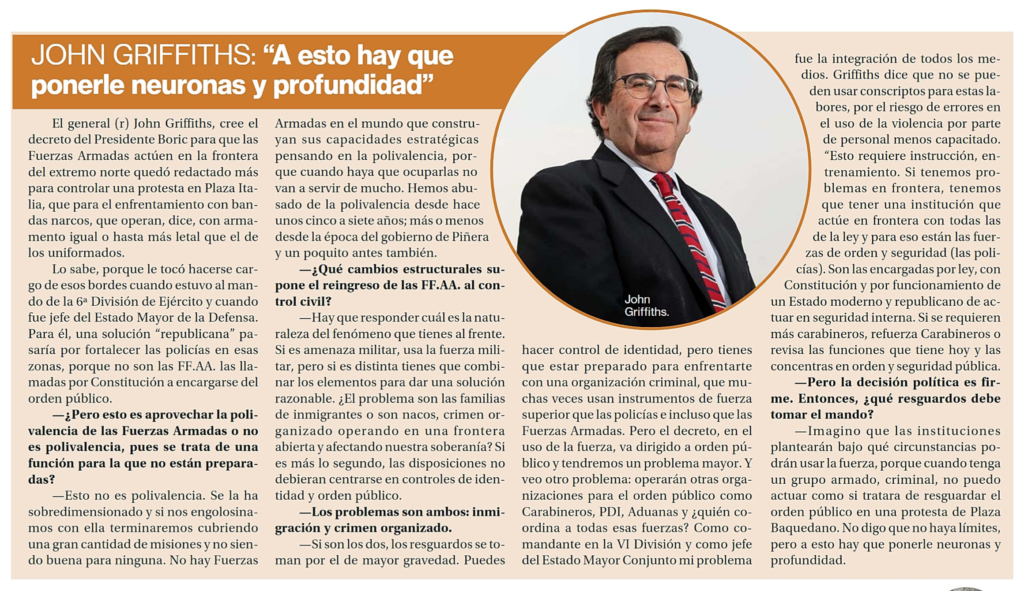
February 24, 2023


