INTERVIEW | Marcelo Masalleras speaks with Ex-Ante about the conflict in the Middle East
This article was translated automatically and may contain differences from the original. For reference, read the original.

Military analyst Marcelo Masalleras: “Israel does not have the strength to occupy Gaza for a long time”
Ex-Ante, October 12, 2023
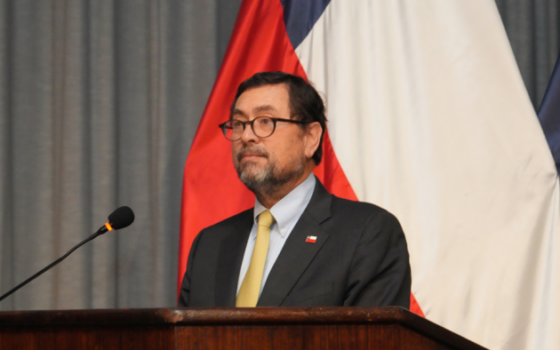
Marcelo Masalleras, senior researcher at AthenaLab, specializing in defense, security, and international relations, analyzes the challenges of an Israeli ground invasion of Gaza, Syria’s accusations of an Israeli attack on its airports, and the new scenario unfolding in the Middle East conflict. Masalleras is a retired colonel of the Army and a professor at the United States Military Academy at West Point and the Army War Academy of Chile. He holds a master’s degree in International Security from Georgetown University.
-What does Syria’s recent accusation of an Israeli attack on the airports of Damascus and Aleppo mean for the conflict in the Middle East?
-This is not a new strategy. Fundamentally, it is aimed at preempting and preventing the supply of equipment, especially weapons, flowing from Iran to Syria and Lebanon, where Hezbollah is located. Hezbollah has a significant number of fighters, apparently better trained than those of Hamas, in greater numbers, and they represent a permanent military threat to Israel. There have been reports of members of the Iranian armed forces in Syria in recent days, apparently deploying logistical flow. Therefore, it is neither new nor illogical to think that actions like this are part of Israel’s attempt to stop the reinforcement of armaments.
-Do you consider this predictable, then?
-I don’t know if predictable, but it is part of what Israel has done previously, just as it has been bombing Gaza, which it has done for years, and as it has targeted objectives in southern Lebanon, where Hezbollah forces are expected to be, it has also done so in Syrian territory. If there is Iranian involvement in the recent events, it is logical that Israel, within the operations to configure the scenario that allows it greater freedom of action and security in operations, would carry out this type of attacks.
-This attack, according to reports from international agencies, occurs a day before a visit that the Iranian foreign minister was to make to Damascus. Do you think what is happening could extend the conflict to other countries in the region?
-This is one of the major questions. Most international analyses foresee and visualize the significant risk that this new phase of the conflict between Israel and Hamas has the potential to extend to other states or affect processes such as the normalization of relations with other states. Saudi Arabia was already in a fairly advanced process of normalizing relations, as had been heard from both the crown prince and the Israeli prime minister, which was not well received by Iran, as it is a competitor within the Gulf. There is a strategic tension between both states. It is important to remember that there are much greater interests at stake than those of Hamas. Iran is a determining factor in what will happen from here on out.
-Is a war between Iran and Israel more or less inevitable in the future, as they are the true contenders?
-I would not dare to say something like that, but they are two states that are in conflict and that could eventually escalate the conflict to a more delicate situation. And Israel’s reaction regarding Iran is also something that may not happen in the short term, but in the medium and long term will have a lot of tension. They are competitors in religious terms. Iran does not accept the existence of the state of Israel and in fact finances the two main terrorist groups currently affecting Israel, Hezbollah and Hamas.
That they are in conflict and will eventually strike each other is feasible. But it should not be forgotten that Israel is presumed to be a nuclear power, the only one in the region, and Iran continues to pursue the possibility of becoming a nuclear power. Israel is always keeping an eye on Iran’s uranium enrichment capability, because once it achieves that capability, it will change the strategic balance in the region.
-In military terms, what do you expect from the conflict between Israel and Hamas in Gaza? How should this develop?
-It is extremely complex and in a small area of just over 360 square kilometers and densely populated. Therefore, any operation must consider that they will have to enter the city. A military operation that involves entering a locality is complex because it confuses the civilian population with the military. It is very difficult to distinguish between enemy and non-enemy. The infrastructure, obviously where the terrorists are protected, is also social infrastructure. One of the great potentials of Israel’s army is its armored units. Mobility and long-range combat, which is one of the capabilities of the armored units, is completely nullified in an urban area.
-How does this affect the decision to invade?
-Any incursion that is made, without a doubt, cannot remain for long, because Israel does not have the sufficient strength to completely occupy Gaza for an extended period. Second, it must be intense, but with the intention of achieving the objectives they seek, rescuing hostages, stopping and destroying the command and the entire upper structure of Hamas. Maintaining a presence will be a tremendous problem and will come at a high cost in civilian and military lives.
-When you say a high cost in civilian and military lives, what are we talking about?
-We are talking about the fact that combat or entering the cities is very complex for the military and they are easily victims of ambushes. Therefore, Israel’s ground forces will have significant attention. And the very combat will necessarily, inevitably, carry the lives of civilians in Palestine. Because those who turn civilians into military targets, in many cases, are the terrorists who use civilian infrastructure and turn it into a military target.
-The United States has mobilized its fleet to the area
-It is a message to Israel that it is supporting them. A concrete, visible message that is there to provide support. And secondly, it is also a message to other regional actors saying, look, do not get involved. This is a problem related to Hamas. In other words, it is also a message to other potential actors who might want to support or become involved in the conflict. And the United States, in this sense, I believe is sending a message of that nature.
-What other important issues need to be observed in this conflict?
-There will be much to analyze regarding intelligence, what happened and how Israel arrived at this point. Also, the ground offensive that is apparently going to happen, and one of the reasons why the offensive has not yet begun is the situation of Hezbollah in the north, at the border with Lebanon.
-Does Hezbollah have greater military capability than Hamas?
-Hezbollah is a terrorist group that has a significantly greater force than Hamas. It is estimated to have around 60,000 fighters, who have more training or experience and have received greater support in terms of equipment and weapons from Iran. There has already been exchanges between Hezbollah and Israel. They may have destroyed some targets in southern Lebanon and in Syria that are believed to be Hezbollah’s. But it will always be a threat. Dividing Israel’s force on two fronts is a necessary point for the terrorists, for Hamas and for Hezbollah.
Source: Ex-Ante