INTERVIEW | Members of AthenaLab consulted by El Mostrador on the RUF
This article was translated automatically and may contain differences from the original. For reference, read the original.
“Dissociates reality”: the criticism from former officials regarding the Government’s indication on the RUF
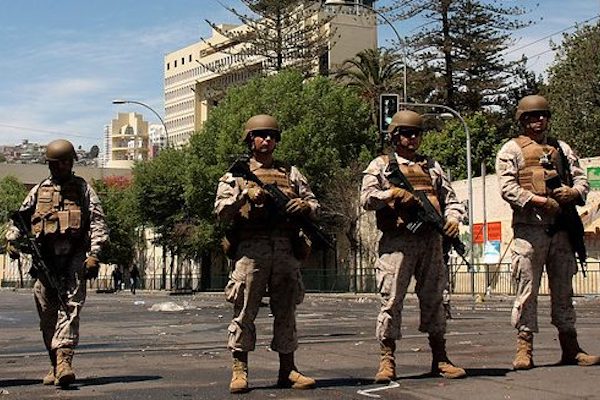
Corvette Captain (r) Richard Kouyoumdjian and General (r) John Griffiths agree on the importance of having a clear regulation on the use of force, but argue that the distinction proposed by La Moneda regarding gender and nationality does not reflect the reality on the streets.
The discussion of the bill aimed at regulating the Rules of the Use of Force (RUF) in the police and Armed Forces, in the context of public order control and the fight against crime, has not been without controversy.
An indication from the Executive has generated uncertainty among both the opposition and the ruling party. Specifically, the part that states that “the regulations governed in this article must consider specifications for a differentiated use of force in cases where there are children, women, sexual diversities, persons with disabilities, migrants, indigenous people, or older adults present.”
This provision led Interior Minister Carolina Tohá to explain the proposal. According to the Secretary of State, this indication is not new and, in fact, does not introduce anything novel compared to what was presented months ago. However, the criticisms have not only come from parliamentarians, but also from the military, who express concerns regarding the Government’s indication.
Former military officials spoke with El Mostrador on this issue and, while they agree on the need for a clear regulation, they argue that the differentiation proposed by La Moneda not only strays from the reality on the streets but also would be “over-theorizing” and “dissociating” the reality on the streets. They even point out that the indication undermines the effectiveness of the norm being implemented, in discordance with international standards.
Corvette Captain (r) Richard Kouyoumdjian, an expert in security, defense, and modern warfare, while disagreeing with the use of military forces for public security purposes, states that what the Government has presented is “impractical, completely detached from the reality experienced on the street, and ineffective for troops deployed in urban centers.”

Richard Kouyoumdjian, expert in security, defense, and modern warfare.
“I do not know what the Government was thinking when they sent it,” questions the defense expert, emphasizing that “the rules must be simple,” as requiring differentiated applications based on minorities or nationalities “is very difficult to apply.”
In Kouyoumdjian’s view, the final message is that forces are being placed on the street “without the capacity for action,” which in turn raises doubts about the debate on the Intelligence Law.
“The truth is that it is difficult to understand the Government, and this does not give me a good feeling regarding what they will send on intelligence,” he comments.
Theorizing beyond what is convenient
General (r) John Griffiths, former Chief of the Army General Staff and expert in National Security and Defense, agrees with Kouyoumdjian, stating that the Rules of the Use of Force must be “general norms” or “principles” that the military understands how to apply thoroughly.
He states that there are no known international precedents that restrict the legitimate right of units to defend their physical integrity as soldiers, carabineros, or police officers.
“Legitimate defense operates when a person is about to affect the physical integrity of a police officer or a soldier, and in which their own life or that of a comrade or innocent civilians is even at risk,” explains Griffiths. Therefore, he argues, “it does not matter if the person is English, from an Asian country, or from a South American country, or their condition is A, B, or C; that is not relevant, what matters is the person’s conduct.”
It is worth mentioning that, in defense of the Government’s indications, Minister Tohá pointed out that the disputed articles refer to the deterrent phase of the police. That is, the moment when the Law Enforcement Forces attempt to engage in dialogue with protesters before using their service weapons.
And General (r) Griffiths agrees with that. “If that migrant approaches to talk to you, there is no problem,” he states. However, he poses the question: “If they approach with a Molotov cocktail, what does it matter that they are a migrant?”
“I believe a tremendous mistake was made, because in these matters the Rules of the Use of Force are meant to sanction behaviors and not the origin condition of those who engage in a particular hostile or non-hostile act against the force,” Griffiths asserts.
Regarding the rest of the regulation, the National Security expert agrees, but believes that it has reached an exercise of “over-theory,” of “theorizing beyond what is convenient.”
In his opinion, it has been “over-theorized” to the point of taking the exercise to levels where distinctions are already being made about the person engaging in the conduct, when the fundamental point – in his view – is different. “The point is to sanction the conduct,” he emphasizes.

John Griffiths, former Army officer.
Griffiths is categorical; he is not in favor of irrational use of force, but calls for setting aside excessive theory and laxity. “To pretend that forces, when they are being shot at, will be able to distinguish regarding everything you are asked to do, forgive me, is a misunderstanding of reality, a dissociation from reality, a dissociation from how things happen,” he concludes.
According to the former military officer, this “dissociation from reality,” to the point of “extremizing” the issue, ultimately leads to the conclusion that “the norm being imposed will not be effective.”
He clarifies that military personnel receive training and know how to handle various situations, including warfare. However, in this case, he warns, if there are no clear rules and they are given the responsibility to intervene in urban centers, “their powers are being restricted.”
Clarifying the RUF, for the former officer, is very valuable to avoid “complex tragedies.”
In line with the statements from the former military officials, there is agreement among parliamentarians that the way to act with women and children must be different when controlling public order. However, there are doubts regarding whether migrants should be treated differently. These concerns come not only from the opposition but also from ruling party deputies who expressed their doubts about the possible implementation of this reform as presented by the Executive. Additionally, the right criticized the Government harshly and indicated that they would reject the indication as it stands.
As the regulation stands, according to Kouyoumdjian, “it will not pass through Congress.”
Source: El Mostrador


