INTERVIEW | How Russia's Military Strategy is Affected by Ukraine's "Web Operation"
This article was translated automatically and may contain differences from the original. For reference, read the original.
- by Marcelo Masalleras
- Interviews
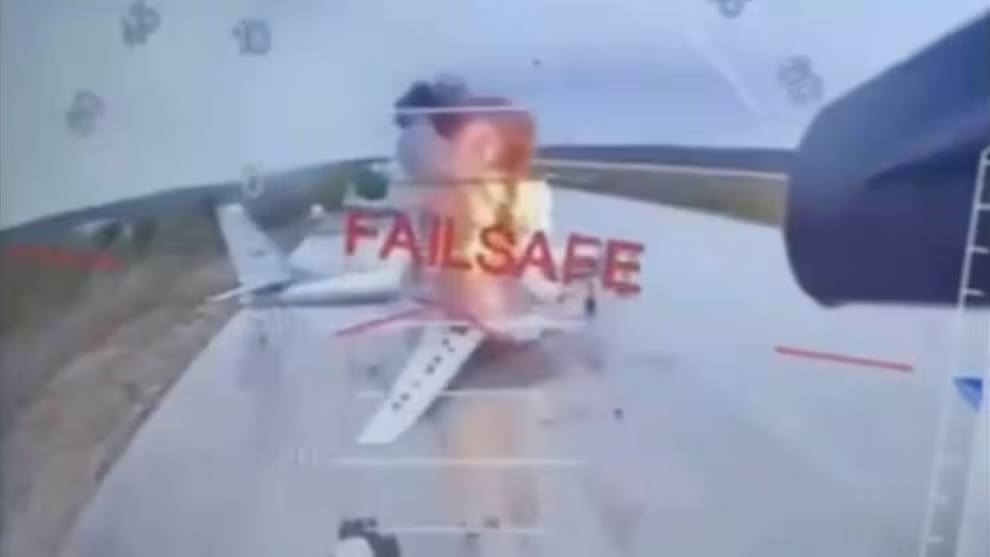
Ukraine claims that its attack with over a hundred drones targeted a total of 41 aircraft, including Tu-95, Tu-22, Tu-160, and A-50 models. Some of these planes have been used by Russian forces to bomb Ukrainian cities throughout the invasion.
Ukraine conducted an unprecedented attack against four air bases of Russia, where part of its fleet of strategic bombers was stationed.
The offensive on Sunday, June 1, was carried out with over a hundred drones, which were smuggled into Russian territory, inside wooden cabins mounted on the back of trucks.
From Kyiv, it was reported that a total of 117 drones targeted 41 military aircraft, of which “at least” 13 were destroyed.
Among the impacted aircraft were Tu-95, Tu-22, and Tu-160 models.
Repairing the damage could be complex, and in the case of total loss, they could not be replaced, as these models are not currently in production.
It has also been reported that at least one A-50 surveillance aircraft was hit or destroyed by the drones.
Ukrainian President Volodymyr Zelensky stated in a thread of posts on X that the so-called “Web Operation” caused “significant losses” at Russian airfields.
He specified that the preparation time for this “absolutely unique” offensive was a year and a half.
According to Zelensky, “34% of the strategic cruise missile carriers stationed at air bases were hit” by Ukrainian drones.
This figure corresponds to nearly a third of the Russian fleet of such aircraft, which have been used to attack Ukrainian cities throughout the war.
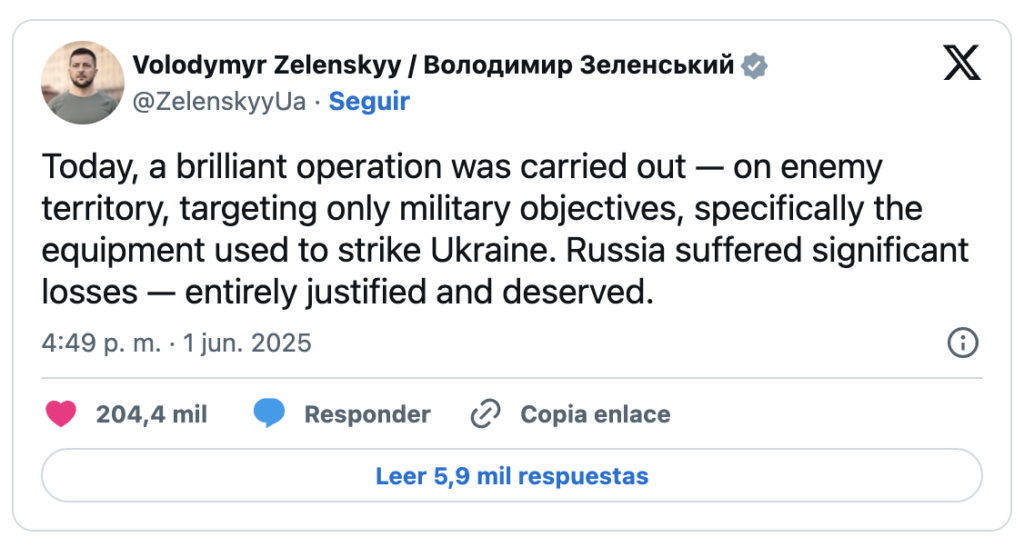
The Security Service of Ukraine (SBU) reported that the attacks caused estimated damages of $7 billion.
The offensive has been described as one of the most sophisticated and significant operations by Ukraine since Russia began its large-scale invasion of the country, on February 24, 2022.
It occurred amid a context in which Russian troops have intensified their attacks and a day before representatives from Kyiv and Moscow were set to meet in Istanbul for a new round of talks aimed at reaching a potential ceasefire.
The Russian Ministry of Defense stated that attacks were recorded in the regions of Murmansk, Irkutsk, Ivanovo, Ryazan, and Amur.
However, it claimed that its bombers only suffered damage in Murmansk and Irkutsk, and that in other locations the attacks were repelled.
For their part, SBU officials have stated that the attacked air bases included Belaya in Irkutsk (about 4,500 kilometers from the Ukrainian border), Diaguilevo in Ryazan (in western Russia, about 520 kilometers from Ukraine), Olenya (near Murmansk, in the Arctic Circle, over 2,000 kilometers from Ukraine), and Ivanovo (over 800 kilometers from Ukraine).
And although Moscow reported that some of those involved in the attacks were detained, Zelensky asserted that those who contributed to the success of the operation were “removed from Russian territory,” so they are “safe.”
Both sides have made claims that have yet to be verified.
The Ukrainian leader stated in a speech that the offensive not only aimed to reduce Russia’s capacity to bomb Ukrainian cities but also to increase pressure for Vladimir Putin’s government to accept an unconditional ceasefire. Previously, Zelensky had already accused the Kremlin of having no real intentions of stopping the conflict.
“It was the Russians who chose to continue the war, even under conditions where the whole world is calling for an end to the slaughter,” said the Ukrainian president after the attacks.
He continued:
“It is truly necessary to pressure Russia to return to reality” .How Ukraine’s “Web Operation” Affects Russia’s Military Strategy
The researcher from
AthenaLab and former officer of the Chilean Army, Marcelo Masalleras , toldLa Tercera that it was an operation “extraordinary in terms of preparation, coordination, and execution” by SBU personnel. He highlights that it was a surprise attack, where stealth was crucial for the drones to reach military bases located thousands of kilometers from the combat front.
He suggests that “Russia never considered a possibility like this” and that Ukraine likely took advantage of that situation.
Although the exact number of destroyed aircraft has not been verified, satellite images have revealed that at least more than a dozen suffered severe damage.

Some Russian bombers, such as the Tu-95 and Tu-22, have the capability to conduct nuclear strikes.
“
The importance of these aircraft lies in their ability to carry conventional payloads or nuclear warheads.. These planes have indeed been used in the war, but they are rather old weaponry. They were designed in the 1950s and 1960s, but they remain operational and have been employed in the conflict,” comments the specialist.“Therefore, the impact is that
everything that has been destroyed or severely damaged is very difficult to replace, because these aircraft are not being produced currently.” However, beyond the effectiveness and characteristics of the attack against Russian air bases, Masalleras anticipates that “we must be very cautious in evaluating the impact it will ultimately have on the war.”
According to the analysis of the AthenaLab researcher,
the consequences of the attack on Sunday could be limited, as “Russia will be able to continue attacking cities and facilities in Ukraine with missiles and drones” , as it has been doing throughout the conflict.However, he adds,
the attack also has symbolic effects that resonate in Moscow’s military efforts .“Obviously, there is an impact in Russia that goes beyond the war, because we are talking about strategic bombers capable of carrying nuclear payloads. Therefore, it also means a reduction in their arsenal or in the vectors that the country has.”
“Let us remember that when we talk about a nuclear power —such as Russia— everyone aims to have what is called a
nuclear triad .”This concept refers to a country’s ability to conduct nuclear strikes from land, air, and sea platforms.
“Russia has them. And, in that case,
if the effect was as massive as Ukraine claims, the impact is significant .”Despite the above, Masalleras presumes that the drone offensive in early June will not significantly change the way cities in Ukraine continue to be attacked, as
“the range of possibilities that Russia has remains broad” .Still, he suggests that the operation carried out on Sunday “will elevate Ukraine’s will to fight,” amid a war in which it has been constantly attacked by Russian troops.
“Without a doubt, this is a demonstration of the innovative capabilities and continued fighting spirit of the Ukrainian people (…)
There is a demonstration that Ukraine is willing to continue defending itself with or without the support of great powers. Its determination is undeniable,” concludes Masalleras. Two days after the drone offensive, during the early morning of Tuesday, June 3, Ukrainian forces used underwater explosives toattack
the bridge connecting Russia to the illegally annexed Crimean Peninsula by Russian troops in 2014. The head of the SBU, Vasyl Malyuk, who led the “Web Operation,” was responsible for overseeing this mission. After the attack on the bridge —the third since the start of Russia’s large-scale invasion— the military authority declared:
“The SBU always goes all the way and never repeats the same strategy”
.