DT12 | Armed Forces and the Military Profession: Clearing Myths
This article was translated automatically and may contain differences from the original. For reference, read the original.
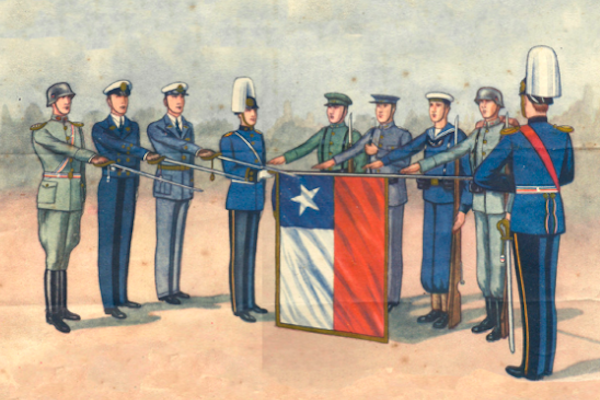
In the current polarized political landscape, some initiatives and ideas have emerged that aim to generate profound modifications in the Armed Forces, notably the unusual proposal to unify training schools and eliminate the distinction between officer and non-commissioned officer ranks.
- International experience shows that having a single rank structure in the armed forces is a condition not practiced in any of the countries in the South American region, nor in developed democracies. On the contrary, evidence indicates the necessity of having separate ranks and specialized institutes.
- The roles of officers and non-commissioned officers or sailors are equally important, though distinct. As in other professional areas of human activity, the presence of specialized professionals and technicians is required to perform different tasks as part of the division of labor, which necessitates independent ranks for officers and non-commissioned officers.
- By performing different functions, distinct competencies and graduation profiles are required, which demand particular training processes, specific curricula, special training experiences, and consequently, different training schools. One is not a subcomponent of the other; rather, they are complementary functions, both important, requiring full dedication of total service time in one modality or the other.
- The training institutes of the Armed Forces have open and transparent admission processes, both for access to the officer career and for that of non-commissioned officers or sailors. Additionally, the main schools provide the opportunity to apply for scholarships and loans backed by the State, just as other higher education institutions do, so there are no entry barriers that can be classified as elitist or classist, but rather based on merit and personal decision.
- In summary, it is considered a mistake to have a single main school and to unify the ranks of officers and non-commissioned officers or sailors. This initiative is not supported by theory or the experiences of other states, does not originate from the Armed Forces, and disregards their functions while underestimating the role and importance of non-commissioned officers and sailors.
- While society requires armed forces for its defense, the existence of institutions that hold a monopoly on the use of arms demands efficient and effective civil control systems.
- Objective control appears to be the best alternative, as it prevents military involvement in political matters while keeping them focused on purely technical issues related to the preparation and employment of military force.
- If military personnel were to be involved in political processes by those in power, as occurs in countries like Cuba and Venezuela, it would severely compromise their independence and apolitical, non-deliberative character, jeopardizing democracy, particularly proper representation and the alternation of power, as seen in the aforementioned examples.
- For effective implementation of civil control over military institutions, a professional military force is required, whose members are not involved in political matters. It is the civil authorities who must define the type of armed forces they want and decide on the missions in which they will be employed, leaving military personnel to make decisions related to force preparation (instruction, training, education, and exercises) and their employment in military operations.
- The image that part of society has of the Armed Forces is partial and anchored in the past. It tends not to evolve, despite the passage of time and the fact that the majority of the troops were born in the 1990s. This can be related to the misinformation surrounding these matters that affects both authorities and citizens, as well as the establishment of ideologically designed stereotypes and images.
- Civil society needs to have a greater number of civilian experts in security and defense matters, in order to act as advisors in the formulation of public policies and sectoral legislation.
- The Armed Forces and the Order and Public Security Forces continue to be recognized among the public institutions with the highest trust from society. They are composed of Chileans who have chosen to postpone their own interests and rights stemming from their status as citizens, in favor of promoting the common good.
- Finally, the challenge will be to strengthen the professional character of the Armed Forces; to promote civil society’s understanding of its defense institutions; to facilitate the training of civilian experts in security and defense matters; and to end a rhetoric anchored in the past and deeply ideologized, which contributes little to the future of Chile.