Aisino Case: Chile Secures a Direct Passport to the Rivalry Between China and the United States
This article was translated automatically and may contain differences from the original. For reference, read the original.

The controversy sparked by the Civil Registry’s decision to annul the award to the Chinese company Aisino for the production of new identity cards and passports, which also involves the United States, has highlighted two very serious issues for Chile:
- The urgency of having legislation on foreign investments in strategic sectors of the economy.
- The need to develop a national strategy to minimize the impact or even take advantage of the strategic competition between Beijing and Washington, which manifests in political, commercial, military, and technological spheres.
Regarding the first point, this is a long-standing issue that emerged almost exactly a year ago when the Chinese state-owned company State Grid acquired a distribution company based in Chile.
At that time, some deputies and senators from different parties experienced a geopolitical awakening and acknowledged that it was advisable to have regulations on foreign investments in strategic sectors (which should be few and well-defined). It is evident, now more than ever, that the Chilean economy needs continued capital inflows, but today’s revenues cannot turn into costs tomorrow. Specific legislation is still conspicuously absent.
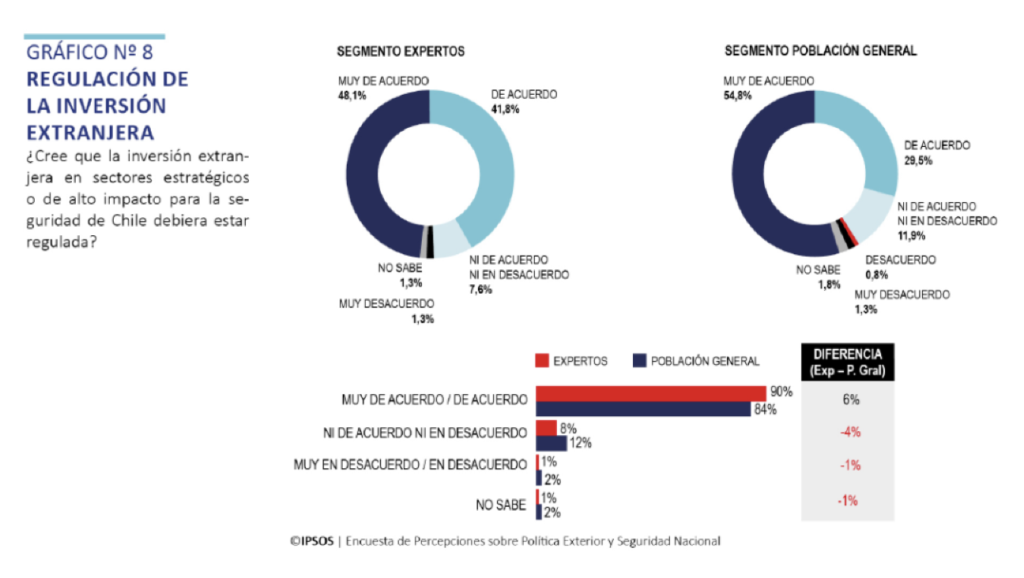
As has been done, all countries protect certain sectors of their economies in one way or another for security reasons, despite the complexity this has become in an interdependent world. For example, the United States has a Committee on Foreign Investment, an entity composed of nine agencies and chaired by the Department of the Treasury, which has the authority to review investments that may pose a risk to national security. Meanwhile, China has a law that gives rise to the so-called “negative list,” which defines sectors prohibited or restricted to foreign capital. The same applies to several European governments, including Germany.
While the Civil Registry cited “inconsistencies” from Aisino, including the failure to explain the scope of the new Chinese Data Security Law, as stated La Tercera, the government spokesperson, Jaime Bellolio, admitted that the continuation of the visa program facilitating Chileans’ entry into the United States was a key factor in the final decision.
The United States Embassy in Chile had already endorsed this version through a statement, where, although it did not celebrate the decision, the Press Section indicated that “each country must make its own decisions regarding national security, but countries and citizens must be able to trust that their identity documents are not subject to risks that threaten national security, privacy, or data security.”
Logically, the Chinese ambassador in Santiago, Niu Qingbao, expressed his “concern” as he believes that “the reason for the annulment relates to the visa exemption policy of third countries, indicating that the annulment decision was made considering factors from third countries.” He stated this in El Mercurio on Thursday, November 18, on page C1.
Aisino, meanwhile, is considering going to international arbitration courts. In this regard, the narrative from the Chinese Embassy remains that private companies from their country are not directed by the ruling Communist Party and operate according to their own criteria. While this may be acceptable, Ian Bremmer argues in an article in the latest issue of Foreign Affairs, that technology companies in China often explicitly align with the priorities of the authoritarian regime in fulfilling national objectives.
The questions that arise at this point are whether this impasse between Beijing and Washington, with potential commercial repercussions for Chile, could have been anticipated. The answer is absolutely affirmative. The signs of the impending storm were evident.
In 2019, then-U.S. Secretary of State Mike Pompeo and Chinese Foreign Minister Wang Yi brought their technological dispute to Santiago, with strong statements on both sides regarding who to choose for the 5G network and the submarine fiber optic cable to connect Chile with Asia. The latter will ultimately head to Australia.
This oceanic country is also a vivid example of the costs that can be incurred when entering into a commercial dispute with Beijing. Since Canberra excluded Huawei from building 5G networks for security reasons, its exports to China began to suffer abrupt declines and restrictions for various reasons.
This leads us to the second point, the need to develop a national strategy to minimize the impact or even take advantage of the strategic competition between Beijing and Washington. This is no easy task, as China is Chile’s primary trading partner and now an investor, while the United States is an important trading partner but also close in military terms due to its presence in the same region and shares a political system with similar democratic values.
It will be the task of the next government to convene various sectors, including civil society, to resolve one of the most pressing dilemmas in foreign policy in decades, which must be addressed considering Chile’s national interests. As the space for active neutralities or non-alignments seems to shrink every day, the news related to Aisino arrives at a time when the process was too close to being finalized, despite all the warning bells. Now, it remains to prepare for the costs that will come from lacking both legislation and strategy and continuing to address our relationship with the two main powers in the world, which are increasingly at odds.
AthenaLab Team