Madeleine Albright (1937-2022): the first woman to lead U.S. diplomacy.
This article was translated automatically and may contain differences from the original. For reference, read the original.
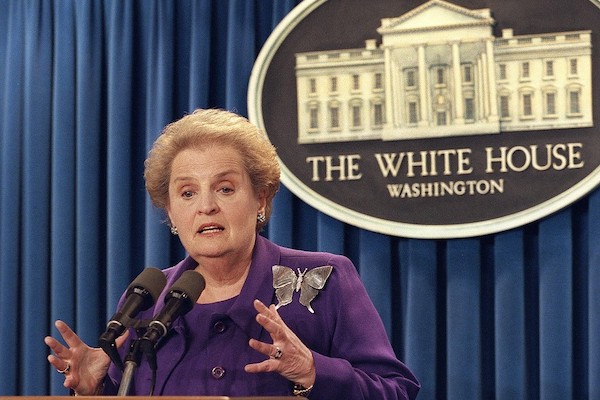
“If we are compelled to use force, it is because we are the United States. We are the indispensable nation. We go with our heads held high and see further than other countries into the future, and we see the danger that the situation poses for all.”
The first woman to head the U.S. Department of State, Madeleine Albright, passed away on Wednesday at the age of 84 due to cancer, as confirmed by her family in a statement.
She was an indefatigable thinker, writer, and executor of international policy. Both her life and work are closely tied to her European origins, as she was born in Czechoslovakia (now the Czech Republic) and arrived in the United States as a refugee in 1948 after her Jewish family fled the Nazis.
She served as Secretary of State during the second term of Democratic President Bill Clinton, from 1997 to 2001, after having held the position of U.S. Ambassador to the United Nations since 1993.
In both positions, she acted decisively when it came to defending the principles of the international order, appealing to force when necessary. She has been described as a “pragmatic idealist,” who believed in “assertive multilateralism” or “muscular internationalism.”
But if there is one phrase that summarizes her vision, it is the one that emerged in an interview with NBC: “If we are compelled to use force, it is because we are the United States. We are the indispensable nation. We go with our heads held high and see further than other countries into the future, and we see the danger that the situation poses for all.”
Indeed, in the 1990s, the United States had emerged as the sole victorious power of the Cold War, which entailed great responsibility but also a significant uncertainty, given the unprecedented “unipolar moment” that was unfolding. Foreign policy needed to find a new script after years of focusing on containing the Soviets.
The humanitarian crises in Africa and the wars in the former Yugoslavia created the opportunity. Albright, for example, defended the presence of U.S. troops in Somalia to assist the United Nations mission, despite the fact that this intervention ended in total failure.
During the war in the Balkans, she consistently pushed for a tougher line against the Serbs in Bosnia, especially after a series of massacres. She strongly supported the expansion of the North Atlantic Treaty Organization (NATO) and military intervention in Kosovo.
She always advocated for bringing Serbian dictator Slobodan Milosevic and his associates to an international criminal court for their war crimes. She believed that authoritarian leaders, such as Iraqi Saddam Hussein, could not get away with their actions. Her last book, published in 2019, is titled “Fascism: A Warning.”
She also visited North Korea, marking the first visit by a high-ranking U.S. official after the end of the war on the peninsula (1950-1953) in an attempt to curb, unsuccessfully, the nuclear ambitions of the Kim dynasty.
Just last month, she referred in The New York Times to the “mistake” that Russian President Vladimir Putin would make if he invaded Ukraine, as indeed occurred on February 24.
“Instead of paving the way for Russia’s greatness, invading Ukraine would ensure Mr. Putin’s infamy by leaving his country diplomatically isolated, economically crippled, and strategically vulnerable to a stronger and more united Western alliance,” she stated.
Whether the United States remains today the “indispensable nation” is a topic of debate, given the emergence of another global power like China.
However, Washington’s determined military support for its NATO European partners amid the war in Ukraine likely aligns closely with Albright’s views, as does the increased closeness achieved with Brussels.
AthenaLab
March 23, 2022