Geographies of Organized Crime in Latin America
This article was translated automatically and may contain differences from the original. For reference, read the original.
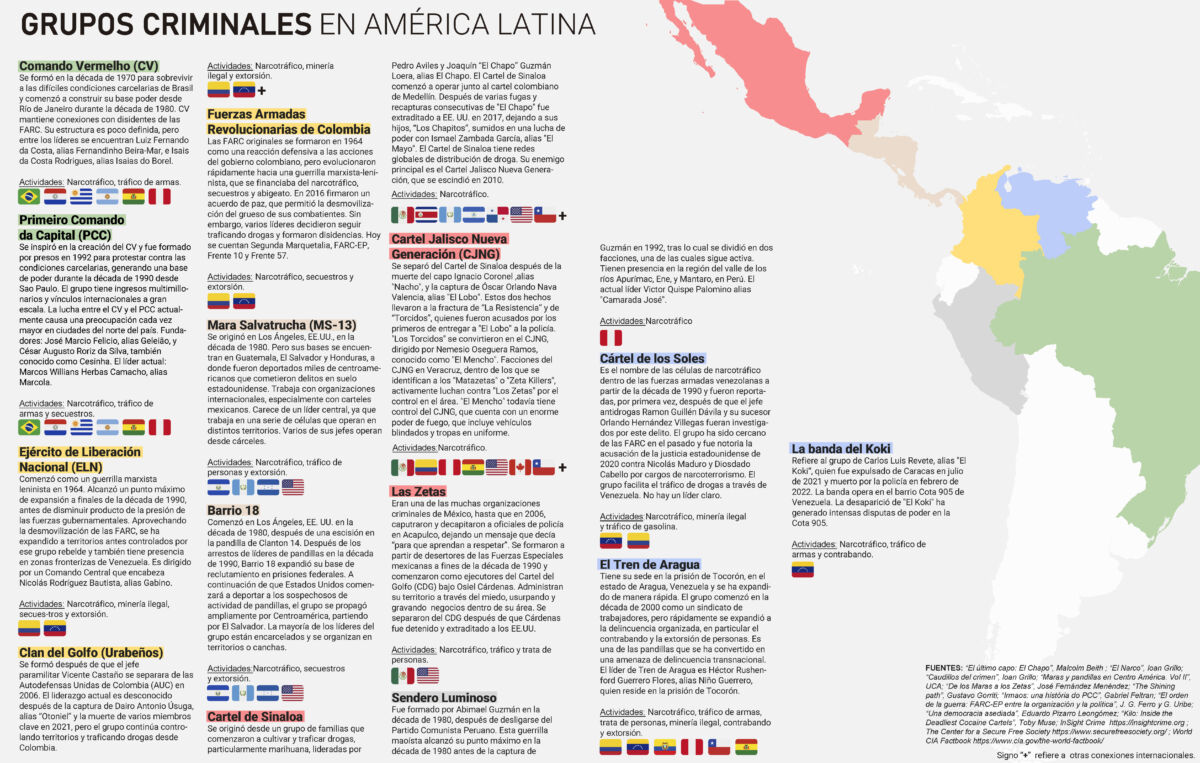
The phenomenon of transnational organized crime is beginning to take on an increasingly important role within the political agenda, the media, and the concerns of citizens in Chile[1]. In fact, national authorities have already reported the presence of three dangerous gangs in our country: the Sinaloa Cartel, the Jalisco New Generation Cartel, and the Tren de Aragua[2], which necessitates a deeper understanding of how these groups operate and their reach.
It is estimated that due to economic openings, new technologies, and connections between different societies (all effects of globalization), along with the chronic institutional weaknesses of Latin American states, these criminal groups have proliferated and managed to expand their illicit businesses with unprecedented strength both within and outside the region.
Today, it could be said that we are facing true “multinationals” of organized crime, which expand their presence by establishing their own subsidiaries in various countries or by forming networks with local criminal groups. Their significant firepower and willingness to employ high levels of violence are key to conquering markets that allow them to increase their economic profits, even circumventing heightened border surveillance due to Covid-19.
In the case of new technologies, they provide more sophisticated tools to organized crime for committing their offenses (for example, optimizing drug distribution through georeferencing) or expanding their activities into cyberspace (electronic fraud, account cloning, etc.). On many occasions, these organizations appear to be quicker and more flexible than authorities in adapting to the environment, as occurred during the pandemic.
This is compounded by the lack of effective state presence within their territories, particularly in strategic border areas. When rampant corruption and the lack of police and intelligence agency reforms are added, it all contributes to the expansion of these criminal groups throughout Latin America.
Experience shows that a deficient or fragile political institutionality is advantageous for organized crime, even more so than a complete absence of it. If the state cannot enforce the law and guarantee collective well-being, then these groups will occupy the space, seeking selective control over access routes, economic activities, and security, while always maintaining basic services for the people. The dichotomy between disorganized states and organized groups is evident.As Ioan Grillo argues in “Gangsters of Crime” (2016), it is uncomfortable for governments to acknowledge that gangs or cartels threaten the nature of the state by challenging its monopoly on violence and the administration of justice, but those who accept coexistence with these groups fundamentally do not recognize their legitimacy. Therefore, the same author argues that criminal groups are more like powers in the shadows than real domains, as they require a weak and corrupt government from which they can parasitize.
All of the above helps to understand the security crisis that the world’s main cocaine-producing region is experiencing, to the point that it accounts for more than 30% of global homicides (around 140,000 on average annually), despite having only 8% of the world’s population. The Inter-American Development Bank has estimated the cost of violence at around US$260 billion or 3.5% of the regional GDP, based on data prior to the pandemic.
Despite living in a context of political instability, economic stagnation, and social discontent, there is an urgent need for an immediate and coordinated response from the states of the Americas to transnational criminal groups. This will not be easy, as it requires achieving, simultaneously, the political will for a frontal fight against organized crime, consensus on certain offenses, identifying routes of dirty money, combating corruption, and increasing inter-agency and international cooperation. The problem is that there are not many other options.
Katherine Caesar and Daniela Ruminot
June 30, 2022
[1]