Free and Open Indo-Pacific: The Legacy of Shinzo Abe 1954-2022
This article was translated automatically and may contain differences from the original. For reference, read the original.
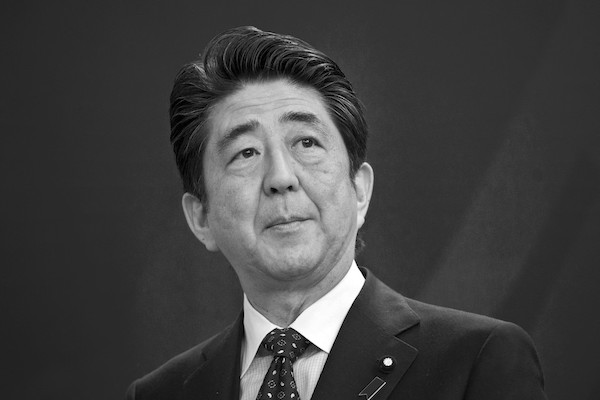
Former Japanese Prime Minister Shinzo Abe (1954-2022) should be remembered as one of the leaders who most transformed the geopolitical landscape of the 21st century, as the architect of the Free and Open Indo-Pacific (FOIP) strategic vision, a space of shared prosperity where respect for international rules, freedom of navigation, and democratic values must prevail. In line with this, he was also a strong proponent of the Trans-Pacific Partnership (TPP), for which he had the support of Chile, a country he considered a sincere friend. “Japan and Chile, sharing basic values such as freedom, democracy, respect for fundamental human rights, and the rule of law, are partners that play an important role in achieving peace, stability, and prosperity in the region and the international community,” he stated during his visit to the country in 2014.
The vision of this leader of the Liberal Democratic Party (LDP) regarding the FOIP began to take shape during his brief first term, when in a message to the Indian Parliament titled “The Confluence of Two Oceans” in 2007, he referred to the interconnection of these maritime spaces and the openness that should govern between them, both for economies and for their political regimes.[1]. However, the following year he ended his term as prime minister without being able to see the idea realized.
During the years away from power, but always as an influential figure in the LDP, Abe worked on his vision while waiting for the opportunity to implement it, and he did so starting in 2012 when he returned to lead Japan.
Convinced that his country needed to take on a new role in global affairs, his concept of “Indo-Pacific” was introduced to the world at a conference in Kenya in 2016, where he stated that “Japan bears the responsibility of promoting the confluence of
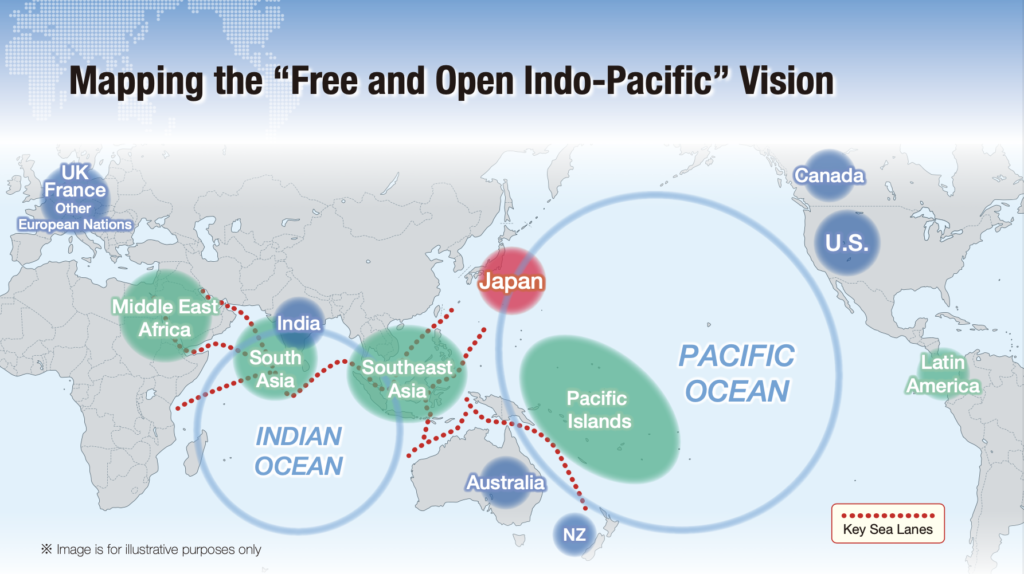
the Pacific and Indian Oceans (…), in a place that values freedom, the rule of law, and a market economy, and that is free from force or coercion, making it prosperous.”[2].
Subsequently, this strategic vision was translated into numerous official documents, inspiring countries such as the United States, Australia, and the European Union to adopt many of its elements, a clear testament to its success.
Abe understood, above all, that Japan’s environment was changing due to the reemergence of China as a power, a historical rival, and the relativization of the United States’ commitment to Japan’s defense during Donald Trump’s administration. Therefore, the country needed to take on a more prominent role not only in the economic sphere, as the world’s third-largest economy, but also as a military and diplomatic power.
This meant moving beyond the Yoshida Doctrine—named after Prime Minister Shigeru Yoshida (1948-1954)—which placed the country’s defense in the hands of the U.S. forces that remained after World War II, while maintaining a limited presence in global affairs and prioritizing economic performance.
Documents from the Japanese Ministries of Foreign Affairs and Defense—the entities responsible for implementing the FOIP—agree on identifying three pillars of this vision: 1) Respect for international norms, freedom of navigation, and free trade; 2) Promotion of economic prosperity through trade and institutional connectivity; 3) Commitment to peace and stability through self-defense capabilities, cooperation with allies, and humanitarian assistance. For example, one can review the document “Achieving the Free and Open Indo-Pacific”[3] and the 2020 Defense Policy[4].
The TPP, which Abe revived after it was discarded by Trump, and the Regional Comprehensive Economic Partnership (RCEP) have been fundamental in implementing the Japanese vision of the FOIP. Additionally, the country has progressively given a more proactive role to its military forces so they can defend allies under attack and deploy throughout the region. Under Abe, defense budgets began to grow alongside the creation of a new national security institutional architecture and the debate over revising the 1947 Constitution article that limits the current role of its military in offensive operations.
Perhaps one of Abe’s greatest successes lies in the fact that his main ally, the United States, has adopted much of his strategy, as have other like-minded countries. However, when compared to the texts that inspired it, we see that the Japanese vision of the Indo-Pacific is the broadest in geographical terms, even reaching the American coasts, which has always been an opportunity for Latin America.
Abe was a leader like few others. He understood that his country was not acting to its full potential and did everything possible to correct this, leaving behind apparent limitations such as an aging population, a stagnant economy, and self-restrained armed forces. His successors in power, such as current Prime Minister Fumio Kishida, have maintained and deepened his vision. Japan is now a solid democracy and has an increasingly open economic policy towards the world. It enjoys a social cohesion greater than many countries and an active international vocation.
Undoubtedly, Japan and the world will miss Shinzo Abe, who voluntarily stepped away from power for health reasons. However, his original idea of a Free and Open Indo-Pacific, developed during the period 2012-2020 as an alternative to the systematic competition between the United States and China, should outlive him for the sake of the maritime democracies that are distributed along the shores of these oceans.
JUAN PABLO TORO
July 8, 2022
[1] Abe, S. (2007). Confluence of the Two Seas. Available at https://www.mofa.go.jp/region/asia-paci/pmv0708/speech-2.html
[2] Abe, S. (2016). Address by Prime Minister Shinzo Abe at the Opening Session of the Sixth Tokyo International Conference on African Development. Available at: https://www.mofa.go.jp/afr/af2/page4e_000496.html
[3] Japan Ministry of Defense (2020). “Achieving the Free and Open Indo-Pacific” at: https://warp.da.ndl.go.jp/info:ndljp/pid/11591426/www.mod.go.jp/e/publ/pamphlets/pdf/indo_pacific/indo_pacific_e.pdf
[4] Defense of Japan (2020) at https://www.mod.go.jp/e/publ/w_paper/ For more information: Japan’s effort for a free and open Indo-Pacific at https://www.mofa.go.jp/files/100056243.pdf and https://www.mofa.go.jp/files/000430632.pdf