REVIEW | "Leadership," the latest from Henry Kissinger
This article was translated automatically and may contain differences from the original. For reference, read the original.
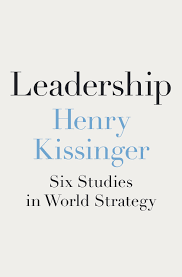
In a world where strong leadership seems absent, Henry Kissinger’s new book (Fürth, 1923) is enlightening as it presents six case studies of 20th-century figures, illustrating the conditions under which they shaped their national and international environments despite adverse circumstances.
The former U.S. Secretary of State begins by identifying two archetypes of leadership: the statesman and the prophet. The former assumes that one of their main tasks is to preserve the essence of the society they lead by managing circumstances rather than being overwhelmed by them. While embracing change and progress, they are aware of its limits. In contrast, the latter is an individual who invokes a transcendent vision from which they believe their moral superiority derives, leaving no room for gradualism, as that would be a concession to time. Their virtue lies in making the impossible seem possible.
Although it is true that day-to-day demands often consume leaders, and we rarely find the two previous archetypes in their pure forms, during periods of crisis, attempting to manage the status quo becomes riskier, necessitating someone to emerge and lay the groundwork for positive transformation.
The author of the essential books “China” and “World Order” selects the following leaders to illustrate their transformational virtues:
- Konrad Adenauer, Chancellor of Germany: The strategy of humility.
- Charles de Gaulle, President of France: The strategy of will.
- Richard Nixon, President of the United States: The strategy of balance.
- Anwar Sadat, President of Egypt: The strategy of transcendence.
- Lee Kuan Yew, Prime Minister of Singapore: The strategy of excellence.
- Margaret Thatcher, Prime Minister of Great Britain: The strategy of conviction.
According to Kissinger, they all share the fact that they transcended the circumstances they inherited, after which they managed to lead their societies to the frontiers of the possible.
For example, he highlights Adenauer’s unconditional acceptance of Germany’s defeat in World War II as a prerequisite for rebuilding a functional democracy within new structures of European integration. This required earning the trust of both the victors and his society, which necessitated “humility.”
The case of de Gaulle is emblematic because, while he defined his objectives prophetically (a free France), he achieved them by executing decisions as a statesman. His legacy lies in promoting French national interest at all costs, although the former U.S. National Security Advisor does not foresee many lessons in terms of public policy. Besides having an exceptional intuition for anticipating events, the French general inspired by example, not necessarily through written prescriptions of what should or should not be done.
In acknowledging his infinite loyalty to his former boss, Kissinger also addresses Richard Nixon, whom he claims was highly respected internationally, unlike the situation domestically. He highlights the U.S. president’s realistic policy in promoting peace through the ongoing adjustment of power balances. This is exemplified by the rapprochement with China, agreements with the former Soviet Union on nuclear missile limitations, and the conclusion of the Vietnam War. All of this allowed for the recalibration of U.S. power on the world stage.
In the case of Lee Kuan Yew, his ability to permeate society with a culture of excellence is emphasized, where neither mediocrity nor corruption could be tolerated, as otherwise, that ambitious collective project called Singapore would fail.
When seeking more commonalities, one finds that these leaders emerged from middle-class backgrounds and attended quality educational institutions that allowed them to realize their potential, which are now in short supply. This situation partly explains the current leadership crisis.
Specifically, Kissinger identifies four characteristics shared by all.
- A sharp sense of reality and a powerful vision.
- The ability to act decisively on matters of national importance under seemingly unfavorable conditions.
- The importance they placed on solitude as personal space for reflection before making major decisions.
- All were divisive. While they sought to have people follow them, they accepted that controversy would be inevitable if they wanted to effect transformations.
“For them, the privilege of citizenship entailed the responsibility to exemplify the particular virtues of their own nations. Serving the people and embodying the best traditions of their society was a great honor,” the author states about Adenauer, de Gaulle, Nixon, Sadat, Lee, and Thatcher.
As Kissinger approaches his 100th birthday, and iconic figures from the last century such as Queen Elizabeth II and the last Soviet leader Mikhail Gorbachev fade from the scene, the veteran “philosopher of international relations” delivers a necessary and even urgent book.
“Leadership: Six Studies in World Strategy”
Penguin Press (2022)
528 pages
Available in online bookstores
Juan Pablo Toro, Executive Director of AthenaLab
September 12, 2022