KEYS | Mobilization and Desperation in Putin's War
This article was translated automatically and may contain differences from the original. For reference, read the original.
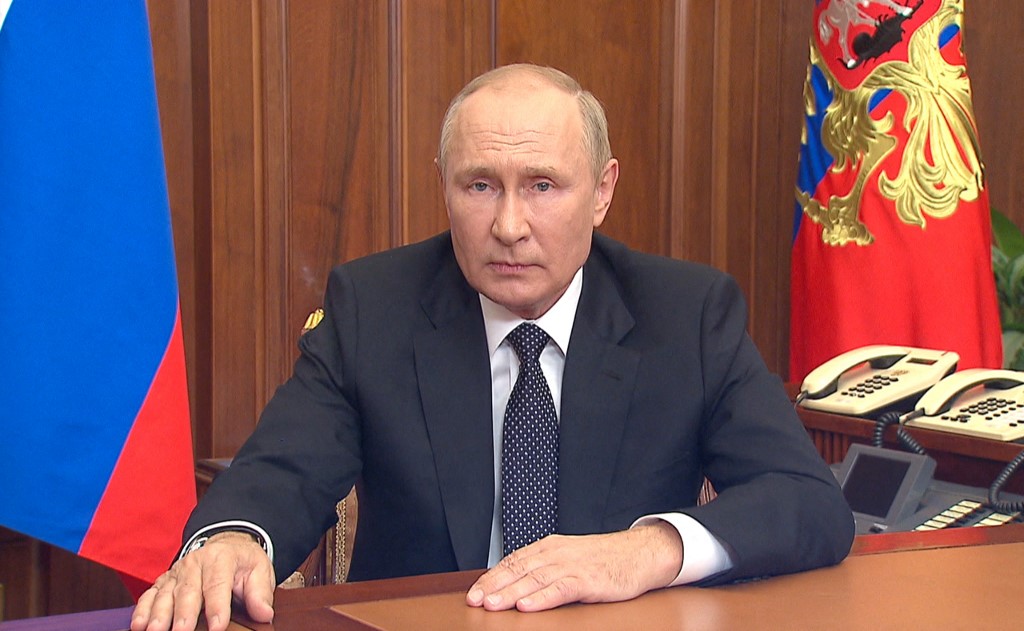
The government of Russian President Vladimir Putin announced the partial mobilization of 300,000 reservists with military experience, while warning that it is capable of using “all necessary means,” including nuclear weapons, to defend the country. Declaring such a mobilization indicates that Russia is in an open war against Ukraine and not in the midst of a “special military operation,” as the Kremlin labeled the invasion launched on February 24. Below is a brief analysis.
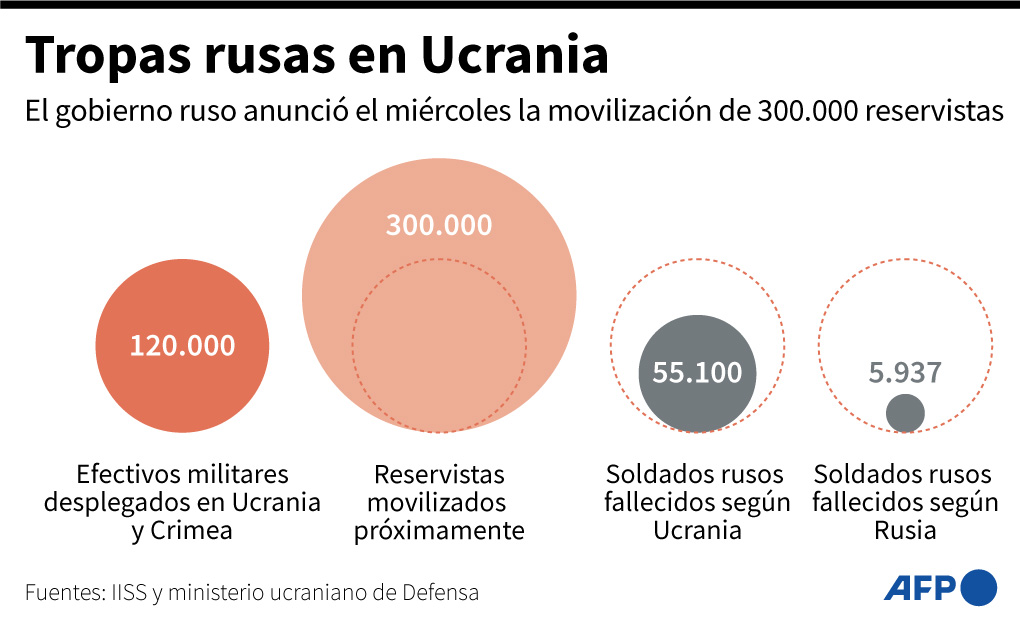
MOBILIZATION Russia deployed about 190,000 troops in the invasion of Ukraine and publicly admits to the death of around 6,000 soldiers. If this is true, it hardly justifies a mobilization like the one announced by the Kremlin. In contrast, the Ukrainians estimate enemy casualties at over 50,000.
If the current Ukrainian offensive to reclaim territory has demonstrated the poor performance of Russian troops in combat, forcing Moscow to recruit mercenaries, individuals with criminal backgrounds, and older men, the impact these new soldiers can make remains to be seen.
However, with a population of 144 million, Russia has considerable room to recruit more fighters. The country’s active reserve is 25 million. Meanwhile, Ukraine has 44 million people, but it is an entire nation armed in defense of its country.
NUCLEAR This is not the first time Putin has brandished the nuclear saber to intimidate countries that assist Ukraine, especially those in Europe. Thus, support for the forces in Kyiv is limited to military equipment and intelligence, without officially deploying troops on the ground. It is also unclear whether they wish to do so. However, the fact that the Russian leader specifies that these weapons of mass destruction would be used to protect the country leads us to the dilemma of what constitutes or where Russia ends for Putin.
REFERENDUMS Moscow’s idea of conducting referendums in areas of Ukraine occupied by Russian troops to lend a veneer of legitimacy to the annexations is not new, as it occurred in the Crimean Peninsula following the 2014 assault. In his speech on Wednesday, the Kremlin leader mentioned the regions of Kherson, Luhansk, Donetsk, and Kharkiv. If the orchestrated plebiscites are held there and yield a favorable result, Putin could consider them part of the Russian Federation, hence the danger of his renewed threat to use “all means at his disposal.”
PRELUDE TO WINTER Putin’s announcement coincides with the onset of autumn in the Northern Hemisphere, a season that necessitates hastening operations before the arrival of winter, which in the past has taken a toll on several European armies. If logistics have been poor during the current campaign, with Russian material movements limited to proximity to rail lines, the arrival of 300,000 troops is unlikely to happen overnight. In addition to transporting them, they will first need to be equipped and retrained. Already, the remnants of the Russian army and its prisoners show the precarious state they are in. According to Russian Defense Minister Sergei Shoigu, the new soldiers will serve to consolidate a front line of 1,000 kilometers, which amounts to acknowledging the reality that they do not have the combat power to advance. Winter is approaching, and soon, for both sides.
INTERNAL EFFECT If Putin’s intention was to regain the initiative after the, so far, successful Ukrainian counteroffensive that has allowed the recovery of thousands of square kilometers, this time he will have to assess the impact of a mobilization. Reports from various international media indicate the outbreak of some small protests against the call to arms and young Russians fleeing to the border with Finland and the mass purchase of tickets to destinations like Turkey. This may explain why the Russian Parliament has tightened laws against deserters.
In an environment where the media is controlled, it is difficult to know how the announcement will be received by a population already subjected to sanctions that have disconnected them from the world. This disconnection is not only commercial and financial but also extends to sports, culture, and tourism.
According to the accounts in the books of Svetlana Alexievich, “The Boys of Zinc,” about the Russian invasion of Afghanistan, and Anna Politkovskaya, “A Dirty War,” about the Chechen campaign, there seems to be little concern from the Russian high command for their troops, and casualties are seen as a natural part of a conflict. Therefore, Putin’s calculation may be that in a war of attrition, everything ultimately comes down to numbers.
FINAL CONSIDERATIONS The majority of Western governments have interpreted Putin’s latest maneuver as a gesture of desperation, and several have announced that they will not recognize the results of the mock referendums. The escalation is a new risky bet from someone who has been losing the game. Injecting additional troops to do more of the same is a recipe for failure. Therefore, a change in strategy should be expected. With the announcement of a partial mobilization, the question is what is stopping Putin from leading Russia into a total war.
AthenaLab Team
September 21, 2022