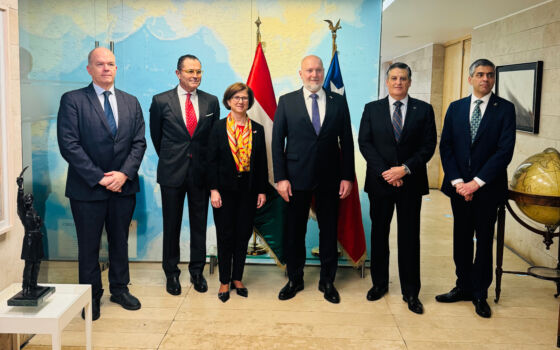
Chairman of the Advisory Council of AthenaLab delivered a lecture at ESE Business School (UAndes)
This article was translated automatically and may contain differences from the original. For reference, read the original.

Leadership in Uncertain Environments
Invited by the Alumni Association of the ESE Business School at the Universidad de Los Andes, I shared experiences from my more than 44 years of service in the Navy, where, like many sailors, I faced unexpected situations filled with uncertainties. Humans do not like uncertainty; on the contrary, they prefer to work and live with certainties. They want to know the when, how much, and how of any activity, as this allows them to prepare and plan their lives in an environment free of surprises. Uncertainty gnaws internally and consumes energy, which is why humans seek certainties in a world of uncertainties. The purpose of this conference was to present personal experiences of someone who has held authority and to show ways to deal with uncertainty while still fulfilling the mission.
The first experience presented occurred more than 15 years ago when, as the Commander of a frigate, while my ship was outside Chile, we faced an unexpected situation that delayed our return to the homeland, without knowing how long it would last. Teamwork and focusing on what is important—the people, their needs, their uncertainties, and their families—constituted the starting point for working with the ship’s officers. After an extended period, we returned home with the mission accomplished and the entire crew safe.
The second case was the Mega Fire in Valparaíso in 2014, when I was appointed as the Chief of Defense for the Constitutional State of Emergency due to Disaster. The inter-agency work, with newly appointed government authorities, NGOs, public services, and armed forces, along with a large number of volunteers and support from the rest of Chile, allowed us to face the worst fire in Valparaíso’s history in an organized and coordinated manner. There were 15 fatalities, nearly 3,000 affected homes, and 12,000 displaced persons. A great cause united many of us from different organizations, but in the face of such a noble and significant purpose of helping and feeling useful to our compatriots, we set aside our differences, egos, and personal interests to generously serve and assist those in need. Many problems needed simultaneous solutions, but there was also much work and commitment to carry it out.
The third case involved facing the serious acts of violence stemming from October 18, 2019, and the pandemic in 2020 as an institution. Every institution or organization must strengthen its internal cohesion and total commitment from the entire chain of command to fulfill the mission. The presence of leaders in the field helps ensure that no one feels alone in their post or patrol; feeling accompanied sought to mitigate the effects of these two crises that Chile experienced intensely and required the Armed Forces, along with other public services, to fully dedicate themselves to society. Every person on the street needed to have the certainty that there would always be an institution behind them protecting them and their families. The example and teamwork in the field by all created the necessary foundations to accomplish the assigned tasks, despite all the uncertainties of those moments.
Finally, all these cases required timely and complex decisions. However, the question that every chief—hopefully a leader—must ask themselves whenever they do not have a clear answer is: To whom/what do I owe my duty? Alternatively, they may refer to life examples; in the case of the Chilean Navy, what would Prat have done in my place? Or, be true to the values and principles one adheres to, or simply, all of the above.
Julio Leiva
Chairman of the Advisory Council of AthenaLab