COMMENTARY | Drug Trafficking in Chile: Where We Stand and Where We Should Go
This article was translated automatically and may contain differences from the original. For reference, read the original.
The VII Annual Report on Drug Trafficking from the National Prosecutor’s Office confirms the reality: drug trafficking has been advancing rapidly in Chile since 2014, the year the Drug Trafficking Observatory was established and regular reports began to be produced.
By the mid-second decade of the 21st century, a process of modernization of local gangs and a massive influx of marijuana was observed creepy, and by the end of that decade, Chile was already positioned third in Latin America as a source of drugs seized in Europe. By the beginning of the third decade, the pandemic accelerated these transformations, with regional cartels establishing themselves in national territory and the consolidation of a narco-economy.
Given this background, the question we must ask is what we are doing to stop the rapid advance of a criminal phenomenon that is impacting societies and states throughout Latin America.
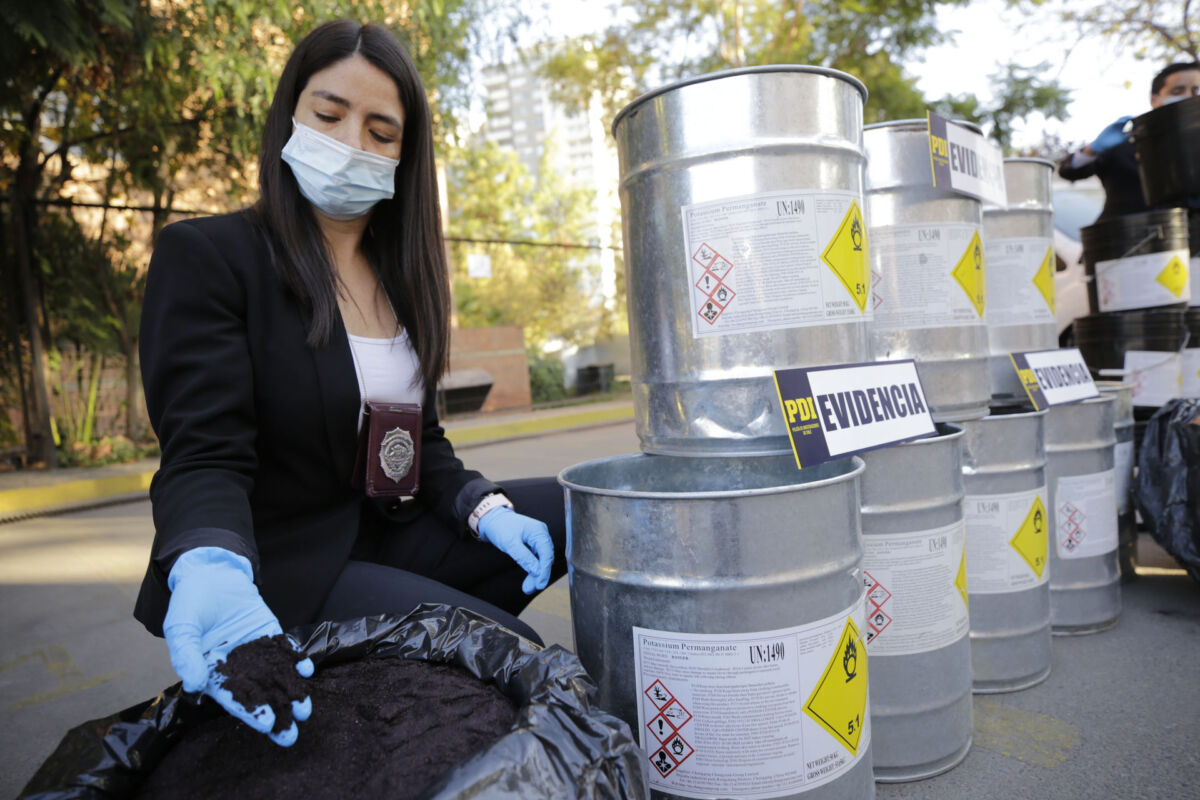
We face a very different landscape than at the beginning of this century, with organized crime operating from prisons and the explosion of the synthetic drug market. In the early 2000s, Chile was characterized as a transit country, where critical infrastructure was exploited by those seeking to re-export their drugs to Asia or Europe. However, large seizures of chemical precursors, such as the 690 tons of ethyl acetate, calcium chloride, sodium hydroxide, and sodium metabisulfite seized at the port of Arica[1], confirm the possibility of producing synthetic drugs on national territory, indicating an emerging role for the country in drug production.
When we add to this the seizures of precursors, the confiscation of money, the discovery of clandestine laboratories, and a 40% increase in convictions under the Drug Law, a challenging landscape is configured for the country.
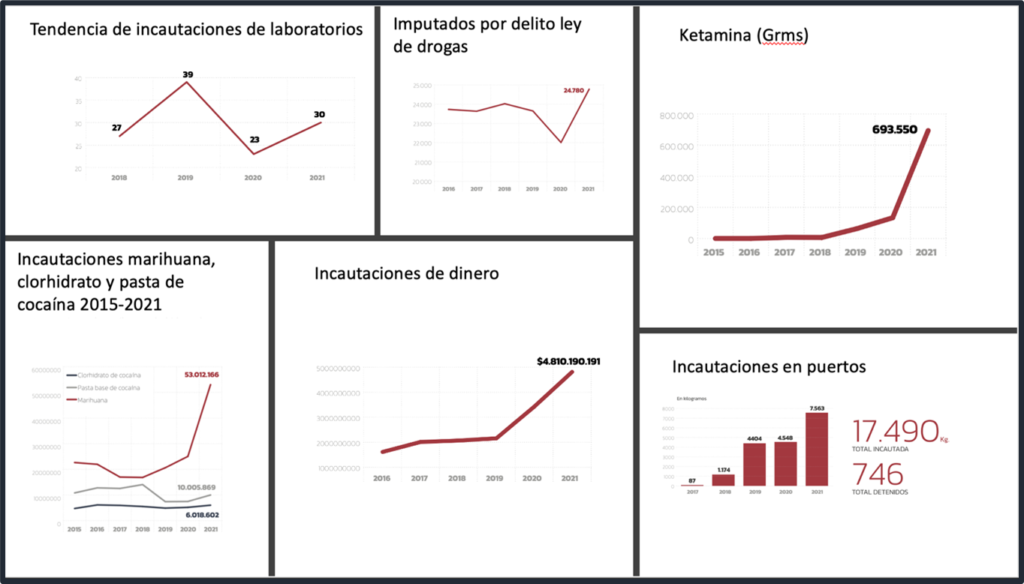
Source: VII Annual Report, Drug Trafficking Observatory, National Prosecutor’s Office.
Addressing security challenges requires understanding the dimensions and nature of the problem. While technology can provide useful tools for pursuing crimes, the management of public security falls under political power and, in particular, the current government, which must define priorities and work in coordination with other actors to move towards common minimums that allow for short, medium, and long-term responses.
Currently, the political world is working to reach a national agreement on security, where parliamentarians, governors, the Executive Branch, and various actors seek to align positions on priorities and concrete actions in this area. President Gabriel Boric’s government has stated since its public account on June 1 that combating organized crime is a priority. In this same vein, it proposed increasing resources and evaluating foreign experiences, while police forces attempt to dismantle gangs involved in high-impact crimes. However, there is a noticeable lack of a comprehensive view of the problem, where all its dimensions are addressed and inter-ministerial and inter-agency work is coordinated.
In the Legislative Branch, discussions on security issues are also taking place, and there are currently projects aimed at, among other things, creating a Ministry of Public Security, updating laws against organized crime and drug trafficking, creating an intelligence system, and strengthening the Financial Analysis Unit, among others.
Furthermore, the Judiciary also plays a fundamental role in the prosecution and sanctioning of crime; however, there is still a need to modernize and adapt investigative techniques in the face of a rapidly changing threat. In this sense, the definition of the next national prosecutor is urgent, as addressing organized crime and drug trafficking must be among their priorities.
All of the above speaks to a necessary shared concern, but not always coordinated, among the political world regarding security. Without designing a public security structure that responds to the new challenges posed by the advance of drug trafficking and the arrival of organized criminal gangs, responses will remain incomplete.
Having a public security structure allows for a comprehensive view of the problem and incorporates all its dimensions. For example, between 2021 and 2022, more than 50,000 young people left the school system[2]. Some of them may find that organized crime offers easy money to acquire the goods and services they aspire to. They thus become a vulnerable group that can be exploited by crime.
The deterioration of historic centers in emblematic cities, such as Valparaíso, Santiago, and Antofagasta, among others, shows the state’s regression in the face of the advance of crime, which occupies these public spaces exercising the same territorial control it already has in the peripheries.
In the case of drugs, substance use among young people affects their development, especially for those who become addicted. It is precisely these individuals who need to be provided with real options for rehabilitation and, more importantly, reintegration.
As mentioned at the beginning of this text, trends in drug trafficking are already clear, and the current scenario reflects the consolidation of these trends. Given that the diagnosis is known to all, it is time to move to concrete actions.
Proposals and Recommendations
The proposed public security structure mentioned is an important step, as it will allow for the design of a national response to the threat. In this sense, having a national task force from which local units can derive would give strength to that structure and provide a comprehensive approach to the problem. However, it is important to consider that the drug threat is of an international nature, so this national response must necessarily incorporate elements of international cooperation with third countries and among national security agencies.
A key element for developing the above is intelligence. It is urgent to advance in an intelligence system that incorporates technology, allows for modeling criminal behavior, and anticipates possible scenarios; an intelligence that considers both internal and external aspects of the threat and generates cooperation among national and international agencies.
At the national level, it is also necessary to advance in updating certain laws and criminal figures, which is why the bill aimed at modernizing the classification of crimes that penalize organized crime is key, as current security challenges are being faced with outdated responses. And perhaps most critically, the state’s regression in the territory must be halted. In this sense, strengthening it and reinforcing the presence of institutions are priority goals so that all designed actions can achieve successful results.
At the national level, the pursuit of assets cannot be overlooked. Organized crime and drug trafficking have an economic objective, so strengthening institutions like the Financial Analysis Unit to follow the money is something that cannot be sidelined. The same applies to expediting laws on the forfeiture of ill-gotten assets, punishing front companies, and relaxing banking secrecy.
Finally, the criminal economy of drug trafficking must be understood as such, and security responses must come from society as a whole, which is the most affected in the first and last instance.
Pilar Lizana, AthenaLab researcher
December 21, 2022
[1] La Tercera, “Operation Etilox”: historic seizure of chemicals for cocaine production achieved in Arica,” December 1, 2022, at https://www.latercera.com/nacional/noticia/operacion-etilox-logran-en-arica-historica-incautacion-de-quimicos-para-la-produccion-de-cocaina/ABVAIJ3XXJEDJEIS3VFQBDEYXM/
[2] La Tercera, “More than 50,000 students leave the Chilean school system between 2021 and 2022,” November 10, 2022, at https://www.latercera.com/nacional/noticia/mas-de-50000-estudiantes-se-restan-del-sistema-escolar-chileno-entre-2021-y-2022/MEVGUHPW3JG7FOUTKGJWR4KJQY/