COMMENTARY | Germany's National Security Strategy: Just a First Step
This article was translated automatically and may contain differences from the original. For reference, read the original.
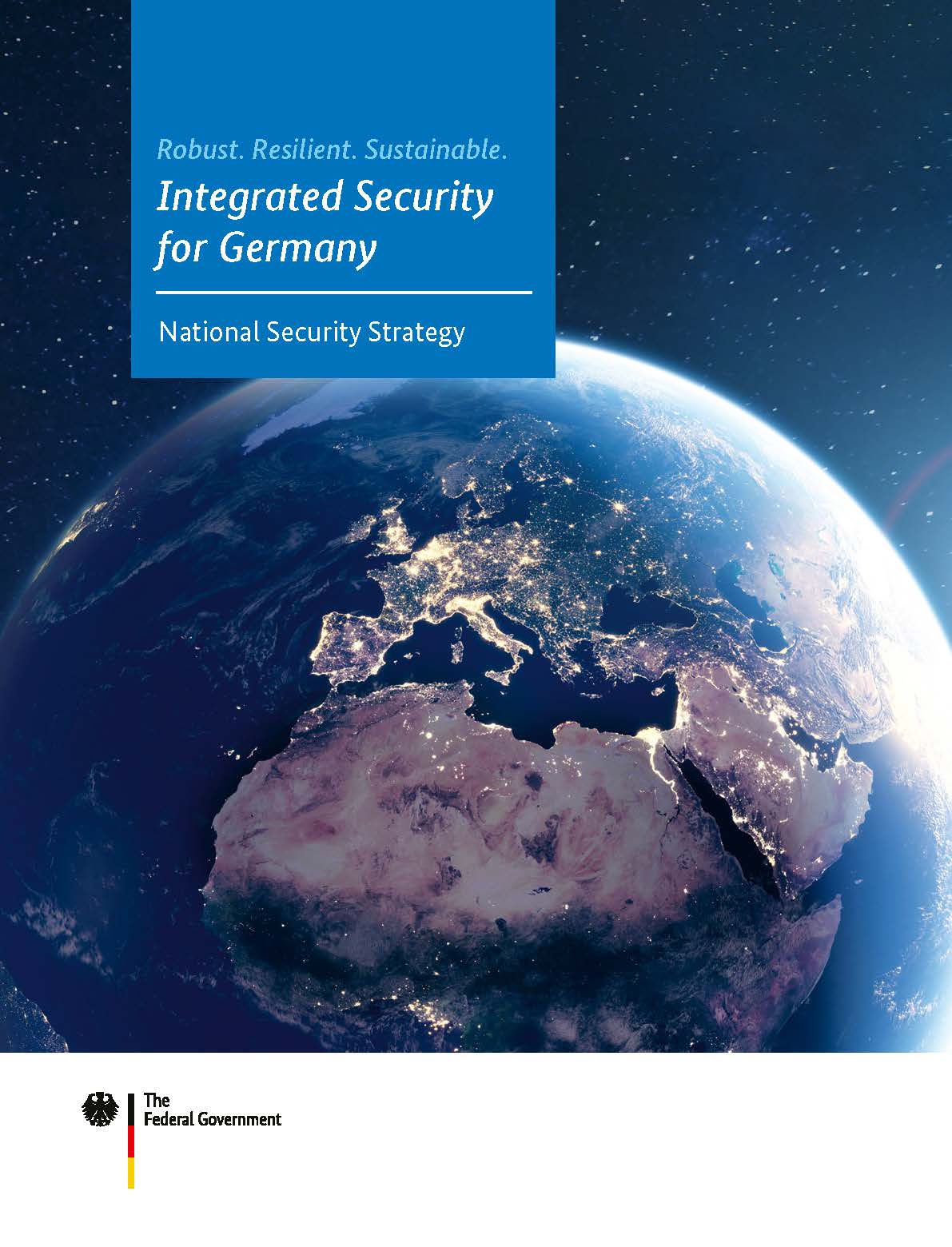
Congratulations to the Federal Government of Germany[1] for publishing this week its first National Security Strategy (NSS), attempting to correct an “anomaly”[2] that had become unsustainable in the new context of the Russian-Ukrainian war: being an assertive power economically while remaining abstinent militarily.
In fact, the text clearly designates Russia as the “most significant threat to peace and security in the Euro-Atlantic area” and finally proposes to strengthen the armed forces through special funds and military spending equivalent to 2% or more of GDP, a figure that stems from the commitment made to the North Atlantic Treaty Organization (NATO).
In an era defined as “multipolar” and marked by “systemic rivalry,” where revisionist powers seek to reconstitute spheres of influence, Germany will seek to achieve comprehensive security that arises from a robust, resilient society committed to sustainable development.
Among the self-criticisms presented in the document, it is acknowledged that it was not a good idea to depend on Russia for energy, a path pursued despite all warnings from allied countries. Now, not only is the will to disconnect reaffirmed, but there is also a decision to pay a higher cost for gas in order to gain greater security.
The NSS focuses primarily on external threats and highlights the importance of partnerships with countries such as the United States and France in pursuit of stability in Europe and the rules-based international system.
It also mentions the Indo-Pacific region as a priority for Germany, which has already been expressed through a specific document published in 2021 and through various naval and aerial deployments in the area. Special mention is made of India and Japan in this regard.
Of course, the NSS addresses broad security issues, such as those related to the impact of climate change and those linked to supply chains, especially for critical materials (from semiconductors to minerals). However, it does not delve into topics such as geopolitical competition for polar regions or the importance of space dominance.
Beyond the merit of the text as an unprecedented effort, it still conceals certain aspects that reflect Germany’s ambiguity in recognizing military instruments as a tool of state power.
The NSS, aside from being signed by Chancellor Olaf Scholz, also includes the signature of Foreign Minister Annalena Baerbock, even though it is presented as a “comprehensive strategy,” meaning it considers all actors involved in providing internal and external security. Therefore, one might question the absence of the Defense Minister’s signature, particularly when it is stated that Germany aims to make its forces among the most powerful conventional forces in Europe.
Moreover, it is nonsensical to speak of “credible deterrence,” which is redundant. Deterrence, which fundamentally operates in the mind of the adversary, is either credible or it is not deterrence. Evidently, Germany’s lack of military muscle and its status as a “net importer of security” for decades have contributed to its current perception as an actor unable to assume responsibilities in the use of force to defend the values and the liberal European order that allowed it to rise from the ashes of World War II.
In fact, Poland appears much better positioned to become the true land military power in NATO with the acquisition of numerous military equipment and the projected expansion of its military forces to 300,000 soldiers.
If there are confusions, China is referred to as a “partner, competitor, and systemic rival” at the same time, following the line of the European Union’s Strategic Compass. However, this positioning has been evolving, as recently announced by European Council President Ursula von der Leyen, who stated that efforts should be made to “reduce risks” given the commercial exposure with Beijing, as its regime has entered a new “era of security and control.”
Nevertheless, a very interesting idea that runs throughout the document relates to the assertion that a country’s freedom can only be obtained by reducing dependencies, which fundamentally allows it to act in a sovereign and unconstrained manner. This is what is now beginning to be included within the so-called economic security.
If the NSS manages to change or rather create a new “strategic mindset”[3] among decision-makers in Germany, it remains to be seen who will be responsible for its implementation, given the absence of a national security council. Therefore, this is merely a first step. It took the Russian-Ukrainian war in the heart of Europe for this country to understand that it cannot be an economic power without a corresponding military strength. While historical past may explain the hesitation to curb any hint of German militarism, there is also a responsibility—so far unaddressed—of not seeking to appease dictators under the conviction that trade is a sufficient disincentive to their ambitions.
Juan Pablo Toro, Executive Director of AthenaLab
June 15, 2023
[1] Federal Government of Germany (2023). “Integrated Security for Germany: National Security Strategy.” Available at: https://www.nationalesicherheitsstrategie.de/en.html
[2] Kundnani, H. (2016). The German Power Paradox. Galaxia Gutenberg: Barcelona.
[3] Giegerich B. and Terhalle M. (2021). The Responsibility to Defend. London: IISS-Routledge.