COLLABORATION | Japan's military forces prepare to confront a rising China
This article was translated automatically and may contain differences from the original. For reference, read the original.
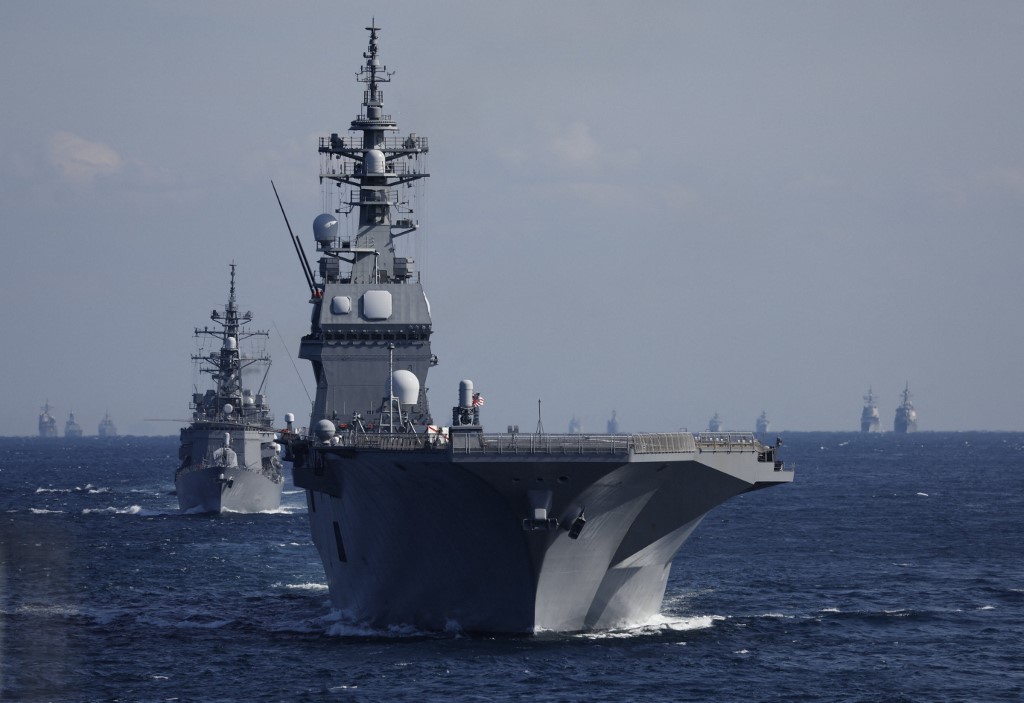
The Japanese Ministry of Defense annually uses White Papers to review the country’s strategic environments and explain how they are managed. Its latest document of this kind shows that Tokyo is significantly improving its position against China.
The most surprising statistic in the 2023 Defense White Paper pertains to the funding of Japan’s Self-Defense Forces (SDF). Over the next five years, Japan intends to spend more than two and a half times on the SDF compared to what it spent in the last five years. Japan plans to increase the budget from 17.2 trillion yen to 43.5 trillion yen, which is approximately $307 billion.
Creating a heavyweight in the Pacific
The Japanese military has long been a compact force with an enviable reputation. It is now on the verge of becoming a heavier force as well. This marks a significant break from history. For decades after World War II, to placate public opinion in Asia and around the world, Japan self-limited its defense budgets to 1% of GDP. It presented itself as an intrinsically harmless society, incapable of launching a new round of imperial conquest. That era of self-restraint has ended due to the belligerence of China, North Korea, and Russia.
Beijing, Pyongyang, and Moscow may come to regret their misconduct.
We must observe the direction of Japanese defense spending, as well as the total amount. According to Defense Minister Hamada Yasukazu, Japan will focus on two priorities: “First, maximizing the effective use of our current equipment by improving operational rates, ensuring sufficient ammunition, and accelerating investments to enhance the resilience of key defense facilities; and second, strengthening the core areas of our future defense capabilities, including long-range defense capabilities that can be used as counterattack capabilities and unmanned assets.”
Tokyo aims to do more than simply expand its forces. Japan wants to extract maximum performance from its current military apparatus; add greater logistical capacity and thus be able to sustain itself in a conflict; harden and diversify defense infrastructure to withstand attacks; and invest in new long-range precision armaments. In this way, it will amplify its ability to strike from a distance and absorb a heavy blow without collapsing.
The result will be a more muscular and stronger boxer, and a fighter whose capabilities are better distributed across the map. The Japan Defense 2023 report indicates that “strengthening the defense architecture in the southwest region” remains an ongoing concern. This means expanding the reach of the Air and Ground Self-Defense Forces with anti-ship and anti-air missiles along the Ryukyu Islands, a chain of islands that forms an arc from the southernmost island of Kyushu, through Okinawa at its midpoint, before ending just north of Taiwan.
It makes sense to fortify the southwestern islands for two main reasons, one defensive and the other offensive. The first priority is to protect Japanese territory, offshore waters, and skies against assaults by sea or air. The SDF deployments here serve a purely defensive function.
Secondly, the islands provide Japan and its American ally the option to turn the island chain into a barrier against naval and aerial movements between the seas of China and the Western Pacific. Maritime and air forces, working in conjunction with units on the islands, can close the straits that allow passage through these bodies of water. Therefore, the SDF can trap hostile forces while keeping Japanese territory defended.
Access denied.
Japan: a sound strategy to counter Xi’s China
Walling off adversaries within the first island chain would deny them the maneuvering space they so desperately need. The main forces in question here are the People’s Liberation Army Navy and the People’s Liberation Army Air Force.
As an added benefit, such a blockade would also limit the Chinese merchant fleet to its local waters, curbing maritime trade and economically harming Beijing if it abuses Japan, Taiwan, or any other neighbor. In summary, Japan’s maritime strategy aims to unite archipelagic geography, military technology, and alliance politics in the service of deterrence and, should the worst occur: open combat.
A first island chain filled with weaponry should give pause to Chinese President Xi Jinping and his allies. As Defense Minister Hamada states, “it is essential to make efforts to ‘defend our country by ourselves’ and increase deterrence. In other words, we need to make the opponent think that ‘attacking Japan will not achieve their objectives.'”
This is a sound strategy. The Prussian military theorist Carl von Clausewitz observed that an absolute victory on the battlefield, while it charts a direct path to success, is not essential for success. A combatant can prevail over another by convincing enemy leaders that they cannot win, or that they cannot win at a cost worth bearing. A rational antagonist withdraws before embracing a losing cause in advance.
Thus, it is possible to win without fighting, although not without power and readiness to fight. Anything that Japan and the U.S.-Japan alliance can do to put steel behind their island chain defense strategy increases their chances of deterring the predators of the Chinese Communist Party.
The race to play at home
Or consider the problem through a sports prism. That the home team has an advantage over any visiting team is a cornerstone of naval warfare, according to the greatest exponents in this field. This is the logic of access and area denial: the home team is close to the battle scenarios, has most of its militarily relevant resources nearby, and knows the physical and human terrain intimately. The significance of this is widely understood. China has based its strategy against the United States on this very premise of trying to deny the U.S. team access to the playing field, or to hinder its efforts once there.
But in the case of Japan and China, geography has placed two home teams on the same field. Here they have played a fiercely contested championship that spans centuries. Although less populated and with a smaller economy than China, Japan has its own geographical and other advantages. In particular, the Japanese archipelago is positioned in front of China’s access to the high seas, giving the SDF a blocking position. Given this, the logic of access to the Western Pacific and area denial works both ways, not just for China. The Japan Defense 2023 attests to this.
Furthermore, to adhere to the sports analogy, the Japan Self-Defense Forces enjoy the support of a team that is almost local and almost visiting: the U.S. joint forces deployed forward in East Asia, ready to enter the field if the game heats up. Japan’s SDF is not alone.
Who has the home team advantage when local Asian teams face off? Japan is making its bet.
James R. Holmes[1]
August 7, 2023
The views expressed in this article are those of the author and do not necessarily reflect the views of AthenaLab.
- Dr. James Holmes holds the J. C. Wylie Chair of Maritime Strategy at the U.S. Naval War College and is a distinguished fellow at the Brute Krulak Center for Innovation and Future Warfare at the University of the Marine Corps. Senior Fellow at AthenaLab
- Article reproduced with permission from the author and originally published at https://www.19fortyfive.com/2023/08/japans-military-is-getting-ready-to-take-on-a-rising-china/