ANALYSIS | "Violent Lobbying": The Pressure from Drug Traffickers in Ecuador
This article was translated automatically and may contain differences from the original. For reference, read the original.
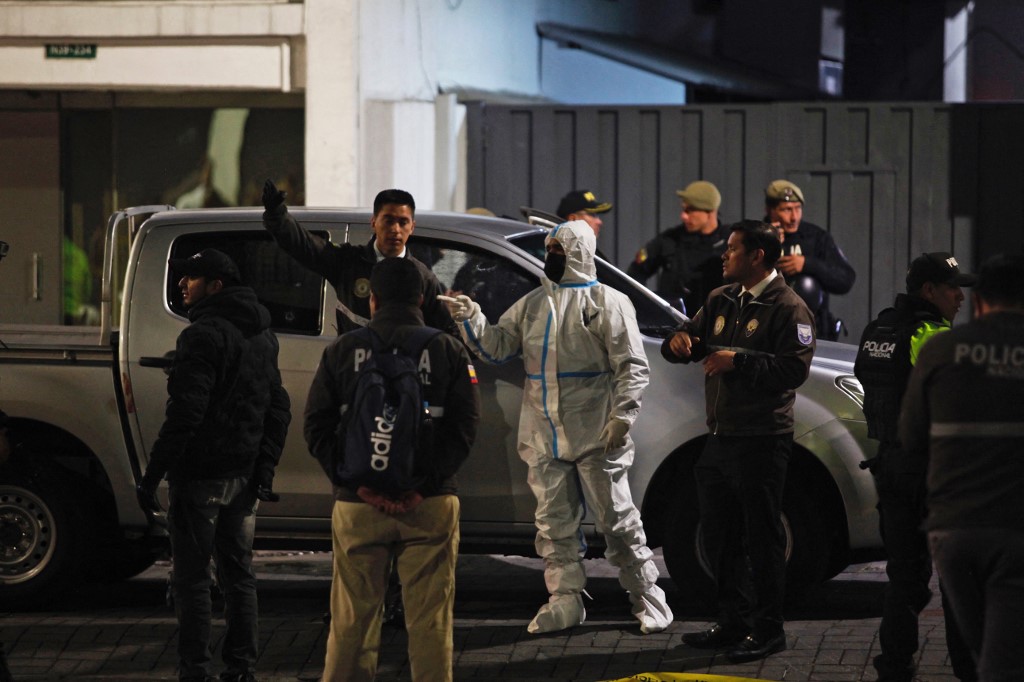
VIOLENT LOBBYING. The recent shooting assassination of presidential candidate Fernando Villavicencio in Ecuador, attributed to “Los Lobos,” the second largest criminal gang in the country, can be framed within what is known in criminal studies as “violent lobbying” (violent lobbying)[1], which is a way to influence political decisions through coercive actions.
Criminal groups engage in “violent lobbying” when they commit attacks against authorities or candidates to remove them as physical obstacles to their objectives or threaten them to shape their present or future behaviors, in the case of candidates for office. There are also instances of campaign vetoes in territories under their control, thus limiting the alternatives for voters.
Moreover, what occurred in Ecuador on Wednesday brings to mind the presidential campaigns of 1990 in Colombia, when three candidates were assassinated by the Medellín Cartel and paramilitaries, and in 1994 in Mexico, when the ruling party candidate Luis Donaldo Colossio was shot dead in a dark plot involving traffickers and politicians. The late Villavicencio faced a threat from the Sinaloa Cartel of Mexico, through its local partners, “Los Choneros.”
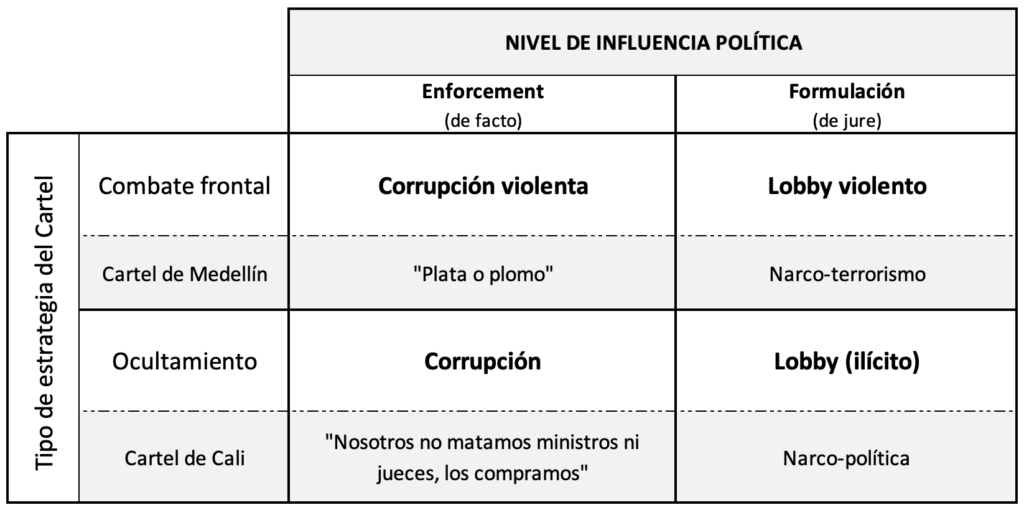
CRIMINAL CONVERGENCE. The assassination that occurred in Ecuador, in light of the available information, appears to be a very characteristic expression of the so-called “criminal convergence” of the 21st century, where organized criminal groups act as true insurgencies, to the point that they begin to seek selective territorial control and offer some governance in the face of conveniently weak states. To execute their actions, they do not hesitate to employ terrorist tactics, including explosive attacks and sniper shootings. The Primeiro Comando da Capital of Brazil and the Jalisco New Generation Cartel of Mexico are examples of this.
The fact that the assassin of the candidate and the detainees are of Colombian nationality also reveals the increasingly international character of these organizations in their composition. It again highlights the fact that, following the dismantling processes of guerrillas, paramilitary demobilizations, and mass resignations of military personnel in Colombia, there remains a vast amount of “labor force” available from individuals with experience in the use of weapons to provide hitman services in the region. The President of Haiti, Jovenel Moïse, for example, was assassinated in July 2021 by a group of hitmen mostly from Colombia while preparing to deliver files on traffickers to the United States.
LOCAL CONTEXT. Ecuador is experiencing a wave of violence, particularly linked to drug trafficking, with various criminal gangs identified, such as “Los Lobos,” who claimed responsibility for the assassination, and “Los Choneros,” the main group in the country. Although neighboring Colombia is the world’s leading producer of cocaine and home to dangerous narco-guerrillas and cartels, this Andean country lived for decades with low levels of violence, where even serious political crises were resolved without bloodshed.
However, this situation began to change in Ecuador in recent years with the emergence of local criminal groups with their own profiles, which, like in the rest of the region, strengthened during the Covid-19 pandemic and linked up with powerful Mexican cartels. Additionally, Colombia has reached record cocaine production levels of 1,400 tons annually, many of which are processed near the common border.
The Pacific ports of Ecuador are also highly sought after due to their location, and their surveillance is the responsibility of the country’s Navy. Until 2009, the United States operated an anti-narcotics base in the coastal town of Manta, but the agreement was canceled under the presidency of Rafael Correa (2007-2017), who criticized the agreement from his campaign onward.
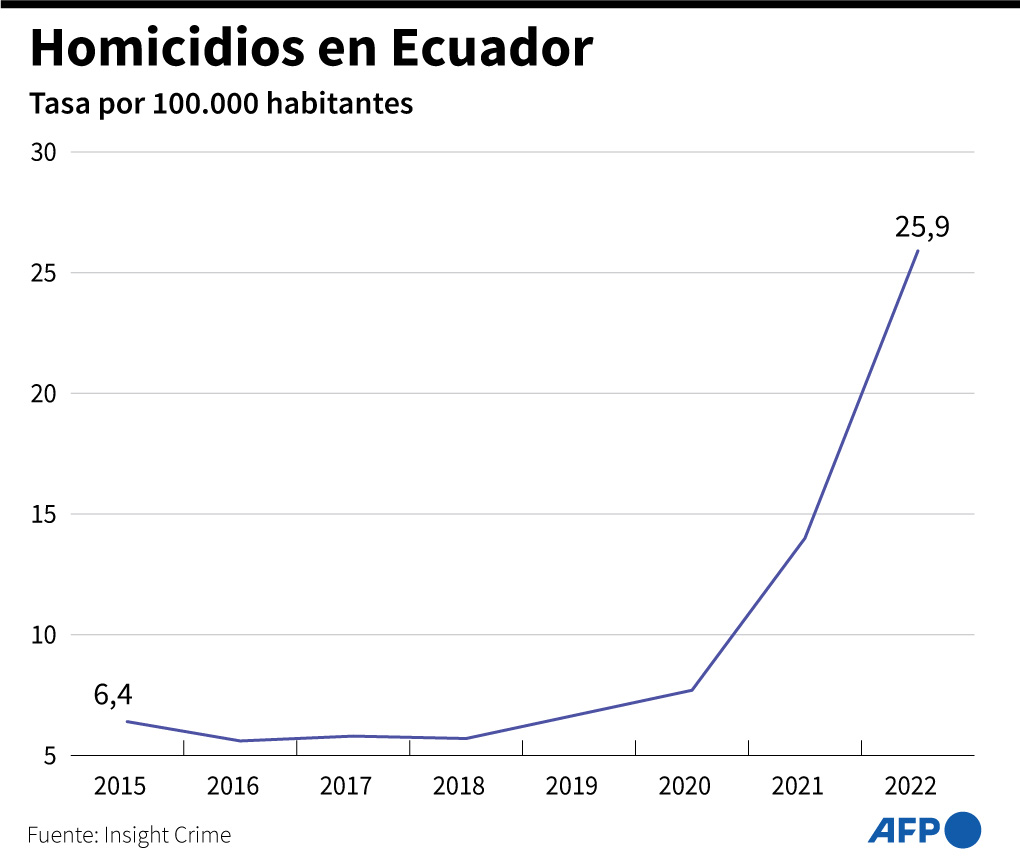
In this context, the magazine Primicias[2] reported that “Ecuador closed 2022 with its worst record of criminal violence. The country reported 4,603 violent deaths, resulting in a rate of 25 cases per 100,000 inhabitants. The growth is exponential, as in 2021 the official rate was 13.7 deaths, meaning an increase of 82.5% in one year.”
ELECTORAL SCENARIO. The current electoral process in Ecuador is the result of the advance of elections decided by President Guillermo Lasso, who opted for this measure in May in response to the crisis triggered by a political trial against him promoted by Congress, for alleged money laundering.
Center-right Lasso declared a “state of emergency” for 60 days in the country, which involves the deployment of armed forces. He also promised that the electoral calendar would be respected, establishing first-round elections to choose a president, vice president, and congress members on August 20. The second round is scheduled for October 15.
Villavicencio, a fierce denouncer of corruption during Correa’s years, a declared enemy of drug traffickers, and a critic of official forces for their alleged negligence, was considered close to Lasso and was in fourth or fifth place in the polls at the time of his death. However, the Ecuadorian political landscape is very fragmented, and there is only certainty that leftist Luisa González (close to Correa) leads the preferences with 25%.
With security already becoming the main issue of the campaign, even before Villavicencio’s assassination, it is likely that candidates offering hardline policies in the style of Salvadoran President Nayib Bukele, such as right-wing businessmen Otto Sonnenholzner and Jan Topic, will capitalize on the fear and shock present in Ecuadorian society.
Juan Pablo Toro, Executive Director of AthenaLab.
August 10, 2023
[1] Lessing, Benjamin (2015). “Logics of violence in criminal war.” The Pearson Institute, Discussion Paper No. 19, Journal of Conflict Resolution, 59(8): 1486–1516.
[2] https://www.primicias.ec/noticias/en-exclusiva/ecuador-incremento-muertes-violentas-latinoamerica/