BOOK | “The Chilean Antarctica,” by Óscar Pinochet de la Barra
This article was translated automatically and may contain differences from the original. For reference, read the original.
- by AthenaLab
- Noticias

The novelty of this survey lies in the decision to consult our neighbors in Argentina, Bolivia, and Peru regarding their foreign policy objectives, the concerns that affect them, and how they perceive different nations.
The importance of Antarctica, as a constitutive part of the State of Chile, was identified early on by civil authorities as well as by the sailors who exercised primordial sovereignty over the southern territories south of the American continent.
However, the legal argument regarding the rights that pertain to us—currently between the meridians of 53° and 90° west toward the South Pole—had to wait until a young law student from the University of Chile dedicated two years to researching the topic for his thesis.
This profound work gave rise to “The Chilean Antarctica,” a book that naturally led Óscar Pinochet de la Barra into diplomatic activity.
The work had four editions—1944, 1948, 1955, and 1976—and became a reference text for scholars and the general public interested in learning more about this new Chilean frontier.
During that same period, Pinochet de la Barra not only visited Antarctica several times but also became one of the architects of the treaty system that governs everything from the activities that can be conducted on that continent to the fate of existing territorial claims.
Unintentionally, he also became a kind of model that every diplomat should aspire to, a representative of Chile to the world, capable of developing ideas to promote national interest and then translating them into concrete actions. Certainly, this is complemented by a personal physical courage, as Antarctic expeditions always carry severe risks due to the hostility of the landscape and the harshness of the climate.
The AthenaLab think tank, since its inception in 2019, has shown a marked interest in highlighting the importance of the Chilean Antarctica, for which studies have been conducted and field visits made. In all these actions, we believe that the inspiring figure of Óscar Pinochet de la Barra has accompanied us in one way or another. As he states in his book, “Antarctica is the most extraordinary place one can imagine, and the attraction it exerts on those who visit it can indeed change the course of their lives.”
For all the above reasons, we consider it a duty to publish a new edition of the book, for which we have the support of the Pinochet de la Barra family, represented by their children Carmen and Alfredo, to whom we express our gratitude for their willingness. We also acknowledge María Luisa Carvallo, who worked for years with the diplomat and contributes the epilogue about his life and work, essential for understanding how one cannot be explained without the other.
We also include the preface of the first edition by Julio Escudero, and that of the second, third, and fourth editions by Antonio Huneeus. Both prefaces have undeniable historical value and help to better understand the remarkable character of the work in its time.
We hope, therefore, that this new edition will bring the Chilean Antarctica closer to new generations and inspire those who have and will have to defend it in the face of increasing geopolitical competition, which is already evident, and the impact of climate change. We are aware that this is only a first step in rescuing the work of those visionaries who thought of Chile strategically and who charted a path that we are obliged to resume.
DSPEECH OF THE MINISTER OF RELATIONS EXTERNAL, ALBERTO VAN KLAVEREN, ON THE OCCASION OF THE REISSUE OF THE BOOK TH EC HILEANA NTARCTICA BYÓ SCARP INOCHET DE LABARRA

.
Dear friends, I am very pleased to be with you today for the presentation of the reissue of the book The Chilean Antarctica
by Óscar Pinochet de la Barra. This publication, since it first came to light in 1944, quickly became an indispensable reference work for anyone wishing to address the geographical, historical, legal, and diplomatic aspects of Antarctica. Its relevance has been maintained over time to the present day. Originally conceived as a thesis, the careful and in-depth analysis conducted by Óscar Pinochet on the Antarctic continent—of which little was known at that time—caused a great stir in academic and diplomatic circles. This prompted him to publish his thesis in the form we know today as The Chilean Antarctica,
which earned him the Municipal Literature Prize the same year it was published.
As we approach the 80th anniversary of the first edition of this publication, I would like to highlight the timely and fortunate decision by AthenaLab to reissue such a relevant volume for our international endeavors. Undoubtedly, this book continues to hold undeniable relevance for our Chilean foreign policy, both in terms of allowing us to engage with the history, geography, explorations, and discoveries of our Antarctic territory, as well as providing us with the background on the rights that Chile possesses in the “white continent.” It seems appropriate to mention that the impact of the publication of The Chilean Antarctica
on the governments of the time was such that it earned its author an invitation to participate in the first expedition to Antarctica in 1947. On that occasion, our first scientific base on the continent was established, the Soberanía Base, now known as the Captain Arturo Prat Base. The following year, in a second expedition, he participated alongside President Gabriel González Videla in the installation of the Bernardo O’Higgins Antarctic Base. From then on, as an explorer, he was part of most of the expeditions that allowed Chile to settle definitively and continuously in the “white continent.”
Regarding his first expedition to Antarctica, Oscar Pinochet recalls that in January 1947 he set sail from Valparaíso on the transport Angamos of the Chilean Navy, where he had the great opportunity to converse with writers of the caliber of Francisco Coloane, Enrique Bunster, Eugenio Orrego Vicuña, as well as with scientists Parmenio Yáñez, Humberto Barrera, Guillermo Mann, and Carlos Oliver Schneider. From this extraordinary experience, Pinochet de la Barra remembers:
“The Chilean base was under construction in February 1947, and we all contributed to carrying wood, bags of cement, sand, doors, and windows. I have never forgotten that job as a third carpenter’s assistant, at the age of 26, who occasionally turned his head to contemplate the national flag presiding over us. It was cold, but less than expected. It snowed occasionally that summer, and we went out to ski in the surroundings. The real emotion came to me one night when … yes, reader, yes, I embraced Antarctica tightly, passionately….”
The intimate and profound impressions of his first Antarctic journey were intertwined with the need to resolve a problem that demanded clarification, namely, whether the polar territories were susceptible to appropriation or not. As is well known, it was not to the liking of the great powers that Chile and Argentina projected their continental territories toward Antarctica and claimed them as sovereign.
The timely advice given to Óscar Pinochet to investigate the topic and then publish the work that is being reissued this afternoon made him one of the best Antarctic specialists in the world and the undisputed expert in Chile. His thorough legal, historical, and geographical knowledge of that region was decisive for our authorities at the time to appoint him as Chile’s delegate to the Antarctic Conference held in Washington in 1959. These sessions lasted 45 days of intense discussions in which 12 countries aspired, albeit from different perspectives, to have a presence in Antarctica.
With the Antarctic Treaty that governs to this day, a very special Agreement was achieved that establishes the freedom of scientific research and its use for exclusively peaceful purposes, devising in accordance with international law the formula that allowed for the freezing of “the Antarctic disputes,” thereby safeguarding Chile’s sovereign rights over the territory located between the meridians of 53° and 90° based on historical titles, geographical proximity, effective presence on the frozen continent, and ongoing scientific research and collaboration. The influence and knowledge of Oscar Pinochet regarding Antarctica led him to later publish the books:Antarctic Memories ,Half a Century of Antarctic Policy, 1940 – 1990
, as well as a series of poems inspired by the white continent.
Finally, it seems pertinent to point out that Óscar Pinochet also played a very important role as a diplomat. During the government of Eduardo Frei Montalva, he served as Undersecretary of Foreign Affairs and later as Ambassador to the Soviet Union and Japan.
With the return of democracy, he was appointed Director of the Chilean Diplomatic Academy and then, in 1991, naturally took on the role of Director of the Chilean Antarctic Institute until 2003. With the reissue ofThe Chilean Antarctica ,
AthenaLab not only honors the dissemination of an essential work for understanding and affirming the rights that Chile holds in the Antarctic territory, but also pays tribute to an exceptional Chilean.
Alberto Van Klaveren
Minister of Foreign Affairs of Chile
November 6, 2023

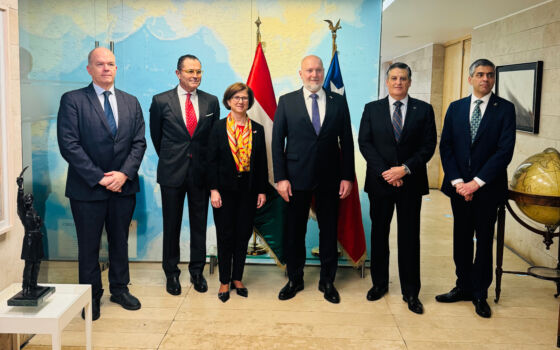
El Mercurio, Gallery of images from the launch