YEAR-END SPECIAL | A Look at 2023
This article was translated automatically and may contain differences from the original. For reference, read the original.

THE WORLD

While the war between Russia and Ukraine threatened to extend indefinitely, the world was surprised in 2023 by the terrorist military incursion of Hamas against Israel, which unleashed a conflict in Gaza, the ramifications of which now extend to the Red Sea, compromising international maritime traffic.
Positive news at the international level included the relative stabilization of relations between the United States and China, following the meeting of Presidents Joe Biden and Xi Jinping in San Francisco — despite warnings about the inevitability of Taiwan’s annexation — and the agreement reached at COP28, which calls for a gradual phase-out of fossil fuels. The decline in global inflation could also be included.
LATIN AMERICA

Latin America had its own surprise with the victory of libertarian Javier Milei, who assumed the presidency of Argentina promising to reform and open the economy, thus ending a long cycle of Peronist clientelism. With shock policies underway, it will be a case to watch closely.
At the same time, the problematic regime of Nicolás Maduro created conditions for a war crisis in the region by holding a referendum to annex a large part of neighboring Guyana, in yet another demonstration that declaring “peace zones” is a futile exercise. The limits on the actions of irresponsible states must be clear. For now, U.S. support for Georgetown and the mediating efforts of some countries seem to have helped to calm tensions.
Organized crime,for its part, continued to thrive in all its manifestations, such as drug trafficking, human trafficking, illegal mining, kidnappings, and other crimes, thus making Latin American organizations among the most powerful in the world.
CHILE

In the case of Chile, 2023 was marked by a constitutional process that led to the rejection of a second draft constitution, the 50th anniversary of the coup d’état — which apparently did not contribute to reducing polarization — the absence of economic growth, and an increase in homicides involving firearms.

PUBLICATIONS

This year, AthenaLab published five working papers, the preparation of which required visits to the northern border and the southernmost region. Topics such as the war in Ukraine and the importance of controlling the sea and its resources were also addressed. Of course, we launched our “Fourth Survey on Foreign Policy and National Security”, which this time included measurements in Argentina, Bolivia, and Peru. Finally, we reissued the book “The Chilean Antarctic” by Óscar Pinochet de la Barra, a reference text on the subject, an activity that included Foreign Minister Alberto Van Klaveren. See more ➜
PEOPLE

As is traditional, we held our two training workshops in Jahuel, where dozens of young people were able to learn about security, defense, and international relations, while also joining the AthenaLab alumni network. Additionally, an Antarctic leadership seminar was held in collaboration with the San Sebastián University. Furthermore, a student from Alberto Hurtado University joined us as an intern.
Members of the AthenaLab team also taught classes and gave lectures at the Pontifical Catholic University of Chile, Adolfo Ibáñez University, University of Chile, Pontifical Catholic University of Valparaíso, University of the Andes, Army War Academy, ANEPE, Military School, Naval War Academy, Georgetown University in the United States, and UCEMA in Argentina.
MEDIA

Members of the AthenaLab team were consulted on various topics, such as the war in Gaza or the penetration of organized crime, by media outlets such as El Mercurio, La Tercera, Diario Financiero, La Segunda, El Mercurio de Valparaíso, El Comercio de Lima, Estadão de São Paulo, El Líbero, El Mostrador, Ex Ante, Radio Agricultura, La Clave, El Conquistador, T13, TVN, T13, Chilevisión, Megavisión, CNN Chile, and CNN International. Articles were also published in specialized journals such as Política Exterior from Spain, Diálogos from Brazil, and the RUSI website from the United Kingdom. See more ➜
We would like to thank all those media outlets for reaching out to us.
SEMINARS AND INTERVIEWS

AthenaLab organized multiple in-person activities that included, among others, the seminars “Climate Change and Regional Security in Latin America” with Columbia University; “Latin America and the European Union: A Crossed Perspective” in collaboration with the Real Instituto Elcano and the Spanish Embassy in Chile; “Japan’s New Strategic Posture” with the Embassy of Japan; “The Brazilian Model of Border Protection” with the Sovereignty and Climate Center of Brazil; “Latin America Facing Asia-Pacific/Indo-Pacific: Perspectives, Narratives, and Opportunities” with CEIUC and CEIUCA; and “Chile Facing the Advance of Illicit Markets” with the National Prosecutor’s Office.
We also conducted in-depth interviews with figures such as U.S. strategic thinker Edward Luttwak; Canadian historian Margaret MacMillan; former Vice President and former head of the National Police of Colombia, General (R) René Naranjo; retired Australian Army General and author Mick Ryan; retired Spanish Army General and member of the European Affairs Panel of the Fundación Alternativas, José Ayala; and Arturo Valenzuela, an academic and former U.S. government official.
In a unique activity,we hosted a private screening of Ridley Scott’s film “Napoleon,” with historical commentary provided by AthenaLab. See more ➜
INSTITUTIONAL RELATIONS

This year, AthenaLab expanded its network of collaboration with research centers, which already includes the Real Elcano Institute of Spain and the Royal United Services Institute (RUSI) of the United Kingdom, by signing a memorandum of understanding with the Sovereignty and Climate Center of Brazil, with which activities were immediately carried out. We also actively collaborated with institutions such as CEP, ICARE, Fundación Dignidad, Sernapesca, and the Embassy of South Korea.
On the international front, members of AthenaLab were speakers at the Conference of the Center for a Free and Secure Society (SFS) in Washington; RUSI Conference on the UK and Latin America in London; Schuman Forum on Security and Defense of the European Union (we were the only Latin American think tank) in Brussels; 1st International Conference on Sovereignty and Climate in Brasília; the IV Ibero-American Congress on Naval Engineering in Seville; and the Conference of the Ministry of Foreign Affairs of Ukraine on reforming the United Nations Security Council, held virtually.
As invited guests, we attended the program “Building a Multi-layered Network of Japan Experts,” organized by the Ministry of Foreign Affairs of Japan; the Conference of the First Sea Lord of the Royal Navy; and the RUSI Land Warfare Conference.
visits

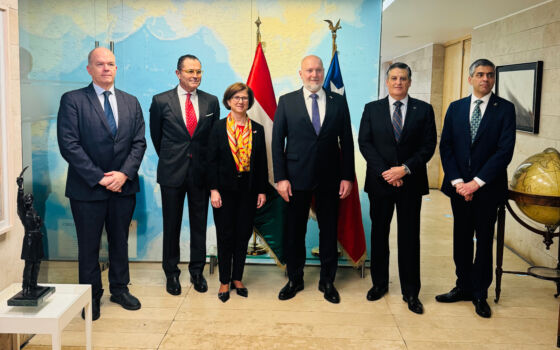
Finally, at the AthenaLab offices, we received ambassadors from Germany, New Zealand, China, the Kingdom of the Netherlands, South Africa, Spain, Singapore, Finland, and Israel. Representatives from the Foreign Ministries and Governments of Canada, the United States, Japan, and Taiwan. Additionally, parliamentarians, constitutional advisors, military officials, academics, researchers, and economic analysts.