SPECIAL DOCUMENT | A Naval Force for the Country's Challenges
This article was translated automatically and may contain differences from the original. For reference, read the original.
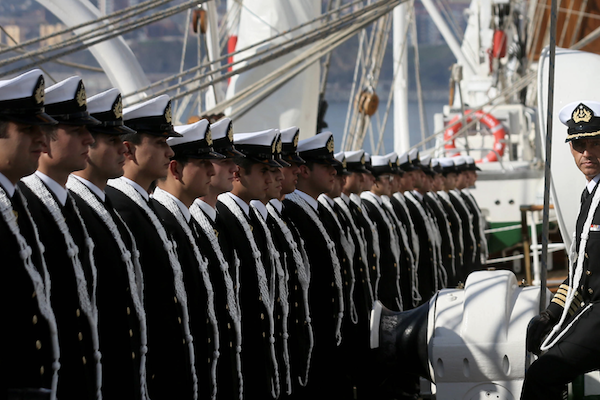
Why is it important to understand the context of naval functions for Chile? The type of navy that the state requires depends on its current situation and interests at sea.
Once again, the Red Sea is making headlines in international news, and unfortunately, not for positive reasons. Since last year, maritime trade has been affected by the Houthis, a group of Yemeni insurgents who gained prominence by supporting the Palestinian cause in Gaza through attacks on any vessels they perceive as supporting the Israeli cause. So far, nothing new. We must consider that attacking ships, whether through piracy or to target a specific country, is an activity almost as old as the use of the sea for transportation, spanning centuries. Navies were established precisely to defend state interests at sea, with maritime trade being one of these interests, enabling the economies of nations and, certainly, maintaining their security. Maritime forces are organized and work in a coordinated manner to provide security at sea at acceptable levels for the community. Let us recall, for example, Operation Atalanta, a NATO initiative aimed at protecting merchant vessels from Somali pirates—a reality depicted by Tom Hanks in the film Captain Phillips— which united the efforts of European navies, the United States, and even China, with the goal of protecting maritime traffic, a task they have continued to fulfill to this day.
The Houthis, unlike Somali pirates, possess more sophisticated weaponry, such as drones and anti-ship missiles, and even airborne military capabilities that have allowed them to assault merchant vessels. So far, they have carried out nearly 30 attacks using missiles or drones, of which 14 have been successful; a significant number for an insurgency. Regardless of whether their objective is economic or political, their actions have indeed affected global maritime trade. A recent study by the think tank Council on Geostrategy indicates that approximately 12% of global goods traffic and nearly 30% of global container traffic transits through this sector. To illustrate the globalization of the economy, the actions of these insurgents have raised maritime insurance costs by about 15%, and in some cases, oil transport insurance has increased by up to 80%; that is to say, for Chile, a significant portion of the products arriving by sea has become more expensive. The response came from the United States and Great Britain, through the deployment of modern combat ships, which have so far destroyed 21 missiles and 50 drones. For these two countries, the effort to maintain their deployed vessels has been greater, considering their global interests that encompass not only the Middle East but also the Caribbean in their anti-drug efforts, and recently, security in the Asia-Pacific region, which has been a focal point of geopolitical disputes, primarily from China. What is interesting in this case is that both nations have been able to deploy their resources to all the aforementioned geographical areas. This is not by chance; the composition and capabilities of their defense, and particularly their naval forces, arise from constant political reviews regarding how and to what extent they can influence locally, regionally, or globally, according to the interests of their respective nations. This is not new; however, it is not always fully realized. The type of naval force that the country requires will depend on its interests at sea.
At the end of the last century, British author Ken Booth stated that states were interested in using the sea to achieve three objectives: first, for commerce, that is, the transportation of goods and services through maritime lines of communication; second, for the transit of their military forces in support of diplomatic efforts, to be used against targets on land and at sea; and finally, third, to exploit resources in and under the sea. Based on this premise, he proposed that navies existed to be the means by which these ends or objectives were achieved. In that context, he argued that the main functions of navies should be threefold: a military function, that is, the capacity to threaten or use force to impose one’s will over that of the adversary; a diplomatic function, where the navy supports the efforts of the country’s foreign relations service to achieve state objectives, in times of peace and crisis; and finally, a policing function, aimed at both the internal and external realms of the country, seeking to extend national sovereignty over maritime domains. Booth maintained that these functions could not be analyzed as separate elements, but rather as an indivisible trinity, whose foundation and, therefore, primary function was military, which enables the other two. Evidently, these last two will not carry the same weight, but will depend on the emphasis the country places on its maritime domain and its foreign policy, which will define which of these functions is more important within the national strategy.
While Booth’s definition is based on a historical understanding of the role of navies, we cannot overlook that it is framed within a concept of classical security, where the state had to protect the population from a typically military adversary. Today, the concept of security, understood as that which affects both the development and well-being of the country and its people, has expanded to other areas, such as economic security, food security, climate security, energy security, water security, among others, which can potentially have serious impacts on the state. Academic Ian Speller, in his book Understanding Naval Warfare, tests Booth’s definition nearly half a century after its formulation, through a thorough analysis of the functions of navies in modern times, concluding that, as a general definition, the original proposal holds as much validity today as when it was presented.
Why is it important to understand the context of naval functions for Chile? Essentially, because amid so many current security problems, and given the level of investments required for a surface force and its medium- and long-term impact, it tends to be sidelined in favor of more immediate needs. This raises the question of what type of navy the state requires, depending on its interests at sea. In this sense, national history demonstrates that the Navy, and particularly its combat forces, has been a vital element in maintaining the security and prosperity of the country, even in times like the present. This surface force allows for maintaining security levels not only in the military realm but also, in the broader spectrum of the term, at acceptable levels for the citizenry, thereby contributing to the country’s development.