ANALYSIS | United States: Unusual Campaign, Uncertain Outcome
This article was translated automatically and may contain differences from the original. For reference, read the original.
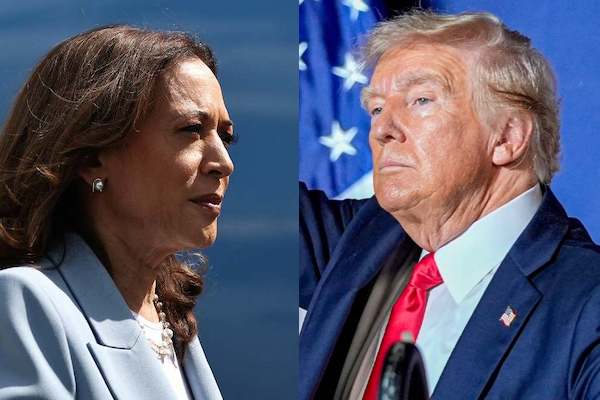
A month is an eternity in politics, and this adage holds true when looking at the U.S. presidential elections. By the end of June, this competition was languishing and heading toward a Republican victory, with former President Donald Trump appearing immune to condemnations and prosecutions against him for various charges, some of which are quite serious, such as conspiracy to commit electoral fraud, in the context of his refusal to acknowledge his defeat in 2020 and the subsequent assault on the Capitol.
Unexpectedly, the electoral landscape was shaken by a debate that was thought to be dull between Biden and Trump, two elderly rivals who had already faced each other in the last election. However, this televised event took place before the party conventions that confirm the candidates. Biden’s poor performance triggered strong pressure for him to withdraw from the race. The president resisted this pressure for three weeks; during that same period, Trump survived an assassination attempt, chose a running mate, and was formally anointed as the Republican candidate. Ultimately, a COVID-19 episode led Biden to step down, opening the door for current Vice President Kamala Harris to take his place.
Harris’s rise to the Democratic nomination has been more than smooth. Although she had not been very visible as vice president, she surprised as a presidential candidate with her ability to raise funds and reenergize her party in just two weeks. The enthusiasm she generates is already visible in polls, which for the first time show a slight advantage in her favor in the national popular vote.
Only 90 days remain until the end of the campaign. Much can happen in that time. For now, Trump has been taken aback by the arrival of the new contender; his speech, repeated at every stop on his campaign tour, is marked by a lack of concrete proposals, a concerning level of erratic rambling, divisive rhetoric, and a high level of direct aggression, including racist allusions (some directed at Harris, who is biracial, the daughter of a Jamaican father and an Indian Tamil mother).
Additionally, and although the momentum is with Harris, winning the popular vote does not guarantee winning the election. What is needed is an absolute majority in the Electoral College (that is, 270 of the 538 votes). In the Electoral College, each state has a number of votes equivalent to the sum of its congressional representatives (except for Washington D.C., the federal capital without parliamentary representation, which has 3 votes in the Electoral College). Then, in most states, the candidate with the most votes in the state will take all of that state’s Electoral College votes. Thus, it is already known that the counting in a few states—Arizona, Georgia, Michigan, Nevada, Wisconsin, Pennsylvania—will determine the final outcome.
The intention to win those key states, as well as generally those located in the interior of the country, is visible in the choice of running mates: not by coincidence, both come from humble backgrounds and rural origins. Trump has chosen James Vance, a young conservative lawyer graduated from Yale, from Ohio, author of a best seller about his memoirs, with little political experience (a year and a half in the Senate), ties to Silicon Valley as a venture capitalist, and a past as a journalist in the Marine Corps. Harris, for her part, chose Tim Walz, the governor of Minnesota, a former elementary school teacher and Army National Guard reservist, who, when he served in the House of Representatives, was known for his ability to work with Republicans. The challenge for Vance and Walz should be to broaden their support base and win over undecided voters. It is unlikely that Vance—prone to missteps—will succeed; but perhaps Walz, with his closeness to the armed forces, can at least partially rally anti-Trump Republicans.
Finally, there is the economic factor, which, while it may not decide the election, does influence the outcome. Today, the economy appears to be slowing down, and a recession is feared. This situation is fertile ground for nativist and protectionist stances, contrary to free trade norms, multilateralism, and international cooperation, which Trump already pushed during his first term and would deepen in a second. Furthermore, Trump has signaled that in a potential second term, he would mistreat important friendships (such as the European Union) and traditional alliances of the country, like NATO, regardless of commitments made. Finally, it is worth noting his fervent admiration for autocracies (Vladimir Putin, Xi Jinping, Kim Jong-un), which connects with his disdain for democratic mechanisms (evidenced by his behavior following the 2020 election).
Many chapters remain before the final outcome of this saga can be anticipated, but Harris and Walz are already doing everything possible to offer a welcoming political space, as the now Prime Minister Keir Starmer did in the United Kingdom, in order to win the center. Trump’s hateful rhetoric and the erratic performance of his running mate could significantly contribute to that goal.
Paz Zárate
Senior Researcher, AthenaLab
August 8, 2024