COLUMN | Reflections on Public Security in Eastern Santiago
This article was translated automatically and may contain differences from the original. For reference, read the original.
- by Richard Kouyoumdjian
- Noticias

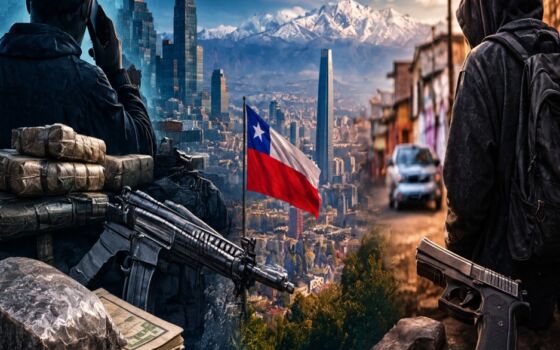
The current model, which includes cameras, portals, community quadrants, and swarms, has its limitations when the issues at hand are complex and involve firearms, and there are no armed police available.
On December 6, 2024, the municipalities of Las Condes, Lo Barnechea, and Providencia will inaugurate new administrations, while in the case of Vitacura and La Reina mayors were re-elected.
All of them prioritized the issue of public security as the most important topic in their programs or offers to residents to gain their preference over other competitors. They are correct; security is by far the primary concern for Chileans, and the eastern sector of Santiago is no exception, despite its crime rates being better than much of the rest of Chile.
Back in early July, a candidate from one of the aforementioned municipalities asked me whether security was an issue, as everything seems to indicate that we are doing well. She was likely asking to gauge my response, and I replied: “Security in this municipality is perhaps the best in Chile, but it is clearly not prepared for the future that may be upon us. Obviously, I said, we must protect and improve what exists, but the relevant point is to act now to prevent more complex criminality from reaching us, because if we do not act now, it will be too late.”
That said, why address the eastern sector of Santiago collectively? For three very simple reasons: 1) They all have security models with a strong emphasis on technology that operate in very similar ways, 2) They all have a security situation with very similar indicators, and 3) They are all very neglected by the central government, which has left them with very reduced numbers of Carabineros and PDI, as security primarily relies on their own organizations dedicated to the issue, and certainly, on the residents themselves, who organize and invest in security, in what is known as the privatization of security, a phenomenon that occurs when the State fails to fulfill the social contract with citizens, who are compelled to turn to their local authorities or take matters into their own hands.
The government and its police, in practice, maintain minimal forces, having reassigned their contingents to other municipalities or sectors of Chile that are more affected. This is evident in the streets, where police vehicles or Carabineros on foot are rarely seen, being replaced by patrol cars or municipal inspectors, who act as police but lack the authority or legal backing for many of the tasks they perform.
I emphasize this because Carabineros de Chile has the constitutional obligation to guarantee and ensure order and security in the national territory, something that we know is not happening in current Chile, and in the municipalities addressed in this column, they are auxiliaries to the security departments rather than the other way around as it should be.
I place great emphasis on this because we can do much to improve and integrate existing technologies, but if we do not confront and seek a solution to the absence of Carabineros, the only option left will be to transform inspectors and patrol officers into police, something that Carabineros evidently does not favor, and which would require constitutional amendments and changes to the respective organic constitutional laws.
Carabineros argues that they were created to replace, among others, municipal police, but that was 100 years ago and in a different context, with a criminal reality that was distinct and less dangerous. Our patrol officers and inspectors do not have the weapons or authority to act against armed criminals, and we must address this situation and the absence of Carabineros, which may be justified but creates a void and a problem to resolve. We cannot wait, and it would be irresponsible to wait for an incident to take action. We must be aware that the current model based on inspectors and patrol officers has its limitations, both legal and in the inherent capabilities they possess.
It is certainly helpful to have good coverage of cameras and reading portals, and it is also evident that they deter criminals. They are an asset that we must protect and improve, and hopefully integrate with other municipalities and, if possible, with all those in the metropolitan region (RM), as is the initiative of Governor Orrego, which is in its early phases and will help a lot, but is always limited by the operational capacities of the police and the Public Ministry.We gain nothing from making tremendous technological investments if we are then unable to act on the data, both for preventive measures and for reactive measures when it is used to seek and bring to justice those who commit crimes. It is said that only 10% of crimes committed in Chile are investigated, and the rest are shelved due to lack of resources.
Cameras and portals, as I mentioned, help, but the information they provide is not fully utilized unless it is used in conjunction with data from residents, businesses, inspectors, and patrol officers, data from other municipalities, and obviously, data from the police. Having centers that merge information is what is known as an intelligence fusion center, something that no municipality currently has, or at least not in a systematic way.
Some would say that it is the government’s or the police’s obligation to do the above, but we already know that the government lacks a strategy, and that if we depend on them, we will be left waiting while criminals and delinquents act freely. The data that comes from a fusion center is data that allows for adjustments to plans, determines how resources are used, and feeds those who seek and work on complex anti-crime actions and second or third-generation crime, as seen in the rest of the RM, and which is already appearing in some areas of eastern Santiago.
I do not believe that the panel of experts recently formed, to which some were selectively invited, will enable the central government to resolve the problem affecting much of Chile. I have lost count of the number of commissions and committees formed, or the initiatives from the Ministry of the Interior and Public Security. Legislative projects do not advance in Congress, and the new Ministry of Security is something on which there is no consensus regarding its structure or its ability to resolve problems, as the resources it will have are the same as those already available.
For now, it will be the municipalities and residents who will have to continue addressing the security problem, but without police, whether Carabineros or municipal, it will be complex to manage if circumstances become more complicated. The current model, which includes cameras, portals, community quadrants, and swarms, has its limitations when the issues at hand are complex and involve firearms, and there are no armed police available.