SUMMARY | Land Warfare Conference 2025: "Unlocking Advantages"
This article was translated automatically and may contain differences from the original. For reference, read the original.
- por Marcelo Masalleras
- Noticias
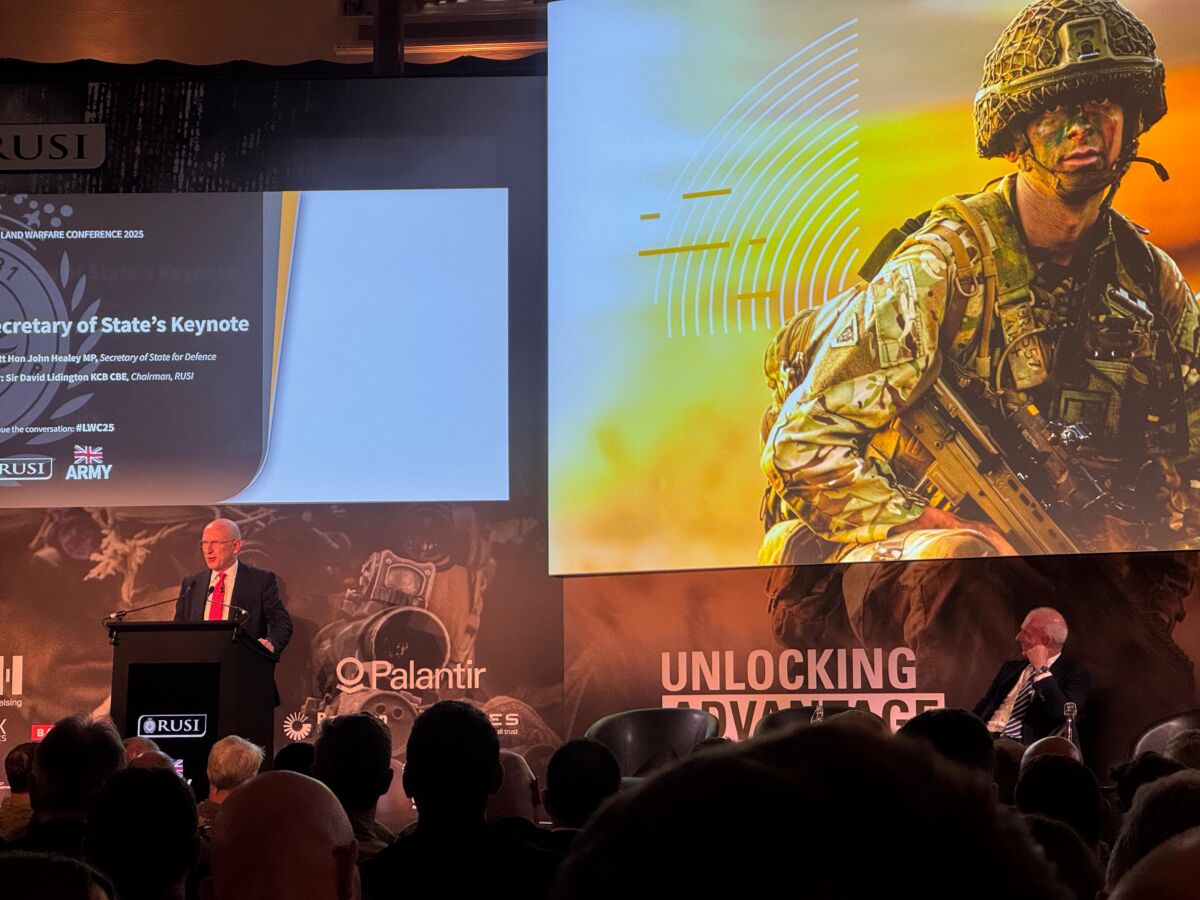
Topics such as the development of a lethal force capable of mass action and military command were part of the discussion at the latest edition of the Land Warfare Conference held by RUSI in London.
“Unlocking Advantages” was the theme of the latest edition of the Land Warfare Conference organized by the Royal United Services Institute (RUSI) in London on June 17 and 18. The discussion included how to develop a lethal force capable of mass action through transformation; the incorporation of combat power multipliers to achieve a fully integrated force with the ability to scale rapidly; and military command, covering topics from operational conception to new challenges at the tactical level. Certainly, the war in Ukraine captured a significant portion of the event’s attention; however, lessons were also drawn from the ongoing conflict in the Middle East and the situation facing the North Atlantic Treaty Organization (NATO).
This time, the speakers were led by the UK Secretary of State for Defence, John Healey, along with Admiral Tony Radakin, Chief of the Defence Staff, and General Roly Walker, Chief of the British Army Staff. The discussion also included the Commander of the Royal Navy, the Chief of the Royal Air Force, and the Commander of the UK Strategic Command. Additionally, the chiefs of the armies of Germany, Australia, France, and Sweden participated, as well as the Commander of the United States Army in Europe and Africa, highlighting the interest and importance of this event. Finally, the conference featured prominent academics, researchers from think tanks, military officials from over 25 countries, and representatives from the defense industry.
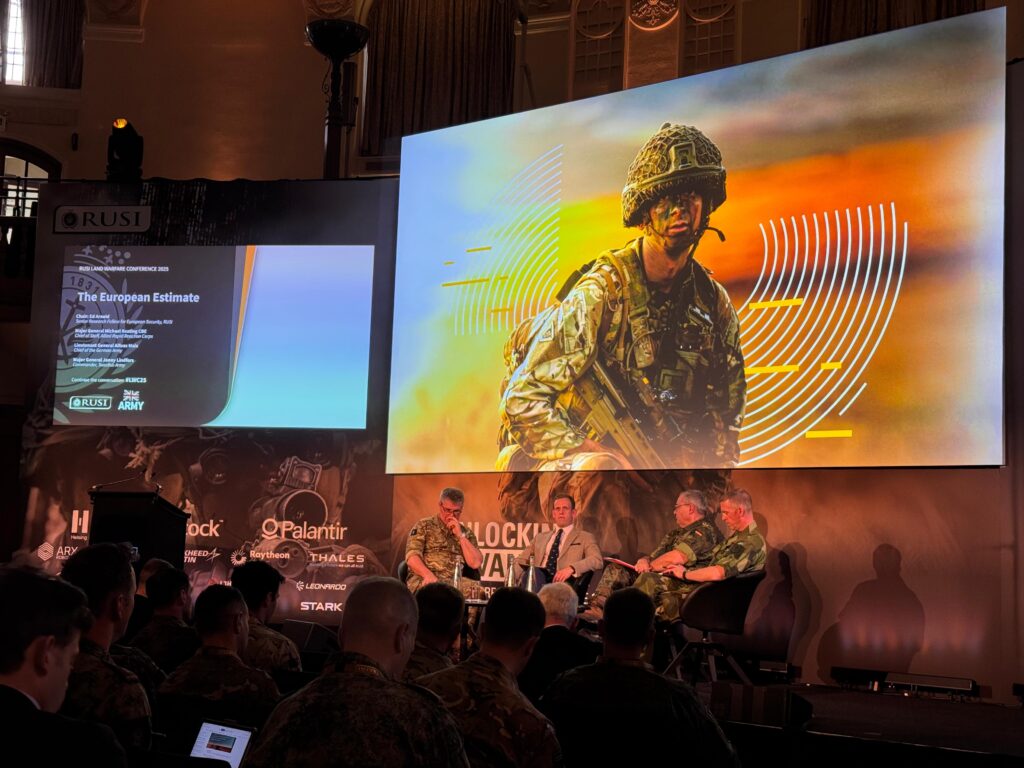
Despite the breadth of topics covered, six relevant aspects can be highlighted. First, the situation and direction of the British Army were emphasized. According to its highest authority, the institution is undergoing a modernization process due to changes in context and threats, particularly from Russia. It was suggested that this process should be accelerated, focusing on leveraging characteristics such as innovation, large-scale production capacity, and decisively advancing towards the digitalization of the force. The force design conceived by the British Army envisions that the future structure will include 20% of assets that must survive against threats. This component—the heart of the force—is characterized by armored means (tanks, infantry fighting vehicles, combat engineers, reconnaissance), protected transport vehicles, long-range artillery, attack helicopters, ground-based air defense, as well as various equipment for the troops. Additionally, there will be a component designed to be subject to attrition equivalent to 40% of the force and another 40% of assets defined as consumables (mainly drones and other expendable equipment). Economically, this effort considers that the 20% described as primary, which will continue to be the central element of the combat system, will utilize 50% of the allocated budget.
Similarly, this force, to be scalable, requires an industrial production system that does not focus solely on generating stocks, but rather promotes accelerated development through research, the creation of disruptive technologies, and the employment of suitable specialists. The idea is to generate capabilities more quickly, of better quality, and at lower cost. Despite these significant challenges, General Walker insisted that the central point of the land force remains the soldier, who, equipped with the appropriate technology and grounded in national values, generates combat capability. Hence, the importance of recruitment, education, training, and talent retention within the institution.
The second highlighted aspect was the need to adequately assess technology. In this regard, it was concluded that technology is of utmost relevance, but it does not provide advantages; rather, it offers the possibility for its user to generate those advantages. Forces must accept reality and combine old and new technologies to achieve maximum performance. While drones are having a decisive impact on the battlefield and will continue to do so, traditional systems remain relevant, such as artillery, which continues to be the most capable element for inflicting damage (the massive use of drones is a consequence of the lack of such means, not their replacement). Likewise, while innovation is very relevant, it is insufficient if countries are unable to scale in magnitude, which must be kept in mind.
On the other hand, the conference addressed the situation of NATO. The main ideas relate to the clear identification of Russia as its primary direct threat and the progressive and clear alignment of that country with China, Iran, and North Korea. Thus, the alliance is in the process of adapting to the new geopolitical and strategic reality, which is demanding significant resources, the generation of units, the acquisition and development of weapon systems, and adaptations in organization and doctrine, to name a few. There was unanimity that the problem they face is clear, and efforts must focus on generating alternative solutions. Undoubtedly, the main challenges are more related to the political realm, where decisions and agreements that define the future of the organization must be made. As expected, the commitment of the United States to its transatlantic partners was a topic of discussion. Ultimately, despite the rhetoric of the current U.S. government, the facts show that its stance has not changed, maintaining the structure and effort deployed in Europe. In the end, while changes may occur in the future, they are deemed unlikely and would not be related to nuclear coverage or critical capabilities that Washington provides, such as air and missile defense and strategic sustainment and transport, to name a few.
A fourth highlighted element was the need to develop timely defense projects that are more lethal but also more economical, capable of meeting the logistical requirements of high-intensity operations that extend over long periods. To address this challenge, emphasis was placed on the integration of “technical and tactical” personnel, both in industry and in headquarters, to gather experiences and provide direct advice. Furthermore, this effort demands strengthening the industrial base, where partnership with the private sector is fundamental, given its flexibility and financial capacity.
The fifth factor addressed was the role and political responsibility in the process. It was the Secretary of State for Defence who directly addressed the issue. In summary, Healey stated the obligation of governments to create the conditions for the establishment of a force like the one the UK intends. Thus, the recent Defence Strategy Review (SDR) reflects this situation, aiming to make the country safer, more protected at home, and stronger abroad. According to the British authority, this challenge presents ambitious objectives, such as increasing defense spending to 3% of gross domestic product, especially after a long period of decline in national investment in this area. To have a larger and more lethal military force than the current one, advantages must be generated on the battlefield. Therefore, talent is required, which must be developed and retained by offering incentives that represent better conditions for military personnel and their families. Recruitment, which provides the appropriate human capital in quality and timing to the British Army, is a responsibility of the state, as is demonstrating to society the role and importance of the military function.
The last point to highlight refers to the challenges posed by future operations. This point concentrated much of the discussion. On one hand, the general opinion is that while the ongoing war in Ukraine must be studied in depth, events in other very different conflict zones, such as those occurring in the Middle East, must also be followed. Additionally, it must be recognized that the task is to prepare for the next war, not the previous one. Related to this, planners must ask not only when the projected preparation process will end, but equally importantly, how prepared the forces currently are to face contingencies.
When identifying challenges in war preparation, the relevance of “mass” was highlighted, whether in terms of the availability of personnel and weapon systems and munitions, as well as the capacity to absorb damage and casualties. All this is in anticipation of the development of prolonged high-intensity conflicts. Here, the increasing incorporation of technology is an irreversible process, where digitalization and artificial intelligence will only continue to rise. Undoubtedly, the idea of transparency on the battlefield was again central, in addition to the current role and predominance of drones.
Regarding the conduct of operations in the future, challenges at both the tactical and operational levels were envisioned. At the tactical level, one of the most important challenges, according to expert David Kilkullen, is represented by the dilemma between dispersing resources to increase survival given the transparency of the battlefield and, on the other hand, the need to act en masse through integration and coordination. This demands adaptation in terms of technology (communications, electronic warfare, digitalization, etc.), organization, and doctrinal concepts. Of course, the above cannot be improvised and requires time to be incorporated and settled into training. Regarding the operational level of war, Dr. Chris Kolenda argued that the ability to articulate this level of military command must be regained. He stated that historical failures, such as those in Vietnam, Iraq, and Afghanistan, share common failures in this regard. To address this and transform tactical successes into the achievement of long-term strategic objectives, clear authority (command and control) is required, as well as the generation of doctrine (relationships, functions, and responsibilities) and the proper positioning of resources, especially military ones.
FINAL REFLECTIONS
- While observing ongoing conflicts is of utmost relevance for obtaining experiences that allow for necessary changes in force design or technology development, it is true that each state must analyze its reality specifically. The next war will likely be different from the one currently being fought. Adversaries adapt to challenges or change to gain comparative advantages and will probably not continue doing the same thing (technology and innovation do not stop). Above all, the particular context of a state or region is unique, as it responds to its own characteristics that are not replicated. Everything impacts the strategic context.
- The solution for force design, in addition to considering budgetary realities, regional and strategic contexts, must be capable of maximizing the capabilities of existing platforms and combining them with new ones that may be incorporated.
- The human factor remains the determining element in the land force. While technology represents a force multiplier, it still does not replace the soldier and the leadership of commanders. Therefore, the proper selection, development, and retention of talent are strategic aspects for National Defense, not only for the armed forces. In personnel training and unit exercises, innovation and adaptability are two concepts that must be urgently and strongly incorporated into the culture of the armed forces.
- The ability to wage high-intensity warfare over an extended period demands the effort and resilience of an entire society, where the government plays a central role in preparing the population and providing the conditions for success for the armed forces.
- The increasingly important role of the industrial base of countries is evident, both for their own benefit and in support of partners. It seems that the solution lies in necessarily integrating the private sector, given its particular characteristics (flexibility, acceleration of processes); however, the central responsibility remains with the state. This demand arises from the need to have sufficient combat power to win, but with a longer time projection that requires sustaining operations. In the case of countries with lesser capabilities and needs, it must be determined in which areas it is essential to have a level of strategic autonomy. Likewise, the importance of having adequate and trained reserves remains paramount.
- The participation and involvement of political authorities is not only desirable but an obligation given their direct responsibility for national security and defense, not to mention that they represent the senior command of the armed forces. Forums like this conference, a place for technical conversation and deliberation, where political power, military leaders, and other manifestations of civil society, such as academics, think tanks, and the defense industry, intervene, are an example to replicate. In this sense, it is hoped that the same will be reinforced in high-quality national forums, such as FIDAE and EXPONAVAL.
Marcelo Masalleras, Senior Researcher at AthenaLab
London, June 19, 2025