TODAY WE REMEMBER | The Return of Baquedano and the Identity of Chile
This article was translated automatically and may contain differences from the original. For reference, read the original.
- by Marcelo Masalleras
- Noticias
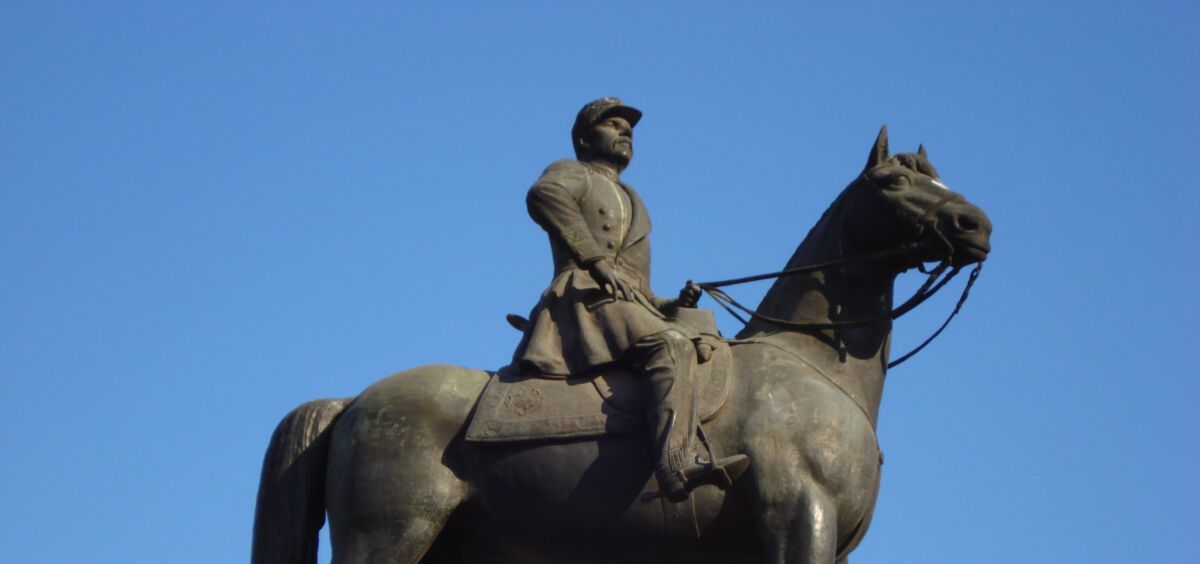
The return of the statue of General Manuel Baquedano to its original location in the square that bears his name this week closes a material, political, and symbolic cycle that began with its removal on March 12, 2021, following the severe damage it suffered amid the violence that erupted in the country. The reinstatement was unanimously approved by the National Monuments Council at the end of February and was executed nearly five years after its departure from the main urban and symbolic axis of Santiago.
This event is significant for a fundamental reason: nations are not sustained solely by institutions, laws, or elections. They also require shared symbols, places of memory, and historical references capable of expressing continuity and identity. When a society loses the ability to protect its common symbols or decides to abandon them out of fear of conflict, it is not just a statue that weakens; rather, it is the very idea of a political community that allows coexistence despite differences, the national cohesion that erodes. The reinstatement of Baquedano, in this sense, does not alone resolve the fractures in Chilean society, but it does set a boundary: violence cannot become the legitimate mechanism for redefining public space, let alone the identity of Chile.
The return also occurs in a week marked by other acts that identify the Republic and its institutions. On one hand, the change of command in the Chilean Army, a foundational institution of the State, during which General Pedro Varela received, from the hands of the national authority, the saber of General José Miguel Carrera, the first commander-in-chief, reflecting a continuity and institutional integrity that characterizes us. This same week, we witnessed the presidential change of command, in which President José Antonio Kast was inaugurated in the plenary hall of the National Congress, with the sash and pin of the liberator General Bernardo O’Higgins.
Manuel Baquedano occupies a central place in Chile’s military and political history. He was the commander-in-chief of the Army during the Pacific War from 1880 to 1881, under whose command victories were achieved in Arica, Tacna, Chorrillos, and Miraflores, entering Lima victoriously. He served as a senator and provisional president of the Republic in August 1891. His figure represents a decisive stage in the consolidation of the Chilean State and the affirmation of military command in critical moments. Like all significant historical figures, his trajectory can be studied critically, but such a reading of history does not require erasing his traces from the national space. Rather, it demands understanding them in their context.
The monument itself is part of that historical memory for two reasons. First, it was erected on September 18, 1928, as a tribute to the general who led the Chilean Army in the Pacific War. The square was named after him, and the sculptural ensemble became a civic, urban, and national reference point for decades. Second, and most importantly, beneath its pedestal rested the Unknown Soldier, a reminder that Chilean military memory does not only refer to leaders but especially to the anonymous sacrifice of those who fought for the country, in this case, under the orders of the undefeated General. The return of the Unknown Soldier is pending, and it is hoped that his return will be with the dignity and formality it deserves, in an official ceremony, with national authorities, military units, and hopefully a large gathering of society.

Thus, the return of the statue transcends the individual figure of Baquedano. What returns is not merely a restored monument. It is a signal of identity and historical continuity in a place that, in recent years, expressed fracture, challenge, and emptiness. An empty plinth in the center of Santiago was also an image of the weakening of the symbolic authority of the State and the country’s difficulty in defending a common narrative about itself. Its reinstatement does not eliminate disagreement, but it recovers the idea that public space should not be captured by destruction or intimidation.
Chile needs precisely that: more capacity to discuss its history without destroying it. Every mature nation critically reviews its symbols, but does not renounce them lightly. National cohesion does not arise from uniformity, but from the existence of permanent references that enable a common conversation among generations, regions, political sensitivities, and institutional traditions. In a time of polarization, fragmentation, and distrust, generating and strengthening trust among citizens and protecting national symbols is not a nostalgic gesture; it is a political and cultural necessity.
The return of Baquedano to his original square should be understood as something more than an urban or administrative decision. It is an affirmation of national continuity. It is also a reminder that Chile cannot build a future if it accepts that its symbols are expelled by violence. And it is, finally, an invitation to rebuild cohesion based on a basic conviction: a country that cares for its memory also strengthens its will to remain united.
Marcelo Masallerras
Head of Research in Security and Defense