AGENDA | Week of Activities and International Engagement at AthenaLab
This article was translated automatically and may contain differences from the original. For reference, read the original.

On March 31, part of the AthenaLab team participated in a session organized by the Chilean Council on International Relations (CCRI), which featured a presentation by the newly appointed Minister of Foreign Affairs of Chile, Francisco Pérez Mackenna, titled “Foundation and Perspective of Chile’s Foreign Policy.” This event provided insight into the initial guidelines of the new government’s foreign policy and created a space for dialogue with international actors.

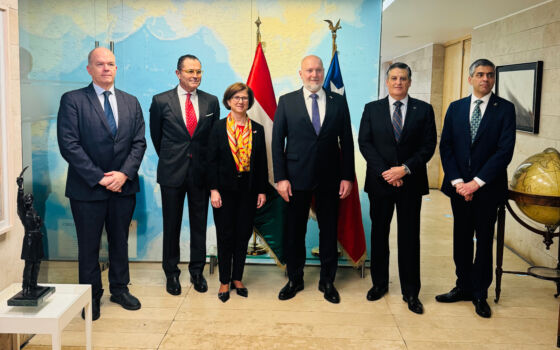
On the same day, AthenaLab hosted Ioannis E. Kotoulas, Ph.D., an academic from the University of Athens, who visited the country accompanied by the Greek Ambassador to Chile, Nikolaos Piperigkos. During his visit, he engaged in a discussion with the research team regarding contemporary geopolitics, history, and classical thought, also exploring potential avenues for academic collaboration and exchange. This meeting served as a precursor to the lecture that Professor Kotoulas delivered at the Greek Embassy, titled “A Frontier State at the Crossroads of Three Seas and Three Continents: A Geopolitical View from Modern Greece.”


This meeting served as a precursor to the lecture that Professor Kotoulas delivered at the Greek Embassy, titled “A Frontier State at the Crossroads of Three Seas and Three Continents: A Geopolitical View from Modern Greece.”
Additionally, on March 31, the seminar “Conflict in the Middle East: How to Understand the World in 2026” was held, organized by the Public Studies Center (CEP). The event featured John Griffiths Spielman, Executive Director of AthenaLab, and Jorge Sahd, Director of the Center for International Studies at the Pontifical Catholic University of Chile, moderated by Macarena Lescornez, Director of Communications at CEP.

In the academic realm, AthenaLab welcomed Dr. Fernando Rodrigues Goulart, a postdoctoral researcher at the Institute of Political Science at the Pontifical Catholic University of Chile, who presented his postdoctoral thesis focused on the politicization of the Armed Forces. This session allowed for a deeper exploration of its institutional implications, challenges for democratic governance, and civil-military balances in the current context.

Finally, AthenaLab hosted advisors from the United States Senate—Megan Bartley, Chief Advisor to the Senate Foreign Relations Committee, and Thomas Hanley, Legislative Advisor—in a meeting with the research team, where topics of foreign policy, international security, and hemispheric strategic dynamics were discussed, strengthening dialogue and cooperation on matters of common interest.