Chile looks to the Moon: from where does it want to do so?
This article was translated automatically and may contain differences from the original. For reference, read the original.
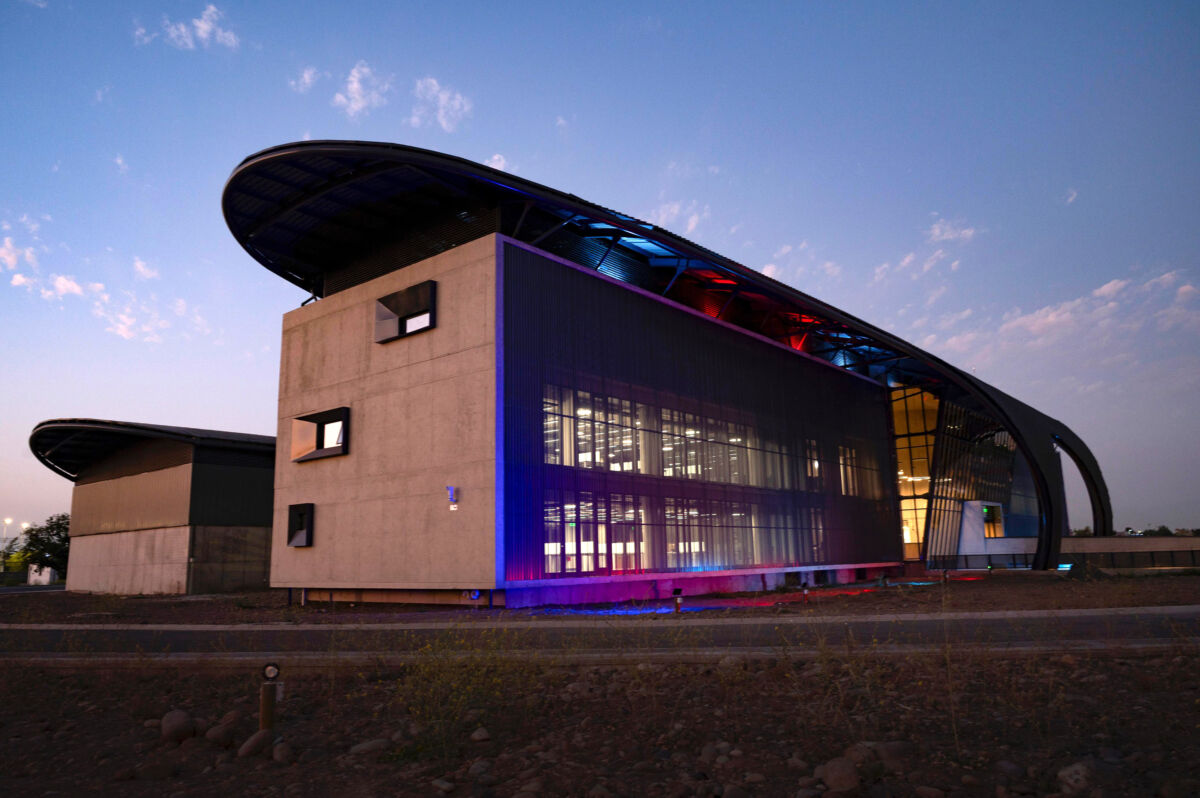
Centro Espacial Nacional (CEN). Gobierno de Chile
As the Orion spacecraft completes the first crewed navigation around the Moon in over fifty years, Chile inaugurates FIDAE with a Space Summit and opens its first National Space Center in Cerrillos, capable of building its own satellites. This coincidence is not anecdotal. It is an accurate image of the crossroads the country faces: the instruments are on the table, but the fundamental strategic decision has yet to be made.
This week, four astronauts aboard the Orion spacecraft completed the first crewed navigation around the Moon in over fifty years. It is no longer about planting a flag. It is about staying, operating, and building. The Moon is no longer a destination: it is a platform. And from that platform—orbital, lunar, and eventually Martian—a significant part of the future international order will be defined.
The launch of Artemis II marks a turning point that goes beyond the technical achievement. What is relevant is not the rocket or the capsule: it is the system that surrounds them. The Artemis Accords establish principles of interoperability, resource use, and transparency that, presented as technical standards, function in practice as the foundation for global space governance. Those who participate in their design define the rules. Those who merely comply depend on them. It is no coincidence that two of the largest space powers have chosen to remain outside: those who do not accept common rules are not excluded from space, but from the system that organizes it. The difference is enormous.
This paradigm shift has a central strategic implication: space has ceased to be a realm of exploration and has become critical infrastructure. Satellites are no longer multipliers of terrestrial power; they are the backbone of the digital economy, logistics, defense, and communications. This infrastructure depends on submarine cables, data centers, and global processing architectures. Consequently, space sovereignty and digital sovereignty converge into a single issue: the control of information flow. There is no autonomy in one without concrete advances in the other. Power, in this new landscape, is not measured in rockets or personal satellites. It is measured by the ability to define standards, protocols, and operating conditions; that is, in who governs the system.
What Chile has and what it still lacks
Chile does not start from scratch in this debate. The Air Force has been building an institutional vision for decades that few countries in the region can showcase. The inauguration of the National Space Center in Cerrillos in December 2025 (5,800 square meters with a clean room certified for assembling satellites, a mission control center, and a data science laboratory) and the signing of the Artemis Accords in October 2024 were not diplomatic gestures: they were positioning decisions. They mean that when discussions arise about how to operate on the Moon or how to regulate extraterrestrial resources, there will be a seat with Chile’s name on it.
But Chile has more than just infrastructure and agreements: it has concrete comparative advantages that very few actors in the world can replicate. The lunar south pole, the central objective of the Artemis program, concentrates reserves of frozen water. Whoever controls that resource will control the hydrogen and oxygen necessary to produce fuel and sustain life beyond Earth. Space mining has ceased to be science fiction: it is now an emerging sector with actors, rules under construction, and strategic decisions to be made in the coming years. Chile enters that conversation with decades of experience operating in the planet’s most extreme environments. Mining in the Atacama Desert, under conditions of temperature, altitude, radiation, and water scarcity that resemble those of extraterrestrial environments, is precisely the type of expertise that lunar missions will need. The extremophiles studied in the salt flats of the north and in Antarctica offer unique biological models to understand how life can survive without an atmosphere.
Chile is a mining power on Earth. This is not a metaphor for what it could become in space: it is the concrete foundation from which to project itself.
However, these advantages do not automatically translate into a strategic position. The risk is becoming trapped in a peripheral role: providing specific capabilities without influence in defining the rules. Technological dependence is not imposed by decree; it is built through accumulated absences in the forums where important decisions are made. Inaugurations and fairs are not enough: it is necessary to integrate space policy and digital policy into a single strategy, to translate adherence to Artemis into active participation in defining standards, and to build a state vision that transcends government cycles.
A decision that cannot be delayed
This week, FIDAE 2026 opens in Santiago, with a Space Summit that will, for the fourth time, bring together the national and international space community. The National Space Center in Cerrillos will showcase to the world the clean room where Chile will build its own satellites. These are concrete signals. But signals are not strategy.
The fundamental question is not whether Chile will participate in the new space architecture. It already does. The question is under what conditions: as an actor that helps shape the system, or as one that simply operates within the rules set by others.
In a world where digital infrastructure increasingly defines sovereign decision-making capacity, that distinction is not minor. Participation grants access. Influence grants power. And in the 21st century, power does not necessarily belong to those who possess the most resources, but to those who define the conditions under which those resources are used.
Chile looks to the Moon. The question is from where it wants to do so.
Kenneth Pugh Olavarría
The opinions expressed in this section are solely the responsibility of their authors and do not necessarily reflect the position of our institution.
by Kenneth Pugh
Senior fellow AthenaLab
Want to publish with us? Review our guidelines for external contributors.
View submission guidelines