National defense, policy, and strategy
This article was translated automatically and may contain differences from the original. For reference, read the original.

Edificio del Ministerio de Defensa Nacional de Chile
A month after the presidential transition, authorities have begun to assume their tasks and priorities. At the same time, the state must project medium- and long-term tasks, prioritize areas, and define the corresponding funding. In this process, National Defense faces challenges of various natures: the progressive expansion of the Armed Forces’ mission spectrum; the deterioration of the internal security situation; the presence of groups that challenge state control over territory and the exercise of sovereignty; an international and regional context of increasing instability; and weapon systems reaching the end of their useful life. This scenario unfolds in a context of budgetary constraints that, without substantive changes and without a cross-party political commitment, is projected into the future.
The usual practice of states is to issue documents that serve as guiding frameworks for defense functions and, in some cases, establish imperative guidelines. Both a policy and a strategy fulfill this function in the realm of national defense. Their development requires analyzing the national and international situation, prioritizing the interests to be protected and promoted, defining objectives for the function, and allocating means and resources to achieve them—tasks that constitute, in themselves, a fundamental strategic necessity for Defense.
Why update a document like the Defense Policy?
As it is a state policy, it should transcend changing governments. Its development requires the participation and consensus of diverse political actors, academia, civil society, and the defense community as a whole, including the Armed Forces. In addition to ensuring the stability and projection of the function, this policy must guide the ministry in fundamental definitions: the identification of national interests to protect or promote, the objectives, the strategic posture, and the main military capabilities to develop, maintain, or recover, among other aspects. Its perspective should be long-term and realistic.
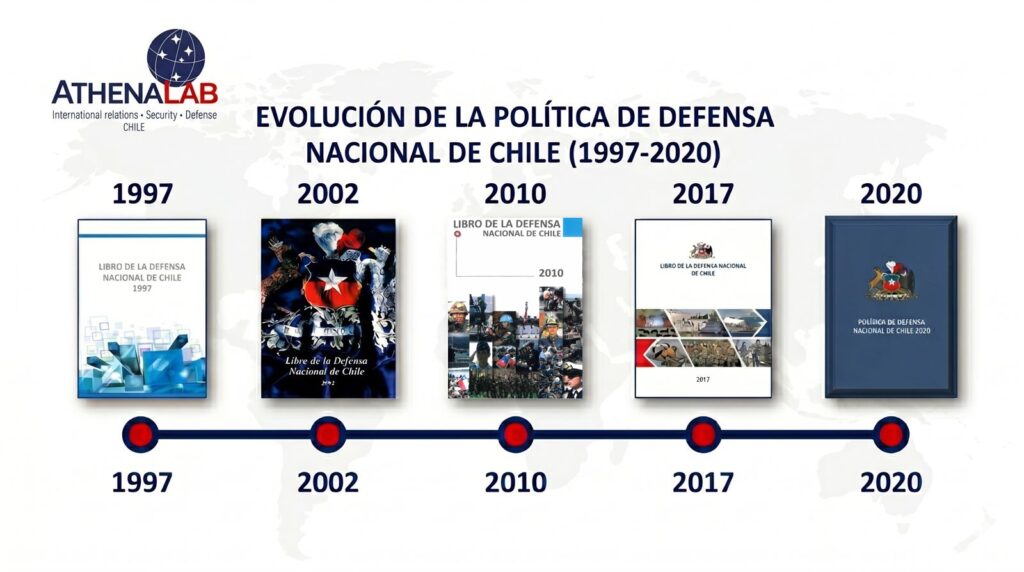
By 2026, there are arguments justifying the update of this document. The first is the transformation of the international and regional context. Since the drafting of Chile’s National Defense Policy 2020, significant changes have occurred in the international system with direct or indirect impacts on Chile: the COVID-19 pandemic; the Russian invasion of Ukraine in 2022; the Hamas attack on Israel in October 2023 and the escalation that extended the conflict to Iran; the arrival of a new administration in the United States with a reordering of its national security and trade priorities; and the weakening of international organizations and instruments. In the regional sphere, the security situation has also deteriorated. In neighboring countries, both Argentina and Peru have initiated programs to recover and develop strategic capabilities that alter the balance of power, which may not be immediate but has projections that must be considered.
The second argument is the internal security situation. Beyond the levels of perceived citizen insecurity, the state faces difficulties in controlling its borders and registers areas where the rule of law does not prevail. Similarly, there is an increasing presence of transnational criminal organizations and a significant number of foreign individuals who entered illegally, whose identity, location, and activities are unknown. All these phenomena affect the state, and National Defense is not exempt from them.
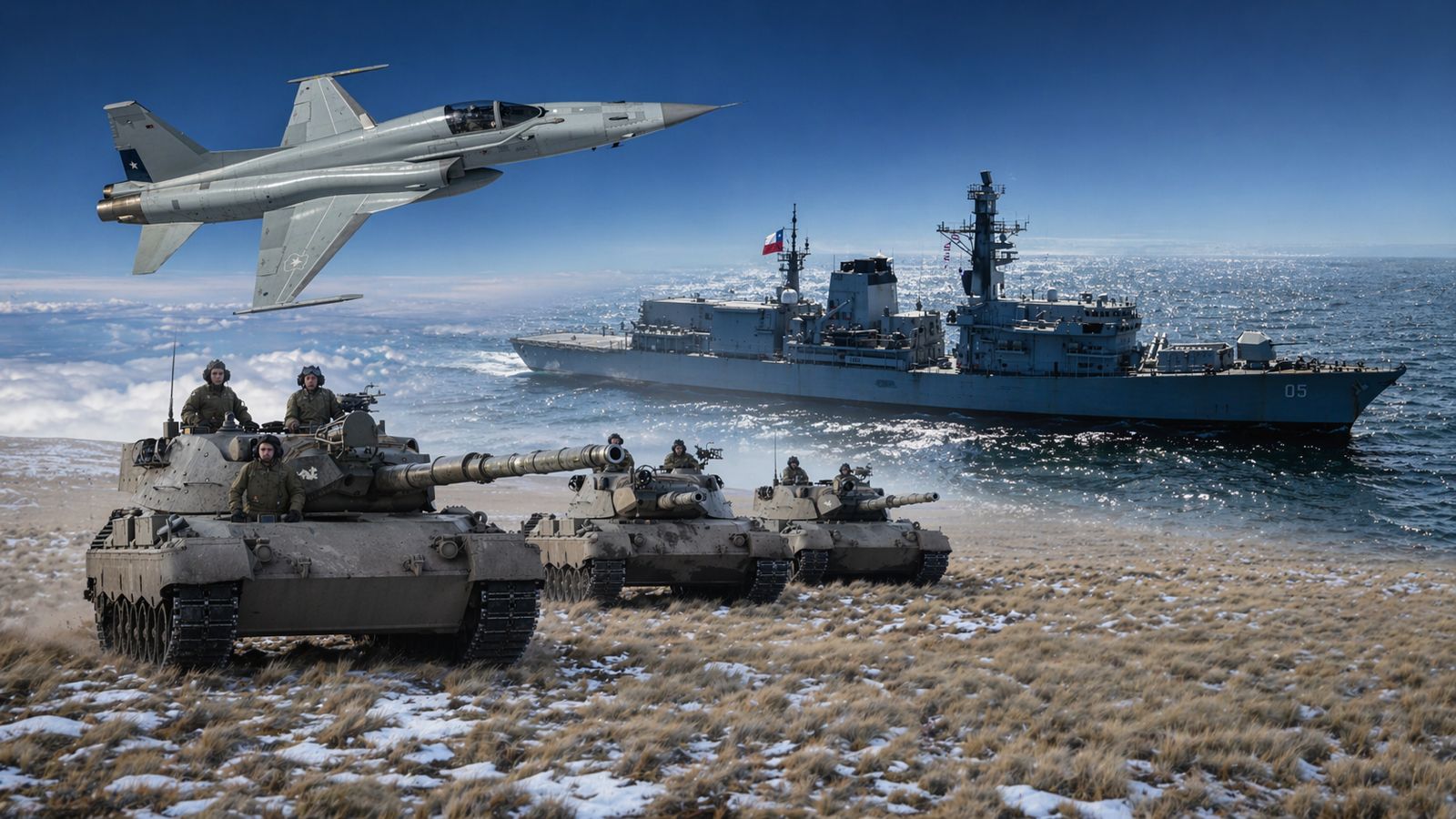
Additionally, part of the capabilities, weapon systems, and equipment of the Armed Forces are reaching the end of their useful life, both due to obsolescence and wear and tear from unplanned deployments in emergency situations or Constitutional States of Exception, which has reduced operational availability. This scenario, as AthenaLab has pointed out, unfolds in a context of budgetary constraints while the spectrum and number of tasks assigned to the Armed Forces have increased.
Source: Institutional websites
Defense Policy or Defense Strategy?
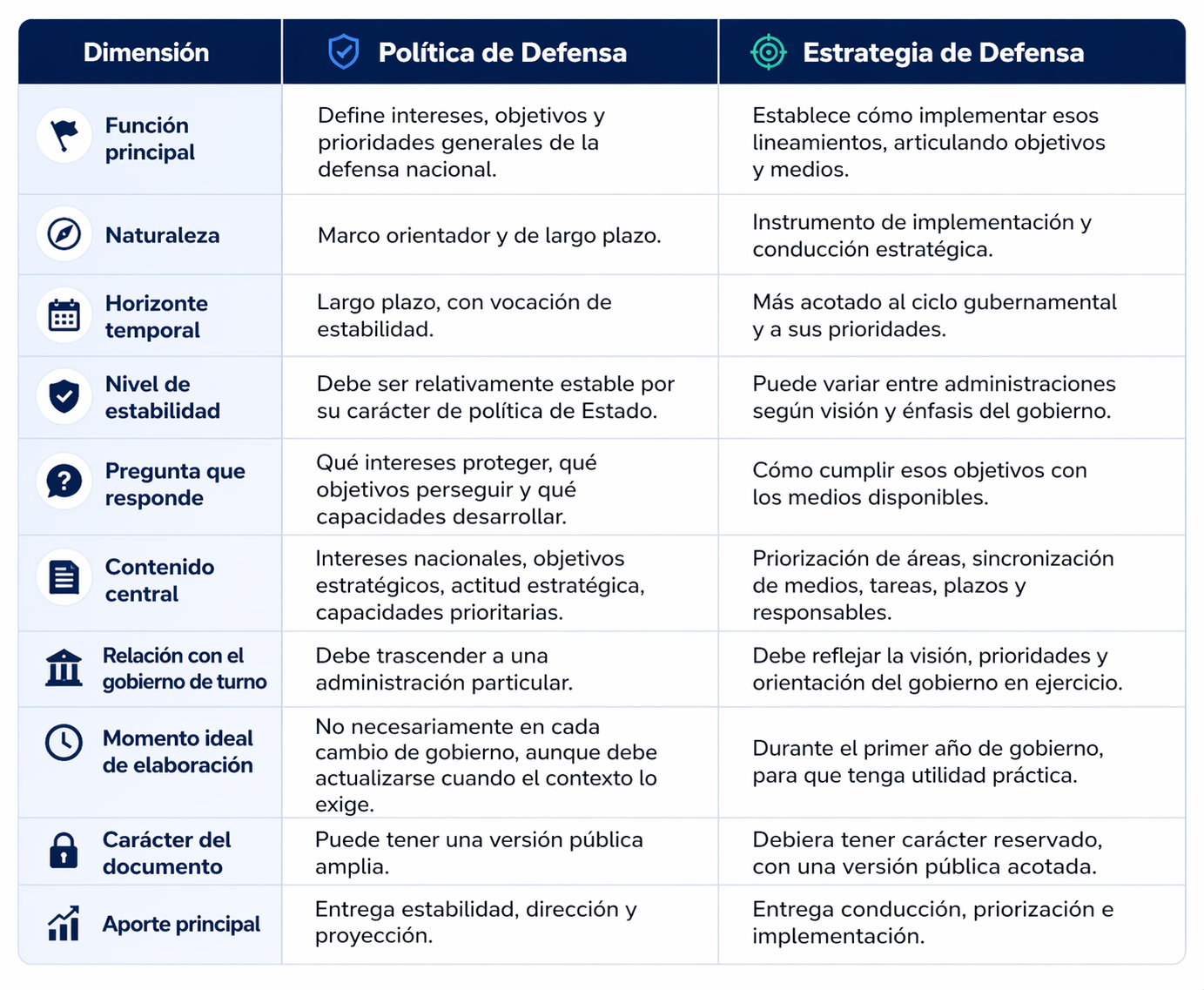
The defense policy and the defense strategy are closely related elements, but they are not equivalent. The policy declares the interests, objectives, and priorities, and establishes guidelines for the overall conduct of the defense function. The strategy, on the other hand, defines how those guidelines will be implemented, aligning objectives and available means, and synchronizing tasks in the temporal, spatial, and purpose dimensions, at the strategic level of defense. In summary, the policy provides stability and long-term projection; the strategy establishes the modes of implementation.
With a current policy in place, the defense strategy allows each government to prioritize areas and emphasize initiatives it deems pertinent, within the framework of national policy. Therefore, it is deemed appropriate to publish the defense strategy during the first year of government, as it is the instrument through which each administration guides the function according to its own vision and priorities. The defense conception of President Gabriel Boric differed from that of President Sebastián Piñera, as well as from that of the current President José Antonio Kast. Consequently, any administration intending to carry out a program different from that of its predecessor must explicitly state what and how it intends to do so, which necessarily implies updating the strategy. Without this, it is difficult to manage National Defense, just as a strategy published in the last months of government lacks practical effect.
While each state should have both documents, this is not a common practice. Generally, countries opt for a single publication that integrates all these considerations, resulting in a corresponding economy of time and effort. This is evidenced by cases such as those of Australia, Canada, the United States, France, Japan, New Zealand, and the United Kingdom.
Own elaboration
If this path is chosen, the document must comprehensively address all elements inherent to both the defense policy and the defense strategy; otherwise, the result will be an incomplete instrument that does not meet the minimum requirements for conducting national defense. A document of this nature should meet, at a minimum, the following conditions:
- Analyze the strategic scenario and threats.
- Evaluate risks, vulnerabilities, and potentials.
- Specify the purpose or purposes it pursues.
- Determine the objectives of national defense.
- Establish the priorities of the function.
- Articulate and synchronize the available means to achieve the objectives.
- Identify the missions and tasks and the responsible agencies for their execution.
- Establish the framework for the development of each initiative in terms of resources, efforts, and timelines, so that those who must implement it have clear parameters regarding what is expected.
- Be brief and direct.
- Have a confidential nature, with a limited public version.
- Be developed during the first year of each new administration.
- Ideally, constitute the sectoral response to a national security strategy that integrates and coordinates the policies and strategies of all state functions.
Furthermore, this document should avoid the following practices:
- Including theory or conceptual descriptions.
- Reviewing actions taken or underway at the time of publication.
- Extending beyond what is necessary.
- Being published at the end of the term.
- Incorporating aspects unrelated to the function or of an ideological nature.
- Becoming a public accountability of management.
Finally, it is important to refer to the confidentiality of the National Defense foundational document. So far, neither the 2020 Defense Policy nor the version processed in November 2025 that updated it met the characteristics proposed here. Due to its content and scope, public dissemination did not generate problems or vulnerabilities. However, a defense strategy as intended here—or a defense policy that incorporates the strategy—should be classified, with restricted access to individuals and organizations that, by their functions, must implement or oversee it. This is because these documents contain the general guidance through which the country will provide defense against threats, reduce risks, and confront potential adversaries, including priorities and the development of strategic capabilities.
No strategically minded state publicly discloses a strategy of this nature, as doing so provides adversaries or competitors with sensitive information that could impact national security and the effectiveness of planned actions. Consequently, each administration should also develop a limited and publishable version of the defense policy or strategy to fulfill the obligation to inform and make government policies transparent.
What can be done?
In general terms, various administrations have attempted to develop corresponding defense policies, which is an effort that should be recognized. Beyond the documents themselves, the theoretical and political exercise that this entails provides significant experiences. However, none have comprehensively addressed the issues raised here, either because they were not complemented by a subsidiary defense strategy or, even when the strategy was incorporated, it proved insufficient to implement the necessary measures and make this important state activity effective. In summary, it is a good exercise, but incomplete according to what has been proposed here.
A strategic decision must be made: to continue with a Defense Policy that also fulfills the function of a strategy—but should be comprehensive—or to separate them and develop a second complementary document as a National Defense Strategy. Given the national reality and drawing from the practice of a significant number of Western democracies, the development of a single document that meets the characteristics described here, along with others that may enrich the proposal, does not seem to be the best option, but rather a realistic and practical alternative. Consequently, the challenge for the newly installed government is to advance in a document that addresses the needs of National Defense, in accordance with its vision and priorities, but to do so before the end of its first year in office.
This is feasible, as the Ministry of Defense has highly qualified authorities and personnel, both civilian and military; it has the support of the Armed Forces and the Joint Chiefs of Staff to carry it out, all composed of professionals willing and motivated by their work; and it has the backing of civil society, including universities and research centers, as well as a community of defense specialists that is currently disorganized.

To fulfill the task, it is estimated that three obstacles present themselves. First, time, as this process requires detailed and in-depth work that should have begun before the government was installed. We hope this was the case. Second, the budgetary reality, which, while not preventing the drafting of the document, conditions what is desired and what can be done. Third, perhaps the most complex issue, is that this defense policy, not being directed by a superior policy or strategy, such as a National Security Strategy, is not necessarily coordinated with other areas of the state, which limits its real effectiveness and impact. The implementation of a National Security Architecture as proposed by AthenaLab, constitutes a priority for Chile and a starting point for improving the security of citizens and the defense of the nation.
Finally, it is estimated that the start of a new government represents a new opportunity to advance in improving National Defense and to view it with a strategic perspective, given its characteristics and relevance. The development of foundational documents, while not an end in itself, transforms them into tools for political guidance and must be elaborated with professionalism, knowledge, priority, and realism. Time is against us, but the conditions exist for achieving good results.
Marcelo Masalleras
Head of Research in Security and Defense
April 24, 2026