Beyond the Chatbot: Implications of Artificial Intelligence for Chile
This article was translated automatically and may contain differences from the original. For reference, read the original.
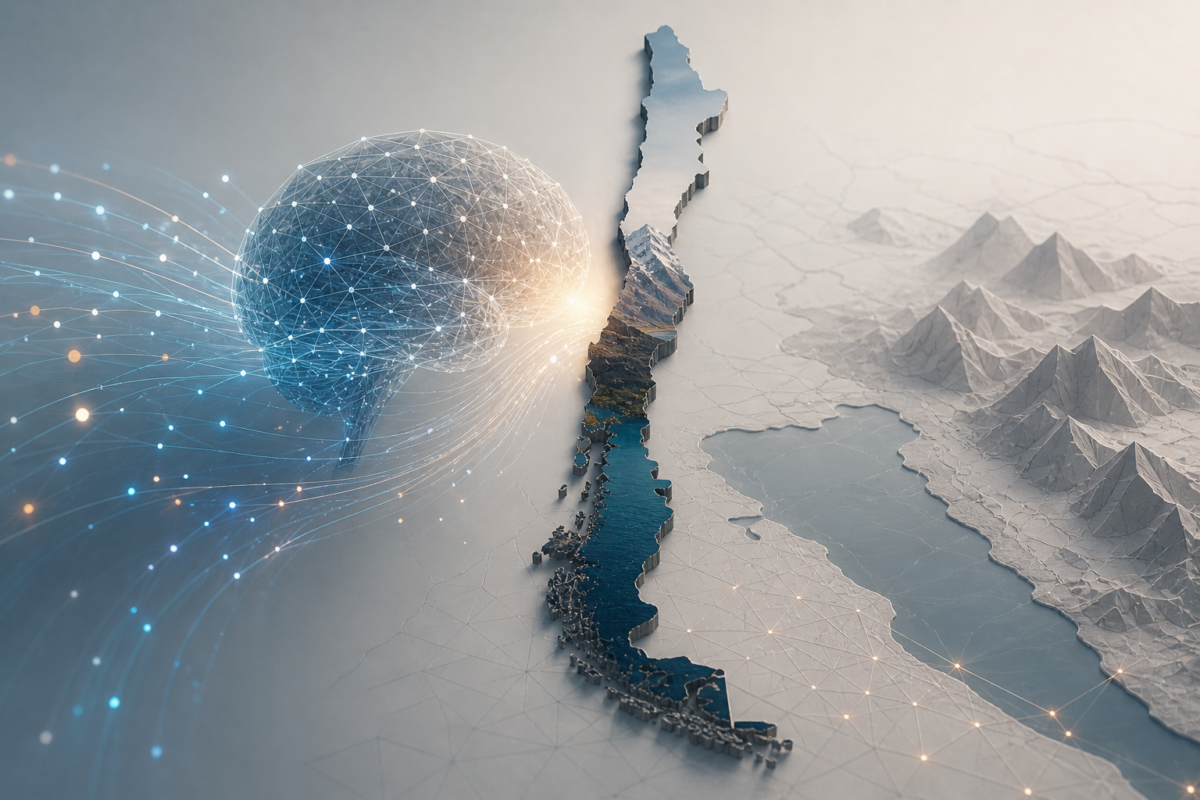
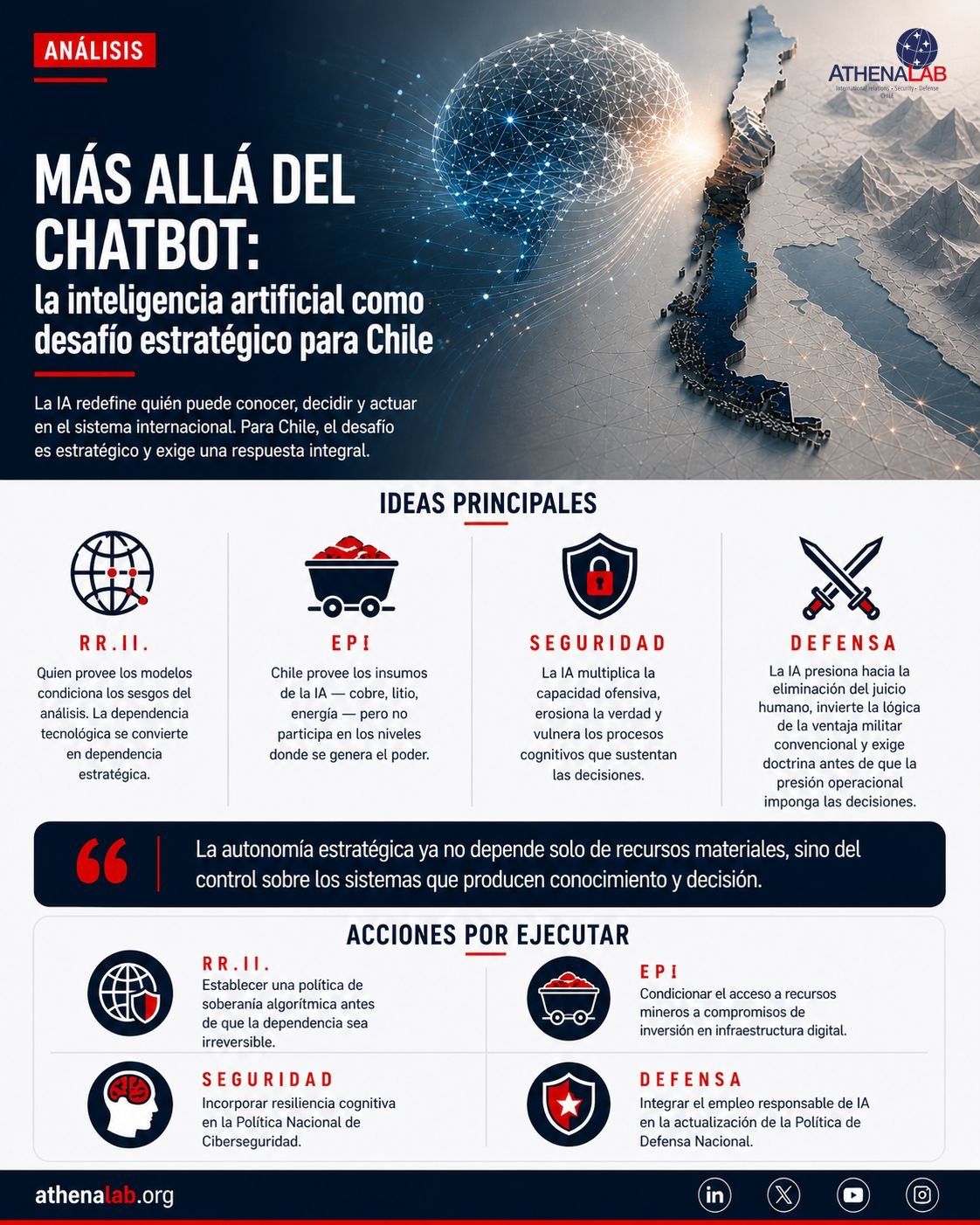
Artificial intelligence (AI) is becoming a variable in the conditions under which power is exercised in the international system. Unlike previous technologies that amplified existing capabilities, AI will redefine who can know and who decides and acts more quickly. A state that does not control the systems that produce its strategic knowledge does not fully control its decision-making cycle. Therefore, strategic autonomy will no longer depend solely on material resources but also on the possession of AI systems that produce better knowledge for decisions in the current international complexity. This reconfiguration operates simultaneously across all domains of power and compels an understanding of the impacts of AI and why its evolution changes the nature of risks. This article examines implications in international relations, international political economy, security, and defense—with special attention to Chile—a country that provides critical inputs for AI but does not participate in the areas where advanced models are developed and exploit their advantages.
Figure 1. AI as a Power Variable: Four Areas of Analysis

I. International Relations
The major AI developers[1] have emerged as a new type of actor in the international order. Their capabilities surpass those of most medium-sized states and they are not subject to the accountability obligations typical of a government.[2] A state that manages its security and foreign policy with AI tools it does not control will be ceding part of its autonomy to another jurisdiction. In this situation, sovereignty over such models emerges as a critical dimension that most national security frameworks have yet to formalize.
The ability to gain priority access to AI models and computing centers thus becomes a new diplomatic objective. States without sovereign access to that infrastructure depend on foreign corporate decisions or on powers that control it. The Pax Silica Alliance, signed in December 2025 by the U.S., Japan, South Korea, Singapore, the Netherlands, Israel, the UAE, the UK, and Australia, illustrates this new dynamic.[3] The implicit objective of “market for all, border for allies” reserves access to cutting-edge semiconductors and advanced computing capacity for those aligned with the United States.
The absence of a binding multilateral framework for the use of AI creates a permissive regulatory environment. UN General Assembly Resolution 79/62, from December 2024, recognizes the urgent need to address the challenges of LAWS from humanitarian, legal, and ethical perspectives, but did not advance toward a legally binding instrument that major powers are unwilling to negotiate.[4] This creates a dilemma for medium-sized countries between supporting strict regulatory frameworks that offer normative credibility but will impose restrictions on their own initiatives. This regulatory void is not only a governance issue but a variable that will condition each state’s options.
II. International Political Economy
AI depends on a contested supply chain that determines which state actor can develop its own capabilities and which will be limited in that area. To understand this, it is useful to think of AI as a set of the following layers: critical minerals, energy, semiconductors, data center infrastructure, language models, and applications.
Critical minerals are the physical substrate, and their geographic concentration makes them factors of strategic coercion. Chile is the world’s leading producer of copper—critical for data center infrastructure—and possesses one of the largest lithium reserves, a central element for energy storage that supports that infrastructure. For a state, being a key link in the supply chain provides advantages but also places it at the center of disputes between external interests. The growing presence of Chinese, American, and European capital in the lithium triangle is evidence of this competition.
The high energy consumption of AI limits the development of capabilities in this area. For example, by 2028, AI could consume the equivalent of 22% of all U.S. households annually.[5] States without access to abundant and reliable energy will be structurally restricted in developing their own AI models. Furthermore, energy demand is expected to grow exponentially, making electricity supply a relevant variable.
The manufacturing of advanced semiconductors is the most critical bottleneck in the entire chain. TSMC, based in Taiwan, accounts for over 90% of global chip production that supports the most powerful models. This concentration gave rise to the concept of “silicon shield,” as dependence on TSMC serves as a deterrent against Chinese aggression, which would trigger a global technological crisis with severe consequences.[6] The U.S. has responded with export restrictions on chips to China and with the CHIPS Act, which aims to relocate part of TSMC’s production to Arizona;[7] making semiconductor manufacturing an issue of economic security.[8]
Data centers—the infrastructure where AI operates—raise a dimension of information sovereignty. While Google, Amazon, and Microsoft control most of the global cloud,[9] most medium-sized states lack sufficient infrastructure of their own scale; therefore, the data of those actors are processed on servers under foreign jurisdiction. Information sovereignty is, in this sense, the link that connects international political economy with the security risks analyzed below.
Figure 2. The Layers of AI: From Critical Minerals to Applications

III. International Security
AI is transforming the security environment in terms of the speed and offensive volume in cyberspace, the distinction between real and false information, and the undermining of the cognitive processes that underpin decision-making.
A state or non-state actor with access to AI models can automate offensive operations in cyberspace at speeds unimaginable a few years ago. According to Anthropic, Mythos would enable adaptive attacks, automatic generation of malicious code, and mass recognition of vulnerabilities.[10] The advantage will no longer depend solely on the available human talent but on the ability to train and deploy their own models. AI will reduce the marginal cost of constant harassment in cyberspace, which will also be even more difficult to attribute and will operate below the threshold of conflict.
AI-assisted disinformation represents an exponential leap over traditional propaganda by operating on individual profiles. AI models allow for the identification of specific cognitive biases at scale and exploit them through personalized content.[11] The possibility that political leaders act based on perceptions shaped by foreign algorithms would be an example of how this phenomenon could penetrate the decision-making cores of the state.
Moreover, models designed with AI to decide faster than the adversary reduce the margin for political deliberation. In high-pressure scenarios, that speed can trigger automatic responses before any human decision-maker intervenes, transforming a false alarm into a real crisis. This necessitates defining thresholds and control mechanisms in advance that preserve political accountability in crisis environments accelerated by AI.
IV. Defense
AI introduces dilemmas without consolidated doctrinal responses regarding the role of commanders’ judgment in warfare. As systems take on more central tasks in the military decision-making cycle, human discretion may become marginal; a trend expressed in the progression from human-in-the-loop (the human approves each decision) to human-on-the-loop (the human supervises but the system acts).[12] In this regard, various LAWS are currently deployed without international consensus on significant autonomy or adequate human control.[13] Algorithmic opacity exacerbates the problem, as a system that recommends a target and cannot verify its own reasoning[14] raises an unanswered question about who is accountable for that decision. The principles of IHL face severe tensions when the decision-making agent cannot be held accountable to any identifiable authority.
On the other hand, AI is altering the traditional logic of military advantage, which historically favored quality over quantity. A RAND report suggests that the combination of “precise mass” and “affordable mass” (AI-enabled unmanned systems, more economical and increasingly capable) could provide a cost-effectiveness advantage over expensive platforms in certain applications.[15] This inversion of conventional logic has consequences for medium-sized armies in terms of size and budget, considering that if AI reduces the cost of scaling autonomous capabilities, actors with fewer resources could compensate for gaps through these systems. Meanwhile, infrastructure that supports AI (data centers, fiber optic cables, and computing centers) has been the target of Iranian drone attacks,[16] becoming a new alternative to degrade the operational capabilities of the adversary without the need for conventional confrontation.
Armed forces that do not develop AI capabilities will be at an operational disadvantage, but those that adopt without adequate doctrine will assume serious institutional risks. The responsible integration of AI in defense is not solely a technical issue; it requires legal frameworks, operational doctrine, and auditing mechanisms that preserve civilian control and coherence with IHL. The Anthropic-Pentagon case illustrates that this debate is not resolved even in the U.S., as the company was labeled a “supply chain risk” for refusing to eliminate its red lines on mass surveillance and LAWS.[17] The real challenge is not whether to integrate AI into defense but to first build the institutional architecture that makes that integration coherent with the values and obligations that define a professional armed force.
V. Implications and Opportunities for Chile
Chile could face a progressive erosion of its strategic autonomy as its decision-making processes depend on systems it does not control and that operate under foreign jurisdiction. Furthermore, in the absence of binding frameworks regarding AI, the rules governing these technologies will be defined by those who have the capacity to develop them, introducing a new dimension of informational asymmetry. Building its own analytical capacity and establishing standards of sovereignty for those models before dependence becomes irreversible is an opportunity that Chile must prioritize. To this end, one measure would be to establish a national algorithmic sovereignty policy that regulates which systems can process strategic information of the state and under what conditions of auditing and jurisdiction.
Our country occupies an ambivalent position in the AI supply chain, being a provider of critical inputs at the lower levels but without participation in the levels where value and power are concentrated. In other words, we provide the inputs that make the AI revolution possible without capturing the capabilities that this revolution generates. Additionally, the country lacks transmission infrastructure to convert its renewable resources into the basis for a competitive industry. Chile, with copper and lithium, could aspire to a scheme that attracts foreign digital infrastructure and technology transfer agreements. Access to strategic mining resources should be conditioned on commitments to invest in local digital infrastructure and technology capacity transfer.
Chile faces the security risk areas analyzed—offensive cyber operations, disinformation, and cognitive manipulation—without consolidated defensive capabilities. Its infrastructure is not sized to absorb a sustained digital harassment campaign that does not cross the threshold that would trigger a formal political response. Moreover, our leaders operate in an environment where personalized cognitive manipulation is technically possible and difficult to detect. Chile must develop AI capabilities in cyberspace and in the realm of cognitive security. Cognitive resilience and the detection of AI-assisted manipulation should be incorporated as explicit dimensions of the National Cybersecurity Policy, along with institutional frameworks that define response thresholds to sustained digital harassment campaigns.
The Chilean Armed Forces could operate in the near future in environments with decision-making cycles that pressure the elimination of human control, supported by opaque algorithms and where adversaries employ LAWS without clear legal frameworks. The absence of doctrine on the use of AI leaves institutions without parameters to evaluate, acquire, and integrate these capabilities coherently with IHL and civilian control. Achieving capabilities that integrate AI responsibly is an operationally relevant condition for the success of national deterrence. The responsible use of AI should be incorporated into the update of the National Defense Policy, establishing doctrinal criteria that guide the acquisition, training, and civilian control over autonomous systems.
Figure 3. Chile Facing AI: Implications, Opportunities, and Actions by Area

V. Conclusion
AI not only adds complexity to the current international scenario but could also reconfigure some of its foundations. States that control the systems that produce knowledge and better decisions will further condition the autonomy margin of other state actors, regardless of their material resources or conventional capabilities. For medium-sized countries, technological dependence will silently and progressively increase the current strategic dependence.
Chile needs a stance on AI for the four domains analyzed. This requires as a prerequisite a national infrastructure of critical data that ensures that decisions on security, foreign policy, and defense do not occur on servers outside the control of the state. The urgency of this issue will increase in parallel with the rise of technological asymmetries, and the opportunity will exist until structural dependence makes the gap irreversible. This would generate not only a technological disadvantage but an irreversible erosion of our autonomy with consequent impacts on national security.
[1] In the case of the U.S., the main players are OpenAI, Anthropic, Google/DeepMind, and Meta, while in China they are Baidu, Alibaba, Huawei, and DeepSeek.
[2] Shaleen Khanal, Hongzhou Zhang, and Araz Taeihagh, “Why and How Is the Power of Big Tech Increasing in the Policy Process? The Case of Generative AI,” Policy and Society 44, no. 1 (2025): 52–69
[3] Australian Government, “The Pax Silica Declaration by Countries Attending the Pax Silica Summit, 12 December 2025,” Department of Industry, Science and Resources, December 13, 2025, https://www.industry.gov.au/publications/pax-silica-declaration-countries-attending-pax-silica-summit-12-december-2025
[4] United Nations, General Assembly. Lethal Autonomous Weapons Systems. A/RES/79/62. New York: United Nations, December 2, 2024. https://undocs.org/A/RES/79/62.
[5] James O’Donnell and Casey Crownhart, “We Did the Math on AI’s Energy Footprint. Here’s the Story,” MIT Technology Review, May 20, 2025, https://www.technologyreview.com/2025/05/20/1116327/ai-energy-usage-climate-footprint-big-tech/.
[6] AthenaLab. 2024. Special Document: Taiwan. Santiago: AthenaLab. https://www.athenalab.org/wp-content/uploads/2024/11/athenalab_doc_especial_taiwan.pdf.
[7] U.S. Congress, “H.R. 4346—CHIPS and Science Act of 2022,” Congress.gov, accessed May 3, 2026, https://www.congress.gov/bill/117th-congress/house-bill/4346.
[8] Chris Miller, Chip War: The Fight for the World’s Most Critical Technology (New York: Scribner, 2022).
[9] Felix Richter, “The Big Three Hold Dominant Lead in Accelerating Cloud Market,” Statista, February 9, 2026, https://www.statista.com/chart/18819/worldwide-market-share-of-leading-cloud-infrastructure-service-providers/.
[10] Chiara Barbeschi and Tarik Fayad, “Anthropic’s Mythos Moment: How Frontier AI Is Redefining Cybersecurity,” World Economic Forum, April 20, 2026, https://www.weforum.org/stories/2026/04/anthropic-mythos-ai-cybersecurity/.
[11] Bentzen, Naja. 2025. Information Manipulation in the Age of Generative Artificial Intelligence. Brussels: European Parliamentary Research Service (EPRS).
[12] NATO Command and Control Centre of Excellence, “Human Oversight in AI-Driven Defence: At What Positions Do We Need the Human in the Loop,” August 4, 2025, https://c2coe.org/download/human-oversight-in-ai-driven-defence-at-what-positions-do-we-need-the-human-in-the-loop/.
[13] Samuel Bendett and David Kirichenko, “Battlefield Drones and the Accelerating Autonomous Arms Race in Ukraine,” Modern War Institute at West Point, January 10, 2025, https://mwi.westpoint.edu/battlefield-drones-and-the-accelerating-autonomous-arms-race-in-ukraine/.
[14] “Inside the AI Black Box, for Real This Time,” The New York Times Magazine, April 15, 2026, https://www.nytimes.com/2026/04/15/magazine/ai-black-box-interpretability-research.html.
[15] Burdette, Zachary, Dwight Phillips, Jacob L. Heim, Edward Geist, David R. Frelinger, Chad Heitzenrater, and Karl P. Mueller. How Artificial Intelligence Could Reshape Four Essential Competitions in Future Warfare. Santa Monica, CA: RAND Corporation, 2026. https://www.rand.org/pubs/research_reports/RRA4316-1.html.
[16] Phoebe Liu, “AI Data Centers Are Now a Big Geopolitical Risk. Securing Them Against Attackers, Drones and More Is Becoming a Lucrative Business,” Forbes, April 21, 2026, https://www.forbes.com/sites/phoebeliu/2026/04/21/ai-data-centers-are-now-big-geopolitical-risk-securing-them-against-iran-attackers-drones-business/.
[17] “Pete Hegseth Wages War on Anthropic,” The Economist, February 24, 2026, https://www.economist.com/business/2026/02/24/pete-hegseth-wages-war-on-anthropic.